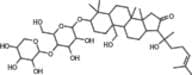
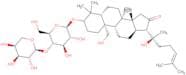
CAS 11028-00-5
:Bacosid A
Beschreibung:
Bacosid A ist eine natürliche Verbindung, die hauptsächlich aus der Pflanze Bacopa monnieri gewonnen wird, die allgemein für ihre Verwendung in der traditionellen Medizin und als Nootropikum bekannt ist. Es wird als triterpenoide Saponin klassifiziert und ist bekannt für seine potenziellen neuroprotektiven und kognitionsfördernden Eigenschaften. Es wird angenommen, dass Bacosid A die synaptische Übertragung erleichtert und das Wachstum von Nervenenden fördert, was zur Verbesserung des Gedächtnisses und der Lernfähigkeiten beitragen kann. Die Verbindung weist antioxidative Eigenschaften auf, die helfen, oxidativen Stress in neuronalen Geweben zu mindern. Darüber hinaus wurde Bacosid A auf seine potenziellen Auswirkungen auf Angst und Depression untersucht, was seine Rolle bei der Förderung des psychischen Wohlbefindens zeigt. Seine Löslichkeit in Wasser ist begrenzt, was seine Bioverfügbarkeit beeinträchtigen kann, aber verschiedene Formulierungen werden erforscht, um seine Absorption zu verbessern. Insgesamt wird Bacosid A für sein therapeutisches Potenzial anerkannt, insbesondere im Kontext der kognitiven Gesundheit und Neuroprotektion, was es zu einem interessanten Thema sowohl in der pharmakologischen Forschung als auch in der Kräutermedizin macht.
Formel:C41H68O13
InChl:InChI=1/C41H68O13/c1-21(2)9-8-14-40(7,50)29-22-10-11-27-38(5,39(22,6)17-23(29)44)15-12-26-37(3,4)28(13-16-41(26,27)20-43)53-36-33(49)31(47)34(25(18-42)52-36)54-35-32(48)30(46)24(45)19-51-35/h9,22,24-36,42-43,45-50H,8,10-20H2,1-7H3/t22-,24+,25-,26+,27+,28?,29-,30+,31-,32-,33-,34-,35+,36+,38-,39-,40+,41-/m1/s1
Synonyme:- (5R,8R,9S,10S,13R,14R,17S)-3-[(2R,3R,4R,5S,6R)-3,4-dihydroxy-6-(hydroxymethyl)-5-[(2S,3R,4S,5S)-3,4,5-trihydroxytetrahydropyran-2-yl]oxy-tetrahydropyran-2-yl]oxy-17-[(1S)-1-hydroxy-1,5-dimethyl-hex-4-enyl]-10-(hydroxymethyl)-4,4,8,14-tetramethyl-1,2,3,5,6,7,9,11,12,13,15,17-dodecahydrocyclopenta[a]phenanthren-16-one
- 3-[(O-α-<span class="text-smallcaps">L</smallcap>-Arabinopyranosyl-β-<smallcap>D</span>-glucopyranosyl)oxy]-19,20-dihydroxydammar-24-en-16-one
- Dammar-24-en-16-one, 3-[(O-α-<span class="text-smallcaps">L</smallcap>-arabinopyranosyl-β-<smallcap>D</span>-glucopyranosyl)oxy]-19,20-dihydroxy-
- Dammar-24-en-16-one, 3-[(α-<span class="text-smallcaps">L</smallcap>-arabinopyranosyl-O-β-<smallcap>D</span>-glucopyranosyl)oxy]-19,20-dihydroxy-
- 3-[(O-α-L-Arabinopyranosyl-β-D-glucopyranosyl)oxy]-19,20-dihydroxydammar-24-en-16-one
- Dammar-24-en-16-one, 3-[(O-α-L-arabinopyranosyl-β-D-glucopyranosyl)oxy]-19,20-dihydroxy-
- Bacoside A
- Dammar-24-en-16-one, 3-[(α-L-arabinopyranosyl-O-β-D-glucopyranosyl)oxy]-19,20-dihydroxy-
- -D-glucopyranosyl)oxy]-19,- 20-dihydroxy-
- Dammar-24-en-16-one,3-[(O-R-Larabinopyranosyl- â
- 3-[(O-alpha-L-Arabinopyranosyl-beta-D-glucopyranosyl)oxy]-19,20-dihydroxydammar-24-en-16-one
- Weitere Synonyme anzeigen
Sortieren nach
Reinheit (%)
0
100
|
0
|
50
|
90
|
95
|
100
4 Produkte.
Bacoside A
CAS:Bacoside A shows potential anti-cancer effects, cytoprotection, EAE inhibition, and vasorelaxation abilities.Formel:C41H68O13Reinheit:98%Farbe und Form:SolidMolekulargewicht:768.98Stevenleaf
CAS:Stevenleaf is a natural compound that has been shown to have antioxidant, anti-inflammatory and neuroprotective properties. It has been found to reduce neuronal death in an experimental model of malignant brain tumor. Stevenleaf also has the ability to inhibit mitochondrial membrane potential and mitochondrial functions, which may be due to its ability to inhibit the activity of cytochrome c oxidase. It is unclear how this compound works in humans, but it may be due to its ability to alter nuclear DNA transcription or by binding with human serum proteins. Stevenleaf may have therapeutic effects against neurodegenerative diseases such as Parkinson's disease and Alzheimer's disease due to its ability to increase the efficiency of mitochondria and prevent cellular damage caused by oxidative stress. The optimum concentration for this compound is not yet known, but it has been shown that at high concentrations it can cause cytotoxicity.Reinheit:90%Min