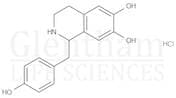
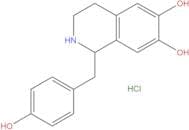
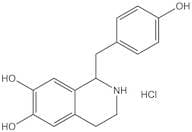
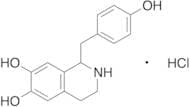
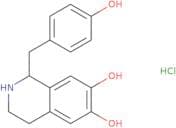
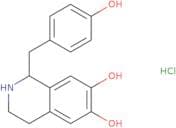
![6,7-Isoquinolinediol, 1,2,3,4-tetrahydro-1-[(4-hydroxyphenyl)methyl]-, hydrochloride (1:1)](/_next/image/?url=https%3A%2Fstatic.cymitquimica.com%2Fcas-image%2Fthumb-webp%2F2060-67-isoquinolinediol-1234-tetrahydro-1-4-hydroxyphenyl-methyl-hydrochloride-1-1.webp&w=3840&q=75)
CAS 11041-94-4
:6,7-Isochinolindiol, 1,2,3,4-tetrahydro-1-[(4-hydroxyphenyl)methyl]-, hydrochlorid (1:1)
- (+-)-1,2,3,4-Tetrahydro-1-((4-hydroxyphenyl)methyl)-6,7-isoquinolinediol hydrochloride
- (+-)-Demethylcoclaurine hydrochloride
- 1-(4-Hydroxybenzyl)-1,2,3,4-Tetrahydroisoquinoline-6,7-Diol Hydrochloride (1:1)
- 6,7-Isoquinolinediol, 1,2,3,4-tetrahydro-1-((4-hydroxyphenyl)methyl)-, hydrochloride, (+-)-
- 6,7-Isoquinolinediol, 1,2,3,4-tetrahydro-1-[(4-hydroxyphenyl)methyl]-, hydrochloride (1:1)
- Higenamine HCl
- Higenamine hydrochloride
- Norcoclaurine HCl
Higenamine hydrochloride
CAS:Higenamine HCl is a β2 adrenoreceptor agonist active in fat and muscle tissue.Formel:C16H18ClNO3Reinheit:99.44% - 99.80%Farbe und Form:White PowderMolekulargewicht:307.772Higenamine hydrochloride
CAS:Natural alkaloidFormel:C16H17NO3HClReinheit:≥ 95.0 % (HPLC)Farbe und Form:PowderMolekulargewicht:307.78Higenamine Hydrochloride
CAS:Kontrolliertes ProduktApplications Higenamine is a chemical compound found in a variety of plants including Nandina domestica, Aconitum carmichaelii, Asarum heterotropioides, Galium divaricatum, Annona squamosa, and Nelumbo nucifera
Not a dangerous good if item is equal to or less than 1g/ml and there is less than 100g/ml in the packageFormel:C16H17NO3·ClHFarbe und Form:NeatMolekulargewicht:307.77(+/-)-Higenamine HCl - synthetic - Bio-X ™
CAS:Kontrolliertes ProduktHigenamine is a chemical that is found in a variety of plants including aconite and sacred bamboo. It acts like a stimulant and works differently in various parts of the body. It can cause tissues to relax in some parts of the body, whereas in other parts it can cause the tissues to contract. Higenamine can be used for athletic performances and those with obesity or asthma.Formel:C16H17NO3•HClReinheit:Min. 95%Farbe und Form:PowderMolekulargewicht:307.77 g/mol(+/-)-Higenamine HCl - synthetic
CAS:Kontrolliertes Produkt(+/-)-Higenamine HCl - synthetic is a synthetic version of the naturally occurring alkaloid, higenamine, which is typically derived from various plant sources such as Nandina domestica and Aconitum species. It functions primarily as a beta-adrenergic receptor agonist, facilitating bronchodilation and increasing cardiac output by stimulating beta-1 and beta-2 adrenergic receptors.Formel:C16H17NO3·HClReinheit:Min. 95 Area-%Farbe und Form:White PowderMolekulargewicht:307.77 g/mol(+/-)-Higenamine HCl - natural
CAS:Kontrolliertes Produkt(+/-)-Higenamine HCl is a chemical compound functioning as a natural alkaloid, which is primarily derived from various plants, including members of the Nandina and Aconitum species. It is known to interact with beta-adrenergic receptors, which are part of the sympathetic nervous system. Through this interaction, it can influence cardiovascular function by increasing heart contractility and rate, as well as promoting bronchodilation.
Formel:C16H17NO3·HClReinheit:Min. 95%Molekulargewicht:307.77 g/mol