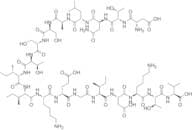
CAS 110652-62-5
:Peptid M
Beschreibung:
Peptid M, identifiziert durch die CAS-Nummer 110652-62-5, ist ein synthetisches Peptid, das in verschiedenen Bereichen, einschließlich Biochemie und Pharmakologie, Interesse geweckt hat. Als Peptid besteht es aus einer spezifischen Sequenz von Aminosäuren, die durch Peptidbindungen verbunden sind, was ihm einzigartige biologische Eigenschaften verleiht. Peptide wie Peptid M zeigen häufig Funktionen wie hormonelle Aktivität, Enzymregulation oder Zellkommunikation. Die Eigenschaften von Peptid M können seine Löslichkeit in Wasser oder organischen Lösungsmitteln, Stabilität unter physiologischen Bedingungen und Potenzial für biologische Aktivität umfassen, die durch seine Aminosäurezusammensetzung und -struktur beeinflusst werden können. Darüber hinaus werden Peptide typischerweise durch ihr Molekulargewicht charakterisiert, das durch die Anzahl und Art der vorhandenen Aminosäuren bestimmt wird. Die spezifischen Anwendungen von Peptid M können variieren, aber es könnte für therapeutische Zwecke untersucht werden, einschließlich seiner Rolle bei der Modulation biologischer Prozesse oder als Forschungswerkzeug zur Untersuchung von Proteininteraktionen. Weitere Untersuchungen zu seiner Pharmakokinetik und Pharmakodynamik wären entscheidend, um sein volles Potenzial in wissenschaftlichen und medizinischen Anwendungen zu verstehen.
Formel:C81H141N21O31
Synonyme:- Asp-Thr-Asn-Leu-Ala-Ser-Ser-Thr-Ile-Ile-Lys-Glu-Gly-Ile-Asp-Lys-Thr-Val
Sortieren nach
Reinheit (%)
0
100
|
0
|
50
|
90
|
95
|
100
2 Produkte.
Peptide M
CAS:Peptide M is a synthetic Peptide, 50 aa, derived from streptococcus M protein, containing an additional c-terminal cysteine residue.Formel:C81H141N21O31Reinheit:98%Farbe und Form:SolidMolekulargewicht:1905.11Peptide M
CAS:Peptide M is a synthetic peptide made up of the amino acid sequence: DTNLASSTIIKEGIDKTV. It is an immunogenic component corresponding to amino acids 303-320 of the photoreceptor cell protein, retinal S-antigen. During studies, it has been found to induce experimental autoimmune uveitis (EAU) in animals which is a T-cell mediated disease causing retina, pineal gland and uveal tract inflammation. EAU successfully models ocular autoimmune diseases such as birdshot retinochoroidopathy and sympathetic ophthalmia. Therefore peptide M can be used in research into these diseases. Structural studies have demonstrated peptide M to form macromolecular assemblies and then an intermolecular beta-sheet structure between a pH range of 4-9.5. It has been suggested, that when the peptide M adopts the monomeric state its structure and beta sheets become disordered. It is also thought that through its extended beta-type conformation peptide M is able to position itself between the major histocompatibility complex and the T-cell receptor.Formel:C81H141N21O31Reinheit:Min. 95%Molekulargewicht:1,905.11 g/mol