CAS 1109-28-0
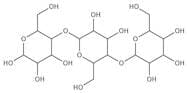
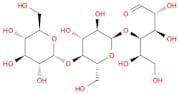
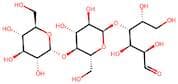
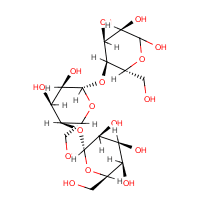
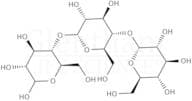
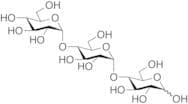
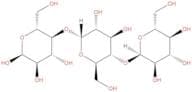
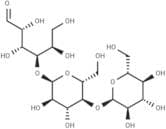
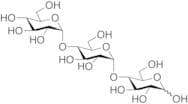
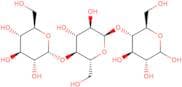
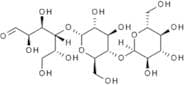
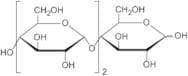
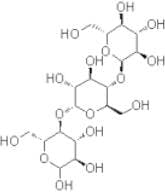
:O-α-D-Glucopyranosyl-(1→4)-O-α-D-Glucopyranosyl-(1→4)-O-α-D-Glucopyranose
Beschreibung:
Die chemische Substanz, die als O-α-D-Glucopyranosyl-(1→4)-O-α-D-Glucopyranosyl-(1→4)-O-α-D-Glucopyranose bekannt ist, mit der CAS-Nummer 1109-28-0, ist eine Art Oligosaccharid, das aus mehreren Glukoseeinheiten besteht, die durch glykosidische Bindungen verbunden sind. Genauer gesagt weist es eine sich wiederholende Struktur von α-D-Glucopyranosyl-Einheiten auf, die durch (1→4)-Bindungen verbunden sind, was für bestimmte Polysaccharide charakteristisch ist. Diese Verbindung ist ein Derivat von Stärke oder Cellulose und zeigt Eigenschaften wie Löslichkeit in Wasser und die Fähigkeit, Gele oder viskose Lösungen zu bilden, abhängig von Konzentration und Temperatur. Sie spielt eine Rolle in biologischen Systemen, dient als Energiequelle und nimmt an verschiedenen Stoffwechselprozessen teil. Die Struktur des Oligosaccharids beeinflusst seine Verdaulichkeit und Funktionalität in Lebensmittel- und pharmazeutischen Anwendungen. Darüber hinaus kann es Süße zeigen und zur Textur und Stabilität von Produkten beitragen. Insgesamt ist diese Verbindung sowohl in natürlichen als auch in industriellen Kontexten von Bedeutung und spiegelt die vielfältigen Rollen von Kohlenhydraten in der Chemie und Biologie wider.
Formel:C18H32O16
InChl:InChI=1/C18H32O16/c19-1-4-7(22)8(23)12(27)17(31-4)34-15-6(3-21)32-18(13(28)10(15)25)33-14-5(2-20)30-16(29)11(26)9(14)24/h4-29H,1-3H2/t4-,5-,6-,7-,8+,9-,10-,11-,12-,13-,14-,15-,16?,17-,18-/m1/s1
InChI Key:InChIKey=RXVWSYJTUUKTEA-CGQAXDJHSA-N
SMILES:O([C@@H]1[C@@H](CO)O[C@H](O[C@@H]([C@@H]([C@H](C=O)O)O)[C@@H](CO)O)[C@H](O)[C@H]1O)[C@H]2O[C@H](CO)[C@@H](O)[C@H](O)[C@H]2O
Synonyme:- <span class="text-smallcaps">D</smallcap>-Glucose, O-α-<smallcap>D</smallcap>-glucopyranosyl-(1→4)-O-α-<smallcap>D</span>-glucopyranosyl-(1→4)-
- <span class="text-smallcaps">D</span>-Maltotriose
- Amylotriose
- D-Glucose, O-α-D-glucopyranosyl-(1→4)-O-α-D-glucopyranosyl-(1→4)-
- D-Maltotriose
- Maltotriose
- Maltriose
- Nsc 170180
- O-α-<span class="text-smallcaps">D</smallcap>-Glucopyranosyl-(1→4)-O-α-<smallcap>D</smallcap>-glucopyranosyl-(1→4)-<smallcap>D</span>-glucose
- O-α-D-glucopiranosil-(1→4)-O-α-D-glucopiranosil-(1→4)-O-α-D-glucopiranosa
- O-α-D-glucopyrannosyl-(1→4)-O-α-D-glucopyrannosyl-(1→4)-O-α-D-glucopyrannose
- Triomaltose
- O-α-D-Glucopyranosyl-(1→4)-O-α-D-glucopyranosyl-(1→4)-D-glucose
- MALTOTRIOSE, D-(+)-
- O-α-DD-Glucopyranosyl-(1-4)-O-α-D-glucopyranosyl-(1-4)-D-glucose, α-D-Glc-(1-4)-α-D-Glc-(1-4)-D-Glc
- α-D-Glc-(1→4)-α-D-Glc-(1→4)-D-Glc
- ALPHA-D-GLC-[1->4]-ALPHA-D-GLC-[1->4]-D-GLC
- O-alpha-D-glucopyranosyl-(1->4)-O-alpha-D-glucopyranosyl-(1->4)-O-alpha-D-glucopyranose
- D-MALTOTRIOSE 99+%
- A-1,4-GLUCOTRIOSE
- O-ALPHA-D-GLUCOPYRANOSYL-(1->4)-O-ALPHA-D-GLUCOPYRANOSYL-(1->4)-O-ALPHA-D-GLUCOSE
- MALTOTRIOSE 96+%
- MALTOTRIOSE, D-(+)-(RG)
- O-α-DD-Glucopyranosyl-(1→4)-O-α-D-glucopyranosyl-(1→4)-D-glucose
- 4-[3,4-dihydroxy-6-(hydroxymethyl)-5-[3,4,5-trihydroxy-6-(hydroxymethyl)oxan-2-yl]oxy-oxan-2-yl]oxy-2,3,5,6-tetrahydroxy-hexanal
- O-ALPHA-D-GLUCOPYRANOSYL-(1->4)-O-ALPHA-D-GLUCOPYRANOSYL-(1->4)-D-GLUCOSE
- D-Glucose, O-.alpha.-D-glucopyranosyl-(1?4)-O-.alpha.-D-glucopyranosyl-(1?4)-
- GLC-ALPHA1,4GLC-ALPHA1,4GLC
- Weitere Synonyme anzeigen
Sortieren nach
Reinheit (%)
0
100
|
0
|
50
|
90
|
95
|
100
17 Produkte.
Maltotriose, 98%
CAS:Maltotriose is a matrose regulon inducer in Escherichia coli. Maltotriose has been used in a study to investigate the influence of fourth generation poly(propyleneimine) dendrimers on blood cells. This Thermo Scientific Chemicals brand product was originally part of the Alfa Aesar product portfolio.Formel:C18H32O16Reinheit:98%Farbe und Form:White to pale cream, PowderMolekulargewicht:504.44Maltotriose
CAS:Sugars, chemically pure, other than sucrose, lactose, maltose, glucose and fructose; sugar ethers and sugar esters, and their salts, nesoiFormel:C18H32O16Farbe und Form:White PowderMolekulargewicht:504.16903Ref: IN-DA003991
1g66,00€5g171,00€10g220,00€1kgNachfragen25g659,00€50gNachfragen100gNachfragen500gNachfragen100mg24,00€250mg28,00€Maltotriose
CAS:MaltotrioseFormel:C18H32O16Reinheit:>95% by hnmr (Typical Value in Batch COA)Farbe und Form: white crsytalline powderMolekulargewicht:504.44g/molMaltotriose
CAS:Formel:C18H32O16Reinheit:≥ 95.0%Farbe und Form:White or off-white crystalline powderMolekulargewicht:504.44D-Maltotriose
CAS:Kontrolliertes ProduktFormel:C18H32O16Farbe und Form:Off-WhiteMolekulargewicht:504.44D-Maltotriose 1000 µg/mL in Water
CAS:Formel:C18H32O16Farbe und Form:Single SolutionMolekulargewicht:504.44Maltotriose
CAS:Maltotriose, found in urine post-maltose intake, is elevated in Glycogen storage disease II from alpha-1,4-glucosidase mutation.Formel:C18H32O16Reinheit:99.39% - 99.911%Farbe und Form:DrypowderMolekulargewicht:504.44D-Maltotriose
CAS:Kontrolliertes ProduktApplications D-Maltotriose is a trisaccharide resulting from the digestion of Amalose by α-Amalase.
References Carvalho, G., et al.: App. Biochem. Biotechnol., 155, 356 (2009), Huuskonen, A., et al.: App. Environ. Microbiol., 76, 1563 (2010), Chang, S., et al.: J. Agric. Food Chem., 58, 2908 (2010),Formel:C18H32O16Farbe und Form:Off-WhiteMolekulargewicht:504.44Maltotriose - Ultrapure
CAS:linear a-(1,4) trisaccharide produced from starch by acid or enzyme hydrolysis
Formel:C18H32O16Reinheit:Min. 95.0 Area-%Farbe und Form:PowderMolekulargewicht:504.44 g/molMaltotriose - Technical
CAS:Starch breakdown productFormel:C18H32O16Reinheit:Min. 90.0 Area-%Farbe und Form:PowderMolekulargewicht:504.44 g/molMaltotriose
CAS:Used to differentiate microorganisms based on their metabolic properties.Formel:C18H32O16Reinheit:Min. 95 Area-%Molekulargewicht:504.44 g/molMaltotriose (DP3) extrapure, 90%
CAS:Formel:C18H32O16Reinheit:min. 90%Farbe und Form:White to off-white, Crystalline powderMolekulargewicht:504.44Maltotriose
CAS:Shortest chain oligosaccharide that can be classified as a maltodextrin. A component of liquid glucose (a commercial sweetener composed of glucose, maltose, maltotriose and maltotetrose).
Formel:C18H32O16Reinheit:Min. 90.0 Area-%Molekulargewicht:504.45 g/molRef: 3D-M-0955
Ausgelaufenes produkt