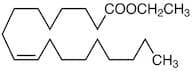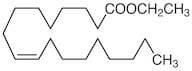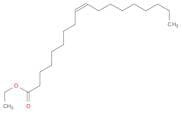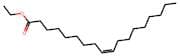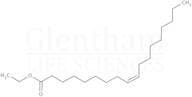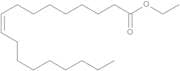
CAS 111-62-6
:Ethyloleat
Beschreibung:
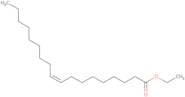
Ethyloleat ist ein Ester, der aus Ölsäure und Ethanol abgeleitet ist, gekennzeichnet durch seine chemische Formel C18H34O2. Er erscheint als farbl Flüssigkeit bis hellgelb mit einem schwachen, angenehmen Geruch. Ethyloleat ist bekannt für seine niedrige Viskosität und hohe Löslichkeit in organischen Lösungsmitteln, was ihn in verschiedenen Anwendungen nützlich macht, einschließlich als Lösungsmittel, Emulgator und in der Formulierung von Arzneimitteln und Kosmetika. Er hat einen relativ niedrigen Siedepunkt und ist unter normalen Bedingungen stabil, obwohl er in Gegenwart von Wasser sowie Säuren oder Basen hydrolysiert werden kann. Ethyloleat wird auch für seine Rolle in der Lebensmittelindustrie als Aromastoff und in der Produktion von Biodiesel anerkannt. Darüber hinaus zeigt er Eigenschaften, die die Hautabsorption verbessern können, was in topischen Formulierungen von Vorteil ist. Sicherheitsdaten zeigen, dass er allgemein als sicher für die Verwendung in Lebensmittel- und Kosmetikprodukten angesehen wird, obwohl er wie viele Chemikalien mit Vorsicht behandelt werden sollte, um mögliche Reizungen zu vermeiden.
Formel:C20H38O2
InChl:InChI=1S/C20H38O2/c1-3-5-6-7-8-9-10-11-12-13-14-15-16-17-18-19-20(21)22-4-2/h11-12H,3-10,13-19H2,1-2H3/b12-11-
InChI Key:InChIKey=LVGKNOAMLMIIKO-QXMHVHEDSA-N
SMILES:C(CCCCC/C=C\CCCCCCCC)CC(OCC)=O
Synonyme:- (Z)-9-Octadecenoic acid ethyl ester
- 9-Octadecenoic acid (Z)-, ethyl ester
- 9-Octadecenoic acid, ethyl ester, (Z)-
- Aethylis oleas
- Clearbright E 81S
- Crodamol EO
- Esterol 123
- Ethyl (9Z)-octadecenoate
- Ethyl (Z)-9-octadecenoate
- Ethyl Oleate
- Ethyl cis-9-octadecenoate
- Ethyloleat
- Nikkol EOO
- Nofable EO 85S
- Nofable EO 99
- Oleate d'ethyle
- Oleate, Ethyl
- Oleato De Etilo
- Oleic acid, ethyl ester
- Weitere Synonyme anzeigen
Sortieren nach
Reinheit (%)
0
100
|
0
|
50
|
90
|
95
|
100
18 Produkte.
Ethyl Oleate
CAS:Formel:C20H38O2Reinheit:>70.0%(GC)Farbe und Form:Colorless to Light yellow clear liquidMolekulargewicht:310.52Ethyl Oleate
CAS:Formel:C20H38O2Reinheit:>95.0%(GC)Farbe und Form:Colorless to Light yellow to Light orange clear liquidMolekulargewicht:310.52Ethyl oleate, tech. 70%
CAS:This Thermo Scientific Chemicals brand product was originally part of the Alfa Aesar product portfolio. Some documentation and label information may refer to the legacy brand. The original Alfa Aesar product / item code or SKU reference has not changed as a part of the brand transition to Thermo SciFormel:C20H38O2Reinheit:70%Farbe und Form:Liquid, Clear colorless to pale yellowMolekulargewicht:310.52Ethyl Oleate
CAS:Salts and esters of oleic, linoleic, or linolenic acidsFormel:C20H38O2Farbe und Form:LiquidMolekulargewicht:310.287189-Octadecenoic acid (9Z)-, ethyl ester
CAS:Formel:C20H38O2Reinheit:75%Farbe und Form:LiquidMolekulargewicht:310.5145Ethyl Oleate
CAS:Ethyl OleateFormel:C20H38O2Reinheit:90%Farbe und Form: colourless liquidMolekulargewicht:310.51g/molEthyl oleate, USP grade
CAS:Formel:C20H38O2Farbe und Form:Clear, colourless to light yellow liquidMolekulargewicht:310.53Ethyl 9(Z)-Octadecenoate
CAS:Formel:C20H38O2Reinheit:>99%Farbe und Form:LiquidMolekulargewicht:310.52Ethyl oleate
CAS:Ethyl oleate, a fatty acid ester from oleic acid and ethanol, is used in NLCs to deliver TFA orally.Formel:C20H38O2Reinheit:97.34% - 99.50%Farbe und Form:LiquidMolekulargewicht:310.51Ethyl Oleate
CAS:Applications It was obtained by the hydrolysis of various animal and vegetable fats and oils.
References Stoffel, W., et al.: Z. Physiol. Chem., 353, 1962 (1972), Bonte, F.J., et al.: Radiology, 108. 195 (1973),Formel:C20H38O2Farbe und Form:ColourlessMolekulargewicht:310.51Ethyl Oleate pure
CAS:Formel:C20H38O2Farbe und Form:Clear, Colourless to pale yellow, LiquidMolekulargewicht:310.52Ethyl oleate
CAS:Ethyl oleate is a glycol ether that is used as a solvent and in the manufacture of other chemicals. It has been shown to have high affinity for proteins and glycosides. Ethyl oleate has been used as an analytical method to identify glycol ethers by using monoclonal antibodies. The optimum extraction process for ethyl oleate is solid phase microextraction, which can be performed on either cellulose or polymeric beads. Surface methodology can be used to study the interactions between ethyl oleate and rat liver microsomes, with sodium-dependent glucose as an example substrate. Glycol ethers are metabolized by epidermal growth factor and may also play a role in metabolic disorders.Formel:C20H38O2Reinheit:Min. 95%Molekulargewicht:310.51 g/mol