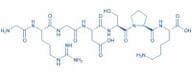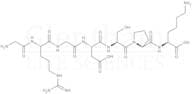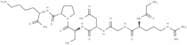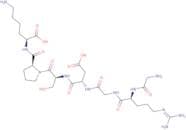
CAS 111119-28-9
:Glycin-Arginin-Glycin-Asparaginsäure-Serin-Prolin-Lysin
Beschreibung:
Die chemische Substanz, die als "Glycin-Arginin-Glycin-Asparaginsäure-Serin-Prolin-Lysin" bekannt ist, ist ein Peptid, das aus sechs Aminosäuren besteht: Glycin (Gly), Arginin (Arg), Asparaginsäure (Asp), Serin (Ser), Prolin (Pro) und Lysin (Lys). Dieses Peptid wird oft wegen seiner biologischen Aktivität und potenziellen Anwendungen in Bereichen wie Biochemie und Pharmakologie untersucht. Seine Sequenz deutet darauf hin, dass es eine Rolle bei der Zellkommunikation spielen könnte, insbesondere bei Interaktionen mit Zelladhäsionsmolekülen und Rezeptoren. Die Anwesenheit von positiv geladenen Aminosäuren wie Arginin und Lysin könnte zu seiner Fähigkeit beitragen, mit negativ geladenen zellulären Komponenten zu interagieren. Darüber hinaus kann die Struktur des Peptids seine Löslichkeit, Stabilität und allgemeine biologische Funktion beeinflussen. Die CAS-Nummer 111119-28-9 identifiziert dieses spezifische Peptid eindeutig und erleichtert dessen Erkennung in der wissenschaftlichen Literatur und in Datenbanken. Insgesamt veranschaulicht Glycin-Arginin-Glycin-Asparaginsäure-Serin-Prolin-Lysin die Komplexität der Peptidinteraktionen in biologischen Systemen und hebt die Bedeutung der Aminosäuresequenzen für die Funktionsbestimmung hervor.
Formel:C28H49N11O11
InChl:InChI=1/C28H49N11O11/c29-8-2-1-5-16(27(49)50)37-25(47)19-7-4-10-39(19)26(48)18(14-40)38-24(46)17(11-22(43)44)36-21(42)13-34-23(45)15(35-20(41)12-30)6-3-9-33-28(31)32/h15-19,40H,1-14,29-30H2,(H,34,45)(H,35,41)(H,36,42)(H,37,47)(H,38,46)(H,43,44)(H,49,50)(H4,31,32,33)/t15-,16-,17-,18-,19-/m0/s1
SMILES:C(CCN)C[C@@H](C(=O)O)N=C([C@@H]1CCCN1C(=O)[C@H](CO)N=C([C@H](CC(=O)O)N=C(CN=C([C@H](CCCNC(=N)N)N=C(CN)O)O)O)O)O
Synonyme:- H-Gly-Arg-Gly-Asp-Ser-Pro-Lys-OH
- glycyl-N~5~-(diaminomethylidene)-L-ornithylglycyl-L-alpha-aspartyl-L-seryl-L-prolyl-L-lysine
- GRGDSPK
- GLY-ARG-GLY-ASP-SER-PRO-LYS
- EMD 56574
- Gly-Arg-Gly-Asp-Ser-Pro-Lys >=97% (HPLC)
- L-Lysine, glycyl-L-arginylglycyl-L-α-aspartyl-L-seryl-L-prolyl-
- GRGDSPK, FIBRONECTIN ATTACHMENT PEPTIDE
- GLY-ARG-GLY-ASP-SER-PRO-LYS ACETATE
- glycyl- arginyl-glycyl-aspartyl-seryl-prolyl-lysine
Sortieren nach
Reinheit (%)
0
100
|
0
|
50
|
90
|
95
|
100
6 Produkte.
H-Gly-Arg-Gly-Asp-Ser-Pro-Lys-OH
CAS:GRGDSPK, fibronectin analog.Formel:C28H49N11O11Reinheit:98.6%Molekulargewicht:715.77GRGDSPK
CAS:GRGDSPK (EMD 56574) is an inhibitory peptide for RGD-mediated adhesion between integrin and extracellular matrix molecules.Formel:C28H49N11O11Reinheit:98%Farbe und Form:SolidMolekulargewicht:715.76RGD Peptide GRGDSPK
CAS:GRGDSPK is the sequence found in cell binding region of fibronectin and many other proteins. The sequence, referred to as RGD, is critical for facilitating cell adhesion.-RGD peptide is an adhesive peptide which can be used in a biomaterial context to attach cells to a range of materials. RGD has many applications including as an antigen for integrin adhesion of thymocytes to thymic epithelial cells. RGD can be used as a blocking peptide to study bacteria and fibronectin. RGD can also be used on collagen-coated plates for study of integrins' role in progenitor cell differentiation. Delivery of RGD peptide inhibits bone mineralization in a dose-dependent manner so GRGDSPK is used to study the role of integrins in bone formation. The presence of RGD peptide dramatically alters bone morphology, with a disruption of osteoblast and mineralized matrix organisation. RGD is a vital research tool in bone formation and integrin.Formel:C28H49N11O11Reinheit:Min. 95%Farbe und Form:PowderMolekulargewicht:715.4 g/molH-Gly-Arg-Gly-Asp-Ser-Pro-Lys-OH
CAS:H-Gly-Arg-Gly-Asp-Ser-Pro-Lys-OH is a peptide that has been shown to have chemotactic activity for monocytes and polymorphonuclear leucocytes, which are cells that participate in the inflammatory response. It also has biological properties that are reactive with hydroxyl groups and can be used to generate monoclonal antibodies. H-Gly-Arg-Gly-Asp-Ser-Pro-Lys-OH has been shown to stimulate the migration of galleria mellonella larvae, suggesting it may have potential as an antiinflammatory agent.Formel:C28H49N11O11Reinheit:Min. 95%Molekulargewicht:715.76 g/molH-Gly-Arg-Gly-Asp-Ser-Pro-Lys-OH
CAS:GRGDSPK, fibronectin analog.
Formel:C28H49N11O11Reinheit:98.7%Molekulargewicht:715.77