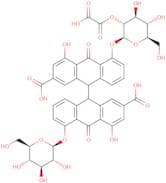
![rel-[5-[[O-(Carboxycarbonyl)-β-D-glucopyranosyl]oxy]-5′-(β-D-glucopyranosyloxy)-9,9′,10,10′-tetrah…](/_next/image/?url=https%3A%2Fstatic.cymitquimica.com%2Fcas-image%2Fthumb-webp%2F395978-rel-5-o-carboxycarbonyl-b-d-glucopyranosyl-oxy-5-b-d-glucopyranosyloxy-991010-tetrahydro-44-dihydroxy-1010-dioxo-99-bianthracene-22-dicarboxylic-acid.webp&w=3840&q=75)
CAS 11137-63-6
:rel-[5-[[O-(Carboxycarbonyl)-β-D-glucopyranosyl]oxy]-5′-(β-D-glucopyranosyloxy)-9,9′,10,10′-tetrahydro-4,4′-dihydroxy-10,10′-dioxo[9,9′-bianthracen]-2,2′-dicarbonsäure
Beschreibung:
Die chemische Substanz, die als rel-[5-[[O-(Carboxycarbonyl)-β-D-glucopyranosyl]oxy]-5′-(β-D-glucopyranosyloxy)-9,9′,10,10′-tetrahydro-4,4′-dihydroxy-10,10′-dioxo[9,9′-bianthracen]-2,2′-dicarbonsäure bekannt ist, mit der CAS-Nummer 11137-63-6, ist eine komplexe organische Verbindung, die durch ihre komplizierte molekulare Struktur gekennzeichnet ist, die mehrere Zuckereinheiten und einen Bianthracen-Kern umfasst. Diese Verbindung weist mehrere funktionelle Gruppen auf, darunter Carbonsäuren und Glykoside, die zu ihrer Löslichkeit und Reaktivität beitragen. Die Anwesenheit von Hydroxylgruppen erhöht ihr Potenzial für Wasserstoffbrückenbindungen, was ihre physikalischen Eigenschaften und biologischen Interaktionen beeinflusst. Ihr Bianthracen-Rahmen deutet auf potenzielle Anwendungen in der organischen Elektronik oder Photonik hin, da ihr konjugiertes System die Elektronendelokalisierung erleichtern kann. Darüber hinaus können die Glucopyranosyl-Einheiten Biokompatibilität verleihen, was sie für pharmazeutische oder biochemische Anwendungen von Interesse macht. Insgesamt veranschaulicht diese Substanz die Schnittstelle zwischen organischer Chemie und Biochemie und zeigt die Vielseitigkeit glycosylierter Verbindungen in verschiedenen Bereichen.
Formel:C44H38O23
InChl:InChI=1/C44H38O23/c45-11-23-31(49)35(53)37(55)43(65-23)63-21-5-1-3-15-25(17-7-13(39(56)57)9-19(47)27(17)33(51)29(15)21)26-16-4-2-6-22(30(16)34(52)28-18(26)8-14(40(58)59)10-20(28)48)64-44-38(67-42(62)41(60)61)36(54)32(50)24(12-46)66-44/h1-10,23-26,31-32,35-38,43-50,53-55H,11-12H2,(H,56,57)(H,58,59)(H,60,61)/t23-,24-,25?,26?,31-,32-,35+,36+,37-,38-,43-,44-/m1/s1
Synonyme:- (9,9'-Bianthracene)-2,2'-dicarboxylic acid, 5-((O-(carboxycarbonyl)-beta-D-glucopyranosyl)oxy)-5'-(beta-D-glucopyranosyloxy)-9,9',10,10'-tetrahydro-4,4'-dihydroxy-10,10'-dioxo-, (R*,R*)-
- 5-{[2-O-(carboxycarbonyl)-beta-D-glucopyranosyl]oxy}-5'-(beta-D-glucopyranosyloxy)-4,4'-dihydroxy-10,10'-dioxo-9,9',10,10'-tetrahydro-9,9'-bianthracene-2,2'-dicarboxylic acid
- Sennoside F
- [9,9′-Bianthracene]-2,2′-dicarboxylic acid, 5-[[O-(carboxycarbonyl)-β-<span class="text-smallcaps">D</smallcap>-glucopyranosyl]oxy]-5′-(β-<smallcap>D</span>-glucopyranosyloxy)-9,9′,10,10′-tetrahydro-4,4′-dihydroxy-10,10′-dioxo-
- [9,9′-Bianthracene]-2,2′-dicarboxylic acid, 5-[[O-(carboxycarbonyl)-β-<span class="text-smallcaps">D</smallcap>-glucopyranosyl]oxy]-5′-(β-<smallcap>D</span>-glucopyranosyloxy)-9,9′,10,10′-tetrahydro-4,4′-dihydroxy-10,10′-dioxo-, (R*,R*)-
- [9,9′-Bianthracene]-2,2′-dicarboxylic acid, 5-[[O-(carboxycarbonyl)-β-<span class="text-smallcaps">D</smallcap>-glucopyranosyl]oxy]-5′-(β-<smallcap>D</span>-glucopyranosyloxy)-9,9′,10,10′-tetrahydro-4,4′-dihydroxy-10,10′-dioxo-, [rel-(9R,9′R)]-
- rel-[5-[[O-(Carboxycarbonyl)-β-<span class="text-smallcaps">D</smallcap>-glucopyranosyl]oxy]-5′-(β-<smallcap>D</span>-glucopyranosyloxy)-9,9′,10,10′-tetrahydro-4,4′-dihydroxy-10,10′-dioxo[9,9′-bianthracene]-2,2′-dicarboxylic acid
- Sennoside E
- [9,9′-Bianthracene]-2,2′-dicarboxylic acid, 5-[[O-(carboxycarbonyl)-β-D-glucopyranosyl]oxy]-5′-(β-D-glucopyranosyloxy)-9,9′,10,10′-tetrahydro-4,4′-dihydroxy-10,10′-dioxo-, (R*,R*)-
- [9,9′-Bianthracene]-2,2′-dicarboxylic acid, 5-[[O-(carboxycarbonyl)-β-D-glucopyranosyl]oxy]-5′-(β-D-glucopyranosyloxy)-9,9′,10,10′-tetrahydro-4,4′-dihydroxy-10,10′-dioxo-, [rel-(9R,9′R)]-
- rel-[5-[[O-(Carboxycarbonyl)-β-D-glucopyranosyl]oxy]-5′-(β-D-glucopyranosyloxy)-9,9′,10,10′-tetrahydro-4,4′-dihydroxy-10,10′-dioxo[9,9′-bianthracene]-2,2′-dicarboxylic acid
- Weitere Synonyme anzeigen
Sortieren nach
Reinheit (%)
0
100
|
0
|
50
|
90
|
95
|
100
1 Produkte.
Sennoside E
CAS:Sennoside E is a natural laxative, which is a hydroxyanthracene glycoside derived from the Senna plant, primarily found in species like *Senna alexandrina*. It acts as a stimulant laxative through its influence on the colon. The mode of action involves the conversion of sennosides by intestinal bacteria into active metabolites, primarily rhein anthrone, which stimulates colonic motility and decreases fluid absorption, leading to increased movement of stool through the bowels.Formel:C44H38O23Reinheit:Min. 95%Molekulargewicht:934.76 g/mol