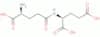
CAS 1116-22-9
:L-γ-Glutamyl-L-glutaminsäure
Beschreibung:
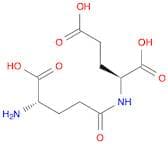
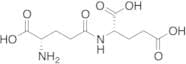
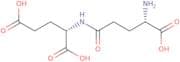
L-γ-Glutamyl-L-glutaminsäure, auch bekannt als Dipeptid, ist eine Verbindung, die aus zwei Glutaminsäureresten besteht, die durch eine Peptidbindung verbunden sind. Es ist gekennzeichnet durch seine Struktur, die eine Carbonsäurefunktionalgruppe und eine Aminogruppe umfasst, die typisch für Aminosäuren ist. Diese Substanz ist in Wasser löslich, was die polare Natur ihrer funktionellen Gruppen widerspiegelt, und sie zeigt Eigenschaften, die mit Aminosäuren assoziiert sind, wie die Fähigkeit, an verschiedenen biochemischen Reaktionen teilzunehmen. L-γ-Glutamyl-L-glutaminsäure wird oft im Kontext seiner Rolle in Stoffwechselwegen und seiner potenziellen Anwendungen in der Ernährung und Pharmazie untersucht. Es kann auch biologische Aktivität zeigen, die die Neurotransmission und zelluläre Signalübertragung beeinflusst, da es an der Synthese von Neurotransmittern beteiligt ist. Die Stabilität und Reaktivität der Verbindung können durch Faktoren wie pH und Temperatur beeinflusst werden, was es wichtig macht, diese Bedingungen in experimentellen Einstellungen zu berücksichtigen. Insgesamt ist L-γ-Glutamyl-L-glutaminsäure ein bedeutendes Molekül in der Biochemie mit verschiedenen Implikationen für Gesundheit und Krankheit.
Formel:C10H16N2O7
InChl:InChI=1S/C10H16N2O7/c11-5(9(16)17)1-3-7(13)12-6(10(18)19)2-4-8(14)15/h5-6H,1-4,11H2,(H,12,13)(H,14,15)(H,16,17)(H,18,19)/t5-,6-/m0/s1
InChI Key:InChIKey=OWQDWQKWSLFFFR-WDSKDSINSA-N
SMILES:[C@H](NC(CC[C@@H](C(O)=O)N)=O)(CCC(O)=O)C(O)=O
Synonyme:- (2S)-2-{[(4S)-4-ammonio-4-carboxylatobutanoyl]amino}pentanedioate
- <span class="text-smallcaps">L</smallcap>-Glutamic acid, <smallcap>L</span>-γ-glutamyl-
- <span class="text-smallcaps">L</smallcap>-Glutamic acid, N-<smallcap>L</span>-γ-glutamyl-
- <span class="text-smallcaps">L</smallcap>-γ-Glutamyl-<smallcap>L</span>-glutamic acid
- Gamma-Glutamylglutamic Acid
- Glutamic acid, N-<span class="text-smallcaps">L</smallcap>-γ-glutamyl-, <smallcap>L</span>-
- Glutamic acid, N-<span class="text-smallcaps">L</span>-γ-glutamyl-
- H-Gamma-Glu-Glu-Oh
- L-gamma-glutamyl-L-glutamic acid
- N-gamma-L-Glutamyl-L-glutamic acid
- gamma-Glutamylglutamate
- γ-<span class="text-smallcaps">L</smallcap>-Glutamyl-<smallcap>L</span>-glutamic acid
- γ-Glutamylglutamic acid
- L-Glutamic acid, N-L-γ-glutamyl-
- L-Glutamic acid, L-γ-glutamyl-
- Glutamic acid, N-L-γ-glutamyl-
- Glutamic acid, N-L-γ-glutamyl-, L-
- Weitere Synonyme anzeigen
Sortieren nach
Reinheit (%)
0
100
|
0
|
50
|
90
|
95
|
100
6 Produkte.
H-Glu(Glu-OH)-OH
CAS:Bachem ID: 4000639.
Formel:C10H16N2O7Farbe und Form:White PowderMolekulargewicht:276.25γ-L-Glutamyl L-Glutamic Acid
CAS:Kontrolliertes ProduktApplications H-GAMMA-GLU-GLU-OH (cas# 1116-22-9) is a useful research chemical.
Formel:C10H16N2O7Farbe und Form:NeatMolekulargewicht:276.24H-Glu(Glu-OH)-OH
CAS:H-Glu(Glu-OH)-OH is a synthetic amino acid that is currently being investigated as a diagnostic agent for the detection of intracellular protein degradation by matrix metalloproteinase-9 (MMP-9). H-Glu(Glu-OH)-OH is taken up by cells in a concentration and time dependent manner, with an uptake rate of approximately 1.6 x 10^6 molecules per cell per hour. The uptake mechanism is not yet known, but has been hypothesized to be due to receptor binding. H-Glu(Glu-OH)-OH binds to cerebellar granule cells and alters mitochondrial metabolism, which may be related to its effects on the ubiquitin proteasome pathway. This compound also has diagnostic potential for atherosclerosis and glutamate transport disorders.Formel:C10H16N2O7Reinheit:Min. 95%Molekulargewicht:276.24 g/mol