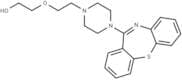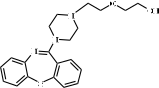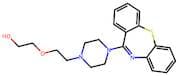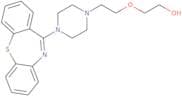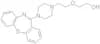
CAS 111974-69-7
:Quetiapin
Beschreibung:
Quetiapin ist ein atypisches Antipsychotikum, das hauptsächlich zur Behandlung von Schizophrenie, bipolaren Störungen und schweren depressiven Störungen eingesetzt wird. Es wirkt, indem es verschiedene Neurotransmittersysteme im Gehirn moduliert, insbesondere durch die Antagonisierung von Dopamin-D2- und Serotonin-5-HT2A-Rezeptoren, was hilft, Symptome von Psychose und Stimmungserkrankungen zu lindern. Quetiapin zeichnet sich durch seine relativ geringe Affinität zu muskarinischen Rezeptoren aus, was zu seinem günstigen Nebenwirkungsprofil im Vergleich zu älteren Antipsychotika beiträgt. Der Stoff wird typischerweise in Tablettenform verabreicht und ist bekannt für seine sedierenden Eigenschaften, was ihn nützlich bei der Behandlung akuter Agitation macht. Quetiapin hat eine Halbwertszeit, die eine einmalige oder zweimal tägliche Dosierung ermöglicht, und unterliegt einem umfangreichen hepatischen Metabolismus, hauptsächlich über das Cytochrom-P450-System. Häufige Nebenwirkungen können Schläfrigkeit, Schwindel und metabolische Veränderungen wie Gewichtszunahme umfassen. Wie bei jedem Medikament ist es wichtig, dass Patienten auf mögliche unerwünschte Wirkungen überwacht werden und dass sie alle Bedenken mit ihrem Gesundheitsdienstleister besprechen.
Formel:C21H25N3O2S
InChl:InChI=1S/C21H25N3O2S/c25-14-16-26-15-13-23-9-11-24(12-10-23)21-17-5-1-3-7-19(17)27-20-8-4-2-6-18(20)22-21/h1-8,25H,9-16H2
InChI Key:InChIKey=URKOMYMAXPYINW-UHFFFAOYSA-N
SMILES:C(COCCO)N1CCN(C=2C=3C(SC=4C(N2)=CC=CC4)=CC=CC3)CC1
Synonyme:- 11-[4-[2-(2-Hydroxyethoxy)Ethyl]-1-Piperazinyl]Dibenzo[B,F][1,4]Thiazepine
- 2-(2-(4-Dibenzo(b,f)(1,4)thiazepine-11-yl-1-piperazinyl)ethoxy)ethanol
- 2-[2-(4-dibenzo[b,f][1,4]thiazepin-11-ylpiperazin-1-yl)ethoxy]ethanol (2E)-but-2-enedioate (2:1) (salt)
- 2-{2-4-(Dibenzob,F1,4Thiazepin-11-Yl)Piperazin-1-Ylethoxy}Ethanol
- 2-{2-[4-(Dibenzo[b,f][1,4]thiazepin-11-yl)-1-piperazinyl]ethoxy}ethanol
- 2-{2-[4-(Dibenzo[b,f][1,4]thiazepin-11-yl)piperazin-1-yl]ethoxy}ethanol
- 2-{[2-(4-Dibenzo[B,F][1,4]Thiazepin-11-Ylpiperazin-1-Yl)Ethyl]Oxy}Ethanol
- Dibenzo[b,f][1,4]thiazepine, ethanol deriv.
- Ethanol, 2-2-(4-Dibenzob,F1,4Thiazepin-11-Yl-1-Piperazinyl)Ethoxy-
- Ethanol, 2-[2-(4-Dibenzo[B,F][1,4]Thiazepin-11-Yl-1-Piperazinyl)Ethoxy]-
- Ketipinor
- Seronia
- Weitere Synonyme anzeigen
Sortieren nach
Reinheit (%)
0
100
|
0
|
50
|
90
|
95
|
100
8 Produkte.
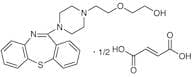
Quetiapine Hemifumarate
CAS:Formel:C21H25N3O2SC4H4O4Reinheit:>98.0%(T)(HPLC)Farbe und Form:White to Almost white powder to crystalMolekulargewicht:441.552-[2-(4-Dibenzo[b,f][1,4]thiazepin-11-yl-1-piperazinyl)ethoxy]ethanol
CAS:Formel:C21H25N3O2SReinheit:98%Farbe und Form:SolidMolekulargewicht:383.5071Quetiapine
CAS:Quetiapine treats schizophrenia and bipolar I, targeting serotonin, dopamine, and adrenoreceptor subtypes, plus H1 histamine receptor.Formel:C21H25N3O2SReinheit:99.14% - 99.63%Farbe und Form:White To Off-White Crystalline PowderMolekulargewicht:383.51Quetiapine
CAS:Kontrolliertes ProduktStability Very Very Hygroscopic
Applications Quetiapine is a dibenzothiazepine antipsychotic commonly used as monotherapy for patients with major depressive disorder and schizophrenia.
Not a dangerous good if item is equal to or less than 1g/ml and there is less than 100g/ml in the package
References Cutler, A., et al.: J. Clin. Psych., 70, 526 (2009); Kapur, S., et al.: Arch. Gen. Psych., 57, 553 (2000); Peuskens, J. & Link, C.: Acta. Psych. Scand., 96, 265 (1997)Formel:C21H25N3O2SFarbe und Form:Off-White To YellowMolekulargewicht:383.51Quetiapine
CAS:Kontrolliertes ProduktQuetiapine is a psychotropic drug that belongs to the class of atypical antipsychotics. It is used in the treatment of schizophrenia and bipolar disorder. Quetiapine has been shown to have a potent inhibitory effect on prolactin levels, which may be due to its ability to induce fumarate reductase and increase blood flow to the hypothalamus. Quetiapine also interacts with a number of other drugs and can lead to adverse reactions when taken with them. The clinical efficacy of quetiapine for schizophrenia was demonstrated by a double-blind, randomized, placebo-controlled trial involving over 400 patients. The therapeutic efficacy of quetiapine has also been demonstrated in treatment trials involving patients with acute mania associated with bipolar disorder and schizoaffective disorder.Formel:C21H25N3O2SReinheit:Min. 95%Farbe und Form:PowderMolekulargewicht:383.51 g/mol

![2-[2-(4-Dibenzo[b,f][1,4]thiazepin-11-yl-1-piperazinyl)ethoxy]ethanol](/_next/image/?url=https%3A%2Fstatic.cymitquimica.com%2Fproducts%2FIN%2Fthumb%2FDA003EQ0.jpg&w=3840&q=75)