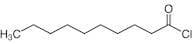
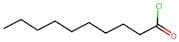
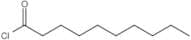
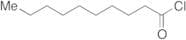
CAS 112-13-0
:Decanoylchlorid
- 5-Nitroquinolin-8-Ol
- Capric acid chloride
- Capric chloride
- Caprinoyl chloride
- Capryl Chloride
- Chlorure de decanoyle
- Cloruro De Decanoilo
- Decanoic acid chloride
- Decanoylchlorid
- n-Decanoyl chloride
- Decanoyl chloride
Decanoyl Chloride
CAS:Formel:C10H19ClOReinheit:>98.0%(GC)(T)Farbe und Form:Colorless to Almost colorless clear liquidMolekulargewicht:190.71Decanoyl chloride, 98%
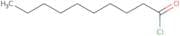
CAS:Decanoyl chloride is used in the synthesis of oligomers composed of alternating 2,6-diaminopyridine and 2,6-pyridinedicarbonyl units. It enhances the activity of proleather from Bacillus sp. during the synthesis of poly(lactic acid) in organic solvents. This Thermo Scientific Chemicals brand producFormel:C10H19ClOReinheit:98%Farbe und Form:Clear, colourless to pale yellow, liquidMolekulargewicht:190.71Decanoyl chloride
CAS:Decanoyl chlorideReinheit:99%Farbe und Form:Colourless LiquidMolekulargewicht:190.71g/molDecanoyl Chloride
CAS:Kontrolliertes ProduktApplications Decanoyl Chloride is used in the synthesis of an effective metalloproteinase inhibitor. Also acts as a reagent in the synthesis of reversible α-ketoheterocycle inhibitors of fatty acid amide hydrolase as potnetial analgesics.
Not a dangerous good if item is equal to or less than 1g/ml and there is less than 100g/ml in the package
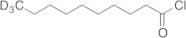
References Levy, D. et al.: J. Med. Chem., 41m 199 (1998); Boger, D. et al.: J. Med. Chem., 48, 1849 (2005);Formel:C10H19ClOFarbe und Form:NeatMolekulargewicht:190.71Decanoyl-d3 Chloride
CAS:Kontrolliertes ProduktApplications Decanoyl-d3 Chloride is an intermediate in the synthesis of Decanoyl-10,10,10,d3-L-carnitine Chloride (D212582), a labelled metabolite of L-Carnitine (C184110) which is an essential cofactor of fatty acid metabolism. Also required for the transport of fatty acids through the inner mitochondrial membrane.
References Mitchell, M.E., et al.: Am. J. Clin. Nutr., 31, 293 (1978); Lango, R., et al.: Cardiovasc. Res., 51, 21 (2001); Vaz, F.M., et al.: Biochem. J., et al.: 361, 417 (2002); Karlic, H., et al.: Nutrition, 20, 709 (2004)Formel:C10D3H16ClOFarbe und Form:NeatMolekulargewicht:193.729Decanoyl chloride
CAS:Decanoyl chloride is a fatty acid derivative that acts as a surfactant and detergent. It is used in the formulation of detergent compositions, such as pluronic f127, which are used for the production of antireflux agents, wetting agents, and solubilizers. Decanoyl chloride is also used in the manufacture of glycol esters and acylation reactions. The molecular weight of decanoyl chloride is between 138-144 g/mol. The chemical formula for decanoyl chloride is C10H20O2. Decanoyl chloride has an acid dissociation constant (pKa) of 10.5 at 25°C. The infrared spectrum shows bands at 1626 cm-1 and 1602 cm-1 due to stretching vibrations of the alkanoic acid moiety or C=O bond. Decanoyl chloride has a redox potential of +0.76 V vs Ag/AgCl atFormel:C10H19ClOReinheit:Min. 95%Molekulargewicht:190.71 g/molDecanoyl chloride
CAS:Decanoyl Chloride helps create metalloproteinase inhibitors and reversible analgesics as a synthesis reagent.Formel:C10H19ClOFarbe und Form:SolidMolekulargewicht:190.71Decanoyl Chloride pure, 98%
CAS:Formel:C10H19OClReinheit:min. 98%Farbe und Form:Clear, Colourless to pale yellow, LiquidMolekulargewicht:190.71