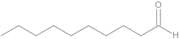
CAS 112-31-2
:Dekanal
Beschreibung:
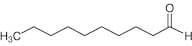
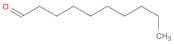
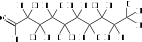
Dekanal, mit der CAS-Nummer 112-31-2, ist ein aliphatischer Aldehyd mit gerader Kette, der durch seine zehn Kohlenstoffatome (C10H20O) gekennzeichnet ist. Es handelt sich um eine farblose bis blassgelbe Flüssigkeit bei Raumtemperatur, die einen charakteristischen fettigen, wachsartigen Geruch aufweist, der an Orangenschalen erinnert. Dekanal ist in Wasser unlöslich, aber in organischen Lösungsmitteln wie Ethanol und Ether löslich. Sein Siedepunkt ist im Vergleich zu kleineren Aldehyden relativ hoch, was seine größere Molekülgröße widerspiegelt. Dekanal wird hauptsächlich in der Parfümindustrie wegen seines angenehmen Duftes verwendet und wird auch als Aromastoff in Lebensmitteln eingesetzt. Darüber hinaus dient es als Zwischenprodukt in der organischen Synthese und kann an verschiedenen chemischen Reaktionen beteiligt sein, einschließlich Oxidations- und Reduktionsprozessen. Aufgrund seiner Aldehydfunktionalität kann Dekanal an typischen Aldehydreaktionen teilnehmen, wie z.B. der nucleophilen Addition. Sicherheitsüberlegungen umfassen seine potenziellen reizenden Eigenschaften, die eine ordnungsgemäße Handhabung und Lagerung erfordern, um die Exposition zu minimieren.
Formel:C10H20O
InChl:InChI=1S/C10H20O/c1-2-3-4-5-6-7-8-9-10-11/h10H,2-9H2,1H3
InChI Key:InChIKey=KSMVZQYAVGTKIV-UHFFFAOYSA-N
SMILES:C(CCCCC)CCCC=O
Synonyme:- 1-Decanal
- Aldehyde C-10
- Aldehyde C-10, Standard
- Capraldehyde
- Capric aldehyde
- Caprinaldehyd
- Caprinaldehyde
- Caprinic aldehyde
- Decaldehyde
- Decanal
- Decanal(C-10)
- Decanaldehyde
- Decylic aldehyde
- Nsc 6087
- n-Decaldehyde
- n-Decanal
- Weitere Synonyme anzeigen
Sortieren nach
Reinheit (%)
0
100
|
0
|
50
|
90
|
95
|
100
18 Produkte.
Decanal
CAS:Formel:C10H20OReinheit:>97.0%(GC)Farbe und Form:Colorless clear liquidMolekulargewicht:156.27Decanal, 96%
CAS:Decanal is used in fragrances and flavoring and it is an important component in citrus along with octanal, citral, and sinensal. It is also used in Air Care Products, Laundry and Dishwashing Products, Personal Care Products. This Thermo Scientific Chemicals brand product was originally part of theFormel:C10H20OReinheit:96%Farbe und Form:Clear colorless, LiquidMolekulargewicht:156.27Decanal
CAS:DecanalFormel:C10H20OReinheit:97%Farbe und Form: clear. colourless liquidMolekulargewicht:156.27g/molDecanal
CAS:Formel:CH3(CH2)8CHOReinheit:≥ 95.0%Farbe und Form:Clear, colourless liquidMolekulargewicht:156.27SVOC Mixture 748 1000 µg/mL in Methanol
CAS:Kontrolliertes Produkt- 100-41-4
- 100-42-5
- 106-42-3
- 106-46-7
- 107-06-2
- 108-08-7
- 108-10-1
- 108-38-3
- 108-67-8
- 108-88-3
- 110-54-3
- 111-65-9
- 111-84-2
- 112-31-2
- 112-40-3
- 1120-21-4
- 124-18-5
- 124-19-6
- 124-48-1
- 127-18-4
- 127-91-3
- 142-82-5
- 526-73-8
- 540-84-1
- 544-76-3
- 5989-27-5
- 611-14-3
- 620-14-4
- 622-96-8
- 629-50-5
- 629-59-4
- 629-62-9
- 64-17-5
- 67-63-0
- 67-64-1
- 67-66-3
- 71-23-8
- 71-36-3
- 71-43-2
- 75-09-2
- 75-27-4
- 7785-26-4
- 78-87-5
- 78-93-3
- 79-01-6
- 95-47-6
- 95-63-6
- 95-93-2
Farbe und Form:MixtureDecyl aldehyde
CAS:Decyl aldehyde is a ten-carbon aldehyde that is a substrate for bacterial luciferase.Formel:C10H20OReinheit:≥95%Farbe und Form:Colorless To Light-Yellow Liquid Is 64°F (Uscg 1999)Molekulargewicht:156.27Decanal
CAS:Kontrolliertes ProduktApplications Decanal is an aliphatic reagent used in the preparation of a new class of antibacterials resulting from erythromycin derivatives. Also used in the preparation of 2,4-disubstituted pyrrolidines from aldehydes.
References Agouridas, C. et al.: J. Med. Chem., 41, 4080 (1998); Zheng, B. et al.: Chem. Comm., 49, 4561 (2013);Formel:C10H20OFarbe und Form:NeatMolekulargewicht:156.27Dacanal
CAS:Dacanal is a glycol ether substrate that has been shown to be effective in the inhibition of bacterial growth. It has been shown to provide a film on the surface of liquids, which prevents the formation of air bubbles and helps maintain a uniform distribution of air entrainment. Dacanal also inhibits the enzymatic activities of acetylcholinesterase and monoamine oxidase in vitro assays. Dacanal was found to have an inhibitory effect against bacteria that are resistant to antibiotics, such as erythromycin-resistant strains of Staphylococcus aureus. This compound also contains natural compounds such as ethyl decanoate and malonic acid, which may contribute to its antibacterial activity.Formel:C10H20OReinheit:Min. 95%Molekulargewicht:156.27 g/mol