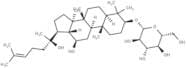
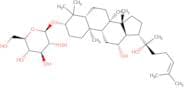
![(2R,3R,4S,5R,6R)-2-[[(10S,12S,14R,17S)-12-hydroxy-17-[(2R)-2-hydroxy-6 -methyl-hept-5-en-2-yl]-4,4…](/_next/image/?url=https%3A%2Fstatic.cymitquimica.com%2Fcas-image%2Fthumb-webp%2F166941-2r-3r-4s-5r-6r-2-10s-12s-14r-17s-12-hydroxy-17-2r-2-hydroxy-6-methyl-hept-5-en-2-yl-44101417-pentamethyl-235678911121-31516-dodecahydro-1h-cyclopenta-a-phenanthren-3-yl-oxy-6-hydroxyme-thyl-oxane-345-triol.webp&w=3840&q=75)
CAS 112246-15-8
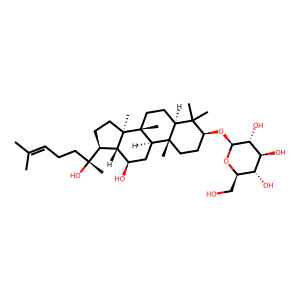
:(2R,3R,4S,5R,6R)-2-[[(10S,12S,14R,17S)-12-hydroxy-17-[(2R)-2-hydroxy-6-methyl-hept-5-en-2-yl]-4,4,10,14,17-pentamethyl-2,3,5,6,7,8,9,11,12,13,15,16-dodecahydro-1H-cyclopenta[a]phenanthren-3-yl]oxy]-6-(hydroxymethyl)oxan-3,4,5-triol
Beschreibung:
Die chemische Substanz mit dem Namen "(2R,3R,4S,5R,6R)-2-[[[10S,12S,14R,17S)-12-Hydroxy-17-[(2R)-2-Hydroxy-6-methyl-hept-5-en-2-yl]-4,4,10,14,17-Pentamethyl-2,3,5,6,7,8,9,11,12,13,15,16-Dodecahydro-1H-Cyclopenta[a]phenanthren-3-yl]oxy]-6-(Hydroxymethyl)oxan-3,4,5-triol" und CAS-Nummer "112246-15-8" ist ein komplexes organisches Molekül, das durch mehrere Stereozentren und eine polycyclische Struktur gekennzeichnet ist. Es weist einen Cyclopenta[a]phenanthren-Kern auf, was auf seine potenzielle biologische Aktivität hinweist, insbesondere im Kontext von steroidähnlichen Verbindungen. Das Vorhandensein von Hydroxylgruppen deutet darauf hin, dass es hydrophile Eigenschaften aufweisen könnte, die seine Löslichkeit in polaren Lösungsmitteln erhöhen. Darüber hinaus enthält das Molekül eine verzweigte Alkylkette, die seine Lipophilie und Interaktion mit biologischen Membranen beeinflussen könnte. Seine komplexe Stereochemie impliziert, dass es spezifische Wechselwirkungen mit biologischen Zielen haben könnte, was es in der medizinischen Chemie und Pharmakologie von Interesse macht. Insgesamt deutet die strukturelle Komplexität dieser Verbindung und ihre funktionellen Gruppen auf potenzielle Anwendungen in therapeutischen Kontexten hin, obwohl weitere Studien erforderlich wären, um ihre spezifischen biologischen Rollen und Wirkmechanismen zu klären.
Formel:C36H62O8
InChl:InChI=1/C36H62O8/c1-20(2)10-9-14-36(8,42)35(7)17-16-34(6)21-11-12-25-32(3,4)26(13-15-33(25,5)22(21)18-23(38)30(34)35)44-31-29(41)28(40)27(39)24(19-37)43-31/h10,21-31,37-42H,9,11-19H2,1-8H3/t21?,22?,23-,24+,25?,26?,27+,28-,29+,30?,31-,33+,34+,35-,36+/m0/s1
Synonyme:- 20(R)-Protopanaxdiol-3-O-beta-D-glycopyranoside
- (8xi,9xi,12alpha,13xi,14beta,17beta)-12-hydroxy-17-[(2R)-2-hydroxy-6-methylhept-5-en-2-yl]-4,4,10,14,17-pentamethylgonan-3-yl beta-D-glucopyranoside
Sortieren nach
Reinheit (%)
0
100
|
0
|
50
|
90
|
95
|
100
7 Produkte.
20(R)-Ginsenoside Rh2
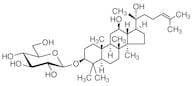
CAS:Formel:C36H62O8Reinheit:>97.0%(HPLC)Farbe und Form:White to Light yellow powder to crystalMolekulargewicht:622.8820(R)-Ginsenoside Rh2
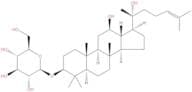
CAS:Ginsenoside Rh2 is one of the most active components of red ginseng, controlling cancer and other metabolic diseases including osteoclast differentiation; ginsenoside Rh2 can suppress RANKL-induced osteoclast differentiation in vitro and in vivo through the regulation of c-Fos and NFATc1 expressions, not excluding the involvement of NF-κB and ERK, it is also suggested to be developed as a therapeutic drug for prevention and treatment of osteoporosis.Formel:C36H62O8Reinheit:20%, 95%, 98%Molekulargewicht:622.87320(R)-Ginsenoside Rh2
CAS:20(R)-Ginsenoside Rh2 (Ginsenoside Rh2) is a minor stereoisomer of ginsenoside Rh2, possesses matrix metalloproteinase inhibitory.Formel:C36H62O8Reinheit:99.58%Farbe und Form:SolidMolekulargewicht:622.87Ref: TM-T3813
1mg46,00€5mg87,00€1mL*10mM (DMSO)119,00€10mg123,00€25mg192,00€50mg264,00€100mg378,00€200mg552,00€20(R)Ginsenoside Rh2
CAS:20(R)Ginsenoside Rh2 is a bioactive compound, specifically a ginsenoside, which is derived from the roots of Panax ginseng. This compound is categorized as a rare saponin, produced through the enzymatic or acidic hydrolysis of protopanaxadiol-type ginsenosides found naturally in ginseng. Its mode of action involves modulating various cellular pathways, including signaling pathways related to apoptosis, inflammation, and immune responses. It has been shown to exert anticancer effects through induction of apoptosis, inhibition of cell proliferation, and disruption of cell cycle progression in cancer cells. Additionally, it may influence the immune system by enhancing or regulating immune cell activity.Formel:C36H62O8Reinheit:Min. 98 Area-%Farbe und Form:PowderMolekulargewicht:622.87 g/mol20(R)-Ginsenoside Rh2-d6
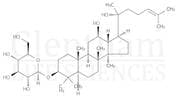
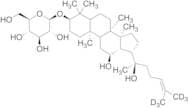
CAS:Kontrolliertes ProduktFormel:C36D6H56O8Farbe und Form:NeatMolekulargewicht:628.91