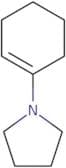
CAS 1125-99-1
:N-(cyclohex-1-en-1-yl)pyrrolidin
Beschreibung:
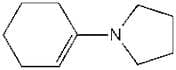
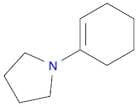
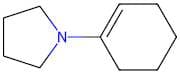
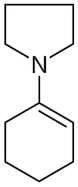
N-(cyclohex-1-en-1-yl)pyrrolidin, mit der CAS-Nummer 1125-99-1, ist eine organische Verbindung, die durch ihre einzigartige Struktur gekennzeichnet ist, die einen Pyrrolidinring mit einem Cyclohexen-Substituenten kombiniert. Diese Verbindung weist einen fünfgliedrigen stickstoffhaltigen Heterozyklus (Pyrrolidin) und eine Cyclohexen-Einheit auf, die eine Ungesättigtheit einführt und zu ihrer Reaktivität beiträgt. Das Vorhandensein der Doppelbindung im Cyclohexenring kann zu verschiedenen chemischen Reaktionen führen, wie elektrophilen Additionen oder Polymerisation. N-(cyclohex-1-en-1-yl)pyrrolidin ist typischerweise eine farblose bis blassgelbe Flüssigkeit bei Raumtemperatur, die eine moderate Löslichkeit in organischen Lösungsmitteln aufweist. Ihre molekulare Struktur deutet auf potenzielle Anwendungen in der organischen Synthese hin, insbesondere in der Entwicklung von Arzneimitteln oder Agrochemikalien. Darüber hinaus können die Eigenschaften der Verbindung durch Faktoren wie sterische Hinderung und elektronische Effekte aufgrund der zyklischen Strukturen beeinflusst werden, was sie zu einem interessanten Thema für weitere Studien in der medizinischen Chemie und Materialwissenschaft macht.
Formel:C10H18N
InChl:InChI=1/C10H17N/c1-2-6-10(7-3-1)11-8-4-5-9-11/h6H,1-5,7-9H2/p+1
InChI Key:InChIKey=KTZNVZJECQAMBV-UHFFFAOYSA-N
SMILES:N1(CCCC1)C=2CCCCC2
Synonyme:- 1-(1-Cyclohexen-1-yl)pyrrolidine
- 1-(1-Cyclohexenyl)pyrrolidine
- 1-(1-Pyrrolidino)-1-cyclohexene
- 1-(1-Pyrrolidinyl)cyclohexene
- 1-(Cyclohex-1-en-1-yl)pyrrolidine
- 1-(Pyrrolidine-1-yl)-1-cyclohexene
- 1-Cyclohex-1-En-1-Ylpyrrolidinium
- 1-Pyrrolidino-1-cyclohexene
- 1-Pyrrolidinocyclohexene
- 1-Pyrrolidinyl-1-cyclohexene
- Cyclohexanone pyrrolidine enamine
- N-(1-Cyclohexen-1-yl)pyrrolidine
- N-(1-Cyclohexenyl)pyrrolidine
- NSC 29652
- Pyrrolidine, 1- (1-cyclohexen-1-yl)-
- 1-cyclohexenylpyrrolidine
- N-(cyclohex-1-en-1-yl)pyrrolidine
- N-Pyrrolidino-1-cyclohexene
- N-(1-CYCLOHEXEN-1-YL)-PYRROLIDIN
- 1-(1-PYRROLIDINO)CYCLOHEXENE 97%
- 1-Cyclohex-1-en-1-ylpyrrolidine
- 1-PYRROLIDINO-2-CYCLOHEXENE
- n-(cyclohexen-1-yl)pyrrolidine
- 1-(1-PYRROLIDINO)CYCLOHEXENE
- Weitere Synonyme anzeigen
Sortieren nach
Reinheit (%)
0
100
|
0
|
50
|
90
|
95
|
100
6 Produkte.
1-(1-Cyclohexen-1-yl)pyrrolidine, 97%
CAS:This Thermo Scientific Chemicals brand product was originally part of the Alfa Aesar product portfolio. Some documentation and label information may refer to the legacy brand. The original Alfa Aesar product / item code or SKU reference has not changed as a part of the brand transition to Thermo Sci
Formel:C10H17NReinheit:97%Farbe und Form:Clear, colorless to yellow, LiquidMolekulargewicht:151.251-(Cyclohex-1-en-1-yl)pyrrolidine
CAS:Formel:C10H17NReinheit:97%Farbe und Form:LiquidMolekulargewicht:151.24871-Cyclohex-1-en-1-ylpyrrolidine
CAS:1-Cyclohex-1-en-1-ylpyrrolidineReinheit:≥95%Farbe und Form:Pale Yellow LiquidMolekulargewicht:151.25g/mol1-Pyrrolidino-1-cyclohexene
CAS:Formel:C10H17NReinheit:>97.0%(GC)(T)Farbe und Form:White to Yellow to Green clear liquidMolekulargewicht:151.251-Pyrrolidino-1-cyclohexene
CAS:Formel:C10H17NReinheit:≥97%Farbe und Form:LiquidMolekulargewicht:151.2531-Pyrrolidino-1-cyclohexene
CAS:1-Pyrrolidino-1-cyclohexene (1PC) is a chemical compound that has been used clinically in the treatment of infections. The 1PC molecule is composed of a pyrrolidine ring and a cyclohexene ring, which are connected by an amide bond. The molecular geometry of 1PC can be regarded as a chair conformation with two hydrogen atoms occupying the two axial positions. It has been shown that 1PC inhibits the growth of bacteria by binding to chloride ions and catalyzing their conversion to reactive chloride species, which disrupts bacterial cells. The reaction mechanism for this process is similar to the Wolff-Kishner reduction, which involves dehydrating and deactivating the substrate. In addition, it was observed that 1PC inhibits bacterial growth by inhibiting protein synthesis through interaction energies with amino acids on ribosomes. This inhibition may be due to its ability to deprotect amino acids on ribosomes orFormel:C10H17NReinheit:Min. 96.5 Area-%Farbe und Form:Clear LiquidMolekulargewicht:151.25 g/mol