CAS 1126-58-5
:Girard's
Beschreibung:
Das Reagenz Girard's T, auch bekannt als 2,4-Dinitrophenylhydrazin (DNPH), ist eine chemische Verbindung, die häufig in der organischen Chemie zur Identifizierung und Charakterisierung von Carbonylverbindungen wie Aldehyden und Ketonen verwendet wird. Es zeichnet sich durch seine Fähigkeit aus, stabile Hydrazon-Derivate bei der Reaktion mit Carbonylgruppen zu bilden, die leicht isoliert und analysiert werden können. Das Reagenz ist typischerweise ein kristallines Feststoff von gelber bis orangefarbener Farbe, und seine Derivate weisen oft ausgeprägte Schmelzpunkte auf, die bei der Identifizierung der ursprünglichen Carbonylverbindung helfen. Das Reagenz Girard's T ist auch bemerkenswert für seine Empfindlichkeit und Spezifität, was es zu einem wertvollen Werkzeug sowohl in Labor- als auch in Industrieanwendungen macht, einschließlich der Analyse von Arzneimitteln und Umweltproben. Darüber hinaus ist es wichtig, dieses Reagenz mit Vorsicht zu behandeln, da es potenziell toxisch ist und während der Verwendung geeignete Sicherheitsmaßnahmen erforderlich sind. Insgesamt spielt das Reagenz Girard's T eine bedeutende Rolle in der organischen Synthese und der analytischen Chemie.
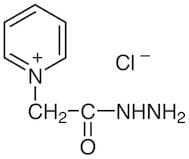
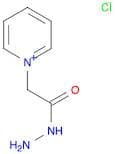
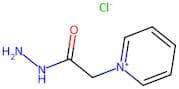
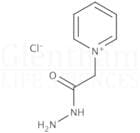
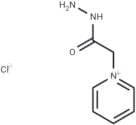
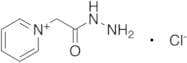
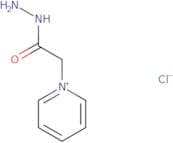
Formel:C7H10N3O·Cl
InChl:InChI=1S/C7H9N3O.ClH/c8-9-7(11)6-10-4-2-1-3-5-10;/h1-5H,6,8H2;1H
InChI Key:InChIKey=NDXLVXDHVHWYFR-UHFFFAOYSA-N
SMILES:C(C(NN)=O)[N+]=1C=CC=CC1.[Cl-]
Synonyme:- 1-(2-Hydrazino-2-oxoethyl)pyridinium chloride
- 1-(2-Hydrazinyl-2-Oxoethyl)Pyridinium Chloride
- 1-(2-Hydrazinyl-2-oxoethyl)pyridin-1-iumchloride
- 1-(Carboxymethyl)pyridinium chloride, hydrazide
- 1-[(Hydrazinecarbonyl)methyl]pyridin-1-ium chloride
- 1126-58-5
- Girard's P reagent
- Girard-P reagent
- Pyridinioacetohydrazide chloride
- Pyridinium, 1- (2-hydrazino-2-oxoethyl)-, chloride
- Pyridinium, 1-(2-Hydrazinyl-2-Oxoethyl)-, Chloride (1:1)
- Pyridinium, 1-(carboxymethyl)-, chloride, hydrazide
- Weitere Synonyme anzeigen
Sortieren nach
Reinheit (%)
0
100
|
0
|
50
|
90
|
95
|
100
9 Produkte.
Girard's Reagent P
CAS:Formel:C7H10ClN3OReinheit:>95.0%(T)Farbe und Form:White to Light yellow to Light orange powder to crystalMolekulargewicht:187.631-(2-Hydrazinyl-2-oxoethyl)pyridin-1-ium chloride
CAS:Formel:C7H10ClN3OReinheit:97%Farbe und Form:SolidMolekulargewicht:187.62681-(2-Hydrazinyl-2-oxoethyl)pyridin-1-ium chloride
CAS:1-(2-Hydrazinyl-2-oxoethyl)pyridin-1-ium chlorideReinheit:97%Molekulargewicht:187.63g/molGirard's reagent P
CAS:Formel:C7H10ClN3OReinheit:≥ 95.0%Farbe und Form:White to light yellow or light orange crystalline powderMolekulargewicht:187.63Girard's Reagent P
CAS:Girard's Reagent P, a cationic hydrazine compound, serves as a derivatization agent for the quantification of glycans, oxysterols, and 5-methylcytosineFormel:C7H10N3O·ClFarbe und Form:SolidMolekulargewicht:187.63Girard's Reagent P
CAS:Kontrolliertes ProduktApplications Girard’s reagent used in the identification and quantification of protein carbonylation as well as in the modification of nucleosides and nucleotides. Used in the preparation of potent photoactive agents.
References Mirzaei, H., et al.: J. Chrom. A, 1134, 122 (2007); Kanofsky, J.R., et al.: Photochem. Photobiol., 73, 349 (2001);Formel:C7H10N3O•ClFarbe und Form:NeatMolekulargewicht:152.183545Girard's reagent P
CAS:Girard's reagent P is a mixture of phenylhydrazine and p-chloro-phenylhydrazine. It is used as a chemical test for the detection of carbonyl groups in organic compounds. This test has been shown to be sensitive to carotenoids, which are found in human serum or urine samples. Girard's reagent P can be used to identify cancer tissues by detecting the presence of hydroxyl groups that are found in the amino acids methionine and cysteine. The hydroxyl group reacts with the phenylhydrazine component of Girard's reagent P, giving off a purple color. Additionally, Girard's reagent P can be used in conjunction with other chemicals to identify specific types of cancer cells such as cerebrotendinous xanthomatosis and neuroblastoma, which have chemical structures that contain hydroxyl groups.Formel:C7H10ClN3OReinheit:Min. 95%Farbe und Form:White PowderMolekulargewicht:187.63 g/mol1-(2-Hydrazinyl-2-oxoethyl)pyridin-1-ium chloride
CAS:Formel:C7H10ClN3OReinheit:97%Farbe und Form:SolidMolekulargewicht:187.63