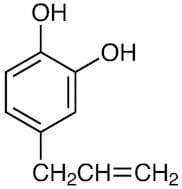
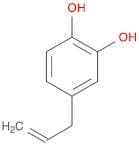
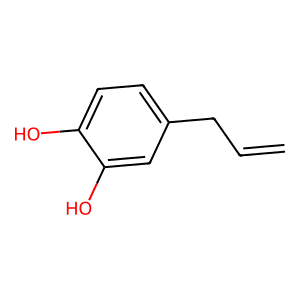
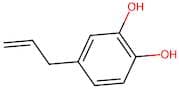
CAS 1126-61-0
:Hydroxychavicol
Beschreibung:
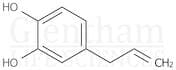
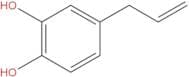
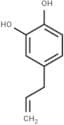
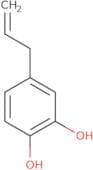
Hydroxychavicol, mit der CAS-Nummer 1126-61-0, ist eine phenolische Verbindung, die hauptsächlich aus der Gewürznelkenpflanze (Syzygium aromaticum) gewonnen wird und für ihre antioxidativen Eigenschaften bekannt ist. Sie erscheint als farblose bis blassgelbe Flüssigkeit und hat einen charakteristischen aromatischen Geruch. Hydroxychavicol ist in organischen Lösungsmitteln löslich und zeigt eine begrenzte Löslichkeit in Wasser. Diese Verbindung wird für ihre potenziellen gesundheitlichen Vorteile anerkannt, einschließlich entzündungshemmender und antimikrobieller Aktivitäten, was sie sowohl für Lebensmittel- als auch für pharmazeutische Anwendungen von Interesse macht. Ihre Struktur weist eine Hydroxylgruppe auf, die an ein Chavicol-Rückgrat gebunden ist, was zu ihrer Reaktivität und biologischen Aktivität beiträgt. Darüber hinaus wurde Hydroxychavicol hinsichtlich seiner Rolle bei der Verbesserung der Stabilität bestimmter Lebensmittelprodukte und als natürliches Konservierungsmittel untersucht. Wie viele phenolische Verbindungen kann es auch zytotoxische Wirkungen gegen verschiedene Krebszelllinien zeigen, was weitere Forschungen zu seinem therapeutischen Potenzial rechtfertigt. Insgesamt ist Hydroxychavicol eine vielseitige Verbindung mit erheblichen Implikationen für Gesundheit, Ernährung und Industrie.
Formel:C9H10O2
InChl:InChI=1S/C9H10O2/c1-2-3-7-4-5-8(10)9(11)6-7/h2,4-6,10-11H,1,3H2
InChI Key:InChIKey=FHEHIXJLCWUPCZ-UHFFFAOYSA-N
SMILES:C(C=C)C1=CC(O)=C(O)C=C1
Synonyme:- 1,2-Benzenediol, 4-(2-propenyl)-
- 1,2-Benzenediol,4-(2-propen-1-yl)-
- 1,2-Dihydroxy-4-allylbenzene
- 1-Allyl-3,4-dihydroxybenzene
- 2-Hydroxychavicol
- 3,4-Dihydroxyallylbenzene
- 4-(2-Propen-1-yl)-1,2-benzenediol
- 4-(2-Propenyl)-1,2-benzenediol
- 4-(Prop-2-En-1-Yl)Benzene-1,2-Diol
- 4-Allyl-1,2-Benzenediol
- 4-Allyl-1,2-dihydroxybenzene
- 4-Allylcatechol
- 4-Allylpyrocatechol
- Desmethyleugenol
- Hydroxychavicol
- Pyrocatechol, 4-allyl-
- Weitere Synonyme anzeigen
Sortieren nach
Reinheit (%)
0
100
|
0
|
50
|
90
|
95
|
100
9 Produkte.
4-Allylpyrocatechol
CAS:Formel:C9H10O2Reinheit:>98.0%(GC)Farbe und Form:White to Gray to Brown powder to crystalMolekulargewicht:150.183,4-DIHYDROXY-ALLYLBENZENE
CAS:Formel:C9H10O2Reinheit:97%Farbe und Form:SolidMolekulargewicht:150.17452-Hydroxychavicol
CAS:Formel:C9H10O2Reinheit:≥ 98.0%Farbe und Form:Brown solidMolekulargewicht:150.184-Allylcatechol
CAS:4-Allylcatechol (Hydroxychavicol) shields rat liver mitochondria against photo-induced lipid/protein damage due to its antioxidant properties.
Formel:C9H10O2Reinheit:97.94%Farbe und Form:SolidMolekulargewicht:150.174-Allylpyrocatechol
CAS:4-Allylpyrocatechol is a cell-specific antimicrobial agent that inhibits the growth of bacteria, fungi, and viruses. It has minimal toxicity and can be used in vivo for the treatment of oral pathogens, including Candida albicans, Streptococcus mutans, and Enterococcus faecalis. 4-Allylpyrocatechol binds to intracellular molecules that are involved in cell proliferation and prevents the formation of reactive oxygen species. This agent also inhibits mitochondrial membrane potential and reduces the expression of genes that encode for proteins involved in signal transduction pathways. The inhibition of these genes leads to cell death. 4-Allylpyrocatechol can be used as an analytical method to measure the susceptibility of cells to eugenol by measuring their response to mitomycin C or propidium iodide. This agent may also be able to prevent chronic oral infections through its effects on oral pathogens.Formel:C9H10O2Reinheit:Min. 95%Farbe und Form:Clear LiquidMolekulargewicht:150.17 g/mol4-Allylbenzene-1,2-diol
CAS:Formel:C9H10O2Reinheit:98%Farbe und Form:Solid, Crystalline Powder or PowderMolekulargewicht:150.177