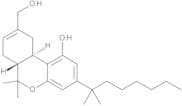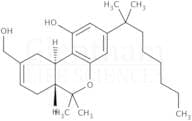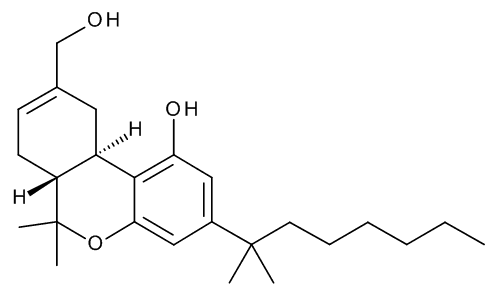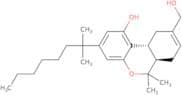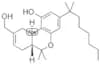
CAS 112830-95-2
:HU-210
Beschreibung:
HU-210 ist ein synthetisches Cannabinoid, das strukturell mit THC, dem aktiven Bestandteil von Cannabis, verwandt ist. Es ist bekannt für seine hohe Potenz und Affinität zu Cannabinoid-Rezeptoren, insbesondere CB1 und CB2, die Teil des Endocannabinoid-Systems im menschlichen Körper sind. Diese Verbindung zeichnet sich durch ihre Fähigkeit aus, ähnliche Wirkungen wie natürliche Cannabinoide hervorzurufen, einschließlich Analgesie, Appetitsteigerung und Veränderungen der Stimmung und Wahrnehmung. Aufgrund seiner Potenz wurde HU-210 auf seine potenziellen therapeutischen Anwendungen untersucht, wirft jedoch auch Bedenken hinsichtlich der Sicherheit und des Missbrauchspotenzials auf. Als Forschungschemikalie ist es nicht für den medizinischen Gebrauch zugelassen und wird oft mit rechtlichen und regulatorischen Herausforderungen in Verbindung gebracht. Seine Stabilität und Löslichkeit in organischen Lösungsmitteln machen es für Laborstudien geeignet, aber der Mangel an umfassenden Studien am Menschen schränkt das Verständnis seiner langfristigen Wirkungen und Sicherheitsprofile ein. Insgesamt veranschaulicht HU-210 die Komplexität synthetischer Cannabinoide und deren Auswirkungen sowohl auf die Forschung als auch auf die öffentliche Gesundheit.
Formel:C25H38O3
InChl:InChI=1S/C25H38O3/c1-6-7-8-9-12-24(2,3)18-14-21(27)23-19-13-17(16-26)10-11-20(19)25(4,5)28-22(23)15-18/h10,14-15,19-20,26-27H,6-9,11-13,16H2,1-5H3/t19-,20-/m1/s1
InChI Key:InChIKey=SSQJFGMEZBFMNV-WOJBJXKFSA-N
SMILES:OC1=C2[C@]3([C@](C(C)(C)OC2=CC(C(CCCCCC)(C)C)=C1)(CC=C(CO)C3)[H])[H]
Synonyme:- (6AR,10aR)-3-(1,1-Dimethylheptyl)-6a,7,10,10a-tetrahydro-1-hydroxy-6,6-dimethyl-6H-dibenzo[b,d]pyran-9-methanol
- (6aR)-trans-3-(1,1-Dimethylheptyl)-6a,7,10,10a-tetrahydro-1-hydroxy-6,6-dimethyl-(6H)-dibenzo[b.d]pyran-9-methanol
- (6aR,10aR)-9-(hydroxymethyl)-6,6-dimethyl-3-(2-methyloctan-2-yl)-6a,7,10,10a-tetrahydro-6H-benzo[c]chromen-1-ol
- (6aS,10aS)-3-(1,1-dimethylheptyl)-9-(hydroxymethyl)-6,6-dimethyl-6a,7,8,10a-tetrahydrobenzo[c]isochromen-1-ol
- 6H-Dibenzo[b,d]pyran-9-methanol, 3-(1,1-dimethylheptyl)-6a,7,10,10a-tetrahydro-1-hydroxy-6,6-dimethyl-, (6aR,10aR)-
- 6H-Dibenzo[b,d]pyran-9-methanol, 3-(1,1-dimethylheptyl)-6a,7,10,10a-tetrahydro-1-hydroxy-6,6-dimethyl-, (6aR-trans)-
- HU-210 DEA Schedule I
- HU 210
- (-)-HU-210
- HU-210/112830-95-2
- HU-210 (exempt preparation)
- (-)-11-OH-Δ8-THC-1,1-dimethylheptyl
- HU-210 (solution)
- HU 210 (100μg/mL in Methanol)
- (6aR)-6aβ,7,10,10aα-Tetrahydro-6,6-dimethyl-1-hydroxy-3-(1,1-dimethylheptyl)-6H-dibenzo[b,d]pyran-9-methanol
- HU-210 (Spice Cannabinoid)
- (6aR)-6aβ,7,10,10aα-Tetrahydro-1-hydroxy-6,6-dimethyl-3-(1,1-dimethylheptyl)-6H-dibenzo[b,d]pyran-9-methanol
- 11-OH-Δ8-THC-1,1-dimethylheptyl
- Weitere Synonyme anzeigen
Sortieren nach
Reinheit (%)
0
100
|
0
|
50
|
90
|
95
|
100
6 Produkte.
HU 210 (100 μg/ml in Methanol)
CAS:Kontrolliertes ProduktFormel:C25H38O3Farbe und Form:Single SolutionMolekulargewicht:386.57HU 210
CAS:Kontrolliertes ProduktStability Hygroscopic
Applications A synthetic agonist analog of ∆9-Tetrahydro Cannabinol (T293200), which is the primary psychoactive component of marijuana. HU-210 is a potent central cannabinoid (CB1) and peripheral cannabinoid (CB2) receptor agonist. It binds to neuroblastoma cell membrane CB1 receptors with about the same affinity as CP-55940. Synthetic cannabinoidsControlled Substance.
References Slipetz, D.M. et al.: Mol. Pharmacol., 48, 352 (1995); Bertalovitz, A.C. et al.: Drug Dev. Res., 71, 404 (2010); Howlett, A.C. et al.: Curr. Pharm. Des., 1, 343 (1995);Formel:C25H38O3Farbe und Form:Light YellowMolekulargewicht:386.57HU 210
CAS:Kontrolliertes ProduktHU-210 is a synthetic cannabinoid receptor agonist with a strong affinity for the CB1 and CB2 receptor (Ki = 0.061 and 0.52 nM, respectively)1. In vitro, it has been shown to promote proliferation of embryonic neural stem cells in the hippocampus through the activation of Gi/o proteins and ERK signaling2. In vivo, it has been associated with counteracting amyloid beta-dependent inflammation in Alzheimer’s disease as well as preventing neuronal loss and cognitive decay. In vivo effects are thought to be mediated by CB1 and CB2 receptors mediated activation of microglia-secreted TNFα and other inflammatory markers3.Formel:C25H38O3Reinheit:Min. 95%Molekulargewicht:386.57 g/mol