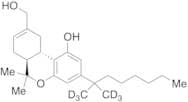
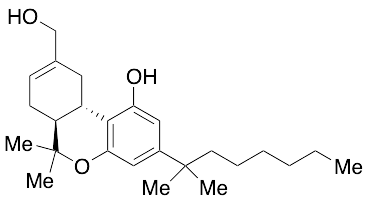
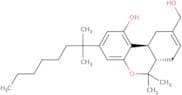
CAS 112924-45-5
:1,1-Dimethylheptyl-11-hydroxytetrahydrocannabinol
Beschreibung:
1,1-Dimethylheptyl-11-hydroxytetrahydrocannabinol, allgemein als synthetisches Cannabinoid bezeichnet, ist eine Verbindung, die die Wirkungen von natürlichen Cannabinoiden nachahmt, die in der Cannabispflanze vorkommen. Diese Substanz zeichnet sich durch ihre komplexe molekulare Struktur aus, die ein modifiziertes Tetrahydrocannabinol (THC)-Gerüst mit einer Dimethylheptyl-Seitenkette und einer Hydroxylgruppe an der Position 11 umfasst. Ihre chemische Formel trägt zu ihrer Lipophilie bei, was es ihr ermöglicht, effektiv mit Cannabinoid-Rezeptoren im Körper zu interagieren, insbesondere mit den Rezeptoren CB1 und CB2, die an verschiedenen physiologischen Prozessen wie Schmerzempfindung, Stimmungskontrolle und Appetitregulation beteiligt sind. Die Verbindung wird typischerweise auf ihre potenziellen therapeutischen Wirkungen untersucht, einschließlich schmerzlindernder und entzündungshemmender Eigenschaften, kann jedoch auch psychoaktive Wirkungen ähnlich denen von THC aufweisen. Aufgrund ihrer synthetischen Natur kann sie unterschiedliche pharmakokinetische und pharmakodynamische Profile im Vergleich zu natürlichen Cannabinoiden aufweisen, was Bedenken hinsichtlich Sicherheit, Legalität und Missbrauchspotenzial aufwirft.
Formel:C25H38O3
InChl:InChI=1/C25H38O3/c1-6-7-8-9-12-24(2,3)18-14-21(27)23-19-13-17(16-26)10-11-20(19)25(4,5)28-22(23)15-18/h10,14-15,19-20,26-27H,6-9,11-13,16H2,1-5H3/t19-,20-/m0/s1
InChI Key:InChIKey=SSQJFGMEZBFMNV-PMACEKPBSA-N
SMILES:OC1=C2[C@@]3([C@@](C(C)(C)OC2=CC(C(CCCCCC)(C)C)=C1)(CC=C(CO)C3)[H])[H]
Synonyme:- (+)-Hu-210
- (6aS,10aS)-3-(1,1-Dimethylheptyl)-6a,7,10,10a-tetrahydro-1-hydroxy-6,6-dimethyl-6H-dibenzo[b,d]pyran-9-methanol
- (6aS,10aS)-9-(hydroxymethyl)-6,6-dimethyl-3-(2-methyloctan-2-yl)-6a,7,10,10a-tetrahydro-6H-benzo[c]chromen-1-ol
- 6H-Dibenzo[b,d]pyran-9-methanol, 3-(1,1-dimethylheptyl)-6a,7,10,10a-tetrahydro-1-hydroxy-6,6-dimethyl-, (6aS,10aS)-
- 6H-Dibenzo[b,d]pyran-9-methanol, 3-(1,1-dimethylheptyl)-6a,7,10,10a-tetrahydro-1-hydroxy-6,6-dimethyl-, (6aS-trans)-
- Dexanabinol
- Hu 211
- Prs 211007-000
- Sinnabidiol
- 1,1-Dimethylheptyl-11-hydroxytetrahydrocannabinol
- [6aS,(+)]-6a,7,10,10aβ-Tetrahydro-1-hydroxy-6,6-dimethyl-3-(1,1-dimethylheptyl)-6H-dibenzo[b,d]pyran-9-methanol
- (6aS,10aS)-3-(1,1-Dimethylheptyl)-6a,77,10,10a-tetrahydro-1-hydroxy-6,6-dimethyl-6H-dibenzo[b,d]pyran-9-methanol
- (6AR)-TRANS-3-(1,1-DIMETHYLHEPTYL)-6A,7,10,10A-TETRAHYDRO-1-HYDROXY-6,6-DIMETHYL-6H-DIBENZO[B,D]PYRAN-9-METHANOL
- (6AR,10AR)-3-(1,1'-DIMETHYLHEPTYL)-6A,7,10,10A-TETRAHYDRO-1-HYDROXY-6,6-DIMETHYL-6H-DIBENZO[B,D]PYRAN-9-METHANOL
- (6aS,10aS)-9-(hydroxymethyl)-6,6-dimethyl-3-(2-methyloctan-2-yl)-6a,7,10,10a-tetrahydrobenzo[c]chromen-1-ol
- (6aS,10aS)-3-(1,1-dimethylheptyl)-6,6-dimethyl-9-methylol-6a,7,10,10a-tetrahydrobenzo[c]chromen-1-ol
- (6aS)-6aα,7,10,10aβ-Tetrahydro-6,6-dimethyl-1-hydroxy-3-(1,1-dimethylheptyl)-6H-dibenzo[b,d]pyran-9-methanol
- Weitere Synonyme anzeigen
Sortieren nach
Reinheit (%)
0
100
|
0
|
50
|
90
|
95
|
100
3 Produkte.
HU 211
CAS:Kontrolliertes ProduktApplications HU-211 is a synthetic cannabinoid derivative that inhibits TNFα and interleukin-6 (1,2,3). HU-211 exhibits neuroprotective, antioxidant, and anti-inflammatory properties. It might be a useful agent for the treatment of stroke patients, by protecting neuronal lysosomes from nitric oxide (NO)-mediated toxicity.
References (1) Shohami, E., et al.: J. Neuroimmunol., 72, 169 (1997)(2) Ramazan, D., et al.: Neuochemical Res., 33, 1683 (2008) (3) Leker, R., et al.: J. Neurol. Sci., 162, 114 (1999)Formel:C25H38O3Farbe und Form:NeatMolekulargewicht:386.57HU 211
CAS:Kontrolliertes ProduktHU 211 is a novel synthetic cannabinoid that has been shown to have a number of pharmacological activities. It has been shown to induce neuronal death by causing mitochondrial membrane potential depolarization, which leads to the release of cytochrome c and other apoptotic factors from the mitochondria. HU 211 has also been shown to inhibit tumor growth in animal models when administered alone or in combination with cytotoxic agents like paclitaxel. The synergistic effect between HU 211 and paclitaxel is due to their ability to decrease the expression of anti-apoptotic molecules. HU 211 also inhibits transcriptional regulation, leading to inhibition of protein synthesis and cell proliferation. HU 211's antitumor activity has been demonstrated in animal models for breast, colon, lung, liver, and prostate cancers as well as bowel disease (including colitis), Parkinson's disease, and dopamine-related disorders.Formel:C25H38O3Reinheit:Min. 95%Molekulargewicht:386.57 g/mol