CAS 113-59-7
:Chlorprothixen
Beschreibung:
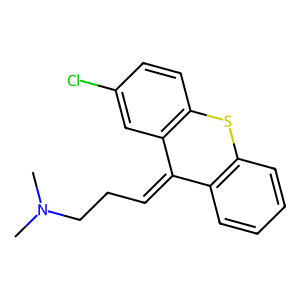
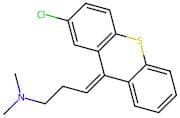
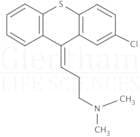
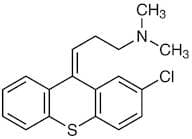
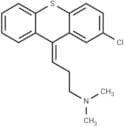
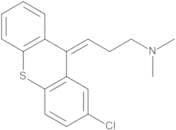
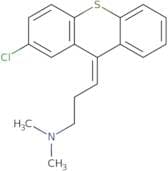
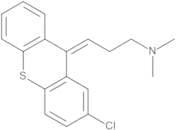
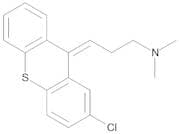
Chlorprothixen ist ein antipsychotisches Medikament, das hauptsächlich zur Behandlung von Schizophrenie und anderen psychotischen Störungen eingesetzt wird. Es gehört zur Klasse der Thioxanthene und weist sowohl antipsychotische als auch sedierende Eigenschaften auf. Die chemische Struktur von Chlorprothixen umfasst einen Thioxanthenkern, der durch ein verschmolzenes Ringsystem mit Schwefel- und Stickstoffatomen gekennzeichnet ist. Diese Verbindung wirkt hauptsächlich als Dopaminantagonist und beeinflusst die Neurotransmitteraktivität im Gehirn, insbesondere die Dopaminrezeptoren, die für ihre therapeutischen Wirkungen entscheidend sind. Chlorprothixen wird typischerweise oral verabreicht und kann auch als injizierbare Formulierung erhältlich sein. Seine Pharmakokinetik umfasst den Metabolismus in der Leber, mit einer relativ langen Halbwertszeit, die in vielen Fällen eine einmal tägliche Dosierung ermöglicht. Zu den häufigen Nebenwirkungen können Sedierung, Gewichtszunahme und extrapyramidale Symptome gehören, die typisch für viele antipsychotische Medikamente sind. Aufgrund seiner sedierenden Wirkungen wird Vorsicht beim Bedienen von Maschinen oder beim Fahren während der Einnahme dieses Medikaments empfohlen. Insgesamt ist Chlorprothixen eine wichtige Option im pharmakologischen Management schwerer psychischer Erkrankungen.
Formel:C18H18ClNS
InChl:InChI=1S/C18H18ClNS/c1-20(2)11-5-7-14-15-6-3-4-8-17(15)21-18-10-9-13(19)12-16(14)18/h3-4,6-10,12H,5,11H2,1-2H3/b14-7-
InChI Key:InChIKey=WSPOMRSOLSGNFJ-AUWJEWJLSA-N
SMILES:C(\CCN(C)C)=C/1\C=2C(SC=3C1=CC=CC3)=CC=C(Cl)C2
Synonyme:- (3E)-3-(2-chloro-9H-thioxanthen-9-ylidene)-N,N-dimethylpropan-1-aminium chloride
- (3Z)-3-(2-Chloro-9H-thioxanthen-9-ylidene)-N,N-dimethyl-1-propanamine
- (3Z)-3-(2-chloro-9H-thioxanthen-9-ylidene)-N,N-dimethylpropan-1-amine
- (Z)-3-(2-Chloro-9H-thioxanthen-9-ylidene)-N,N-dimethyl-1-propanamine
- 1-Propanamine, 3-(2-chloro-9H-thioxanthen-9-ylidene)-N,N-dimethyl-, (3Z)-
- 1-Propanamine, 3-(2-chloro-9H-thioxanthen-9-ylidene)-N,N-dimethyl-, (Z)-
- 2-Chloro-3-(Dibenzo(B,E)Thiin-10-Ylidene)Propyldimethylamine
- 9H-Thioxanthene, 1-propanamine deriv.
- CPT
- CPX
- Chlorprothixen
- Chlorprotixen
- Chlorprotixene
- Chlothixen
- Chorprothixene
- Clorprotixeno
- Cloxan
- Iaractan
- Mk 184
- N 714
- Paxyl
- Rentovet
- Ro 4-0403
- Ro 4-04033
- Tactaran
- Taractan
- Tarasan
- Tardan
- Thioxanthene-Δ9,γ-propylamine, 2-chloro-N,N-dimethyl-, (Z)-
- Thioxanthene-Δ<sup>9,γ</sup>-propylamine, 2-chloro-N,N-dimethyl-, (Z)-
- Traquilan
- Trictal
- Truxal
- Truxaletten
- Truxil
- Vetacalm
- cis-Chlorprothixene
- Weitere Synonyme anzeigen
Sortieren nach
Reinheit (%)
0
100
|
0
|
50
|
90
|
95
|
100
12 Produkte.
{3-[(9Z)-2-chloro-9H-thioxanthen-9-ylidene]propyl}dimethylamine
CAS:Formel:C18H18ClNSReinheit:98%Farbe und Form:SolidMolekulargewicht:315.8602Chlorprothixene 100 µg/mL in Acetonitrile
CAS:Formel:C18H18ClNSFarbe und Form:Single SolutionMolekulargewicht:315.86Chlorprothixene
CAS:Formel:C18H18ClNSReinheit:>98.0%(T)Farbe und Form:White to Orange to Green powder to crystalMolekulargewicht:315.86Chlorprothixene
CAS:Chlorprothixene (Truxal) is a typical antipsychotic drug of the thioxanthene class, which was the first of the series to be synthesized.Formel:C18H18ClNSReinheit:98.77% - 99.756%Farbe und Form:Pale Yellow Crystals SolidMolekulargewicht:315.86Chlorprothixene
CAS:Applications Chlorprothixene
Not a dangerous good if item is equal to or less than 1g/ml and there is less than 100g/ml in the packageFormel:C18H18ClNSFarbe und Form:White To Light YellowMolekulargewicht:315.86Chlorprothixene
CAS:Kontrolliertes ProduktChlorprothixene is a derivative of fluorescein and has been used in the treatment of bone cancer. The reaction mechanism of chlorprothixene is not well understood, but it is believed to be due to its ability to bind with 5-HT2 receptors. Chlorprothixene also has anti-inflammatory properties, which may be due to the inhibition of nitrogen atoms in immune cells. This drug has low potency and can cause drug interactions with other drugs that are metabolized by enzymes in the liver such as cytochrome P450 enzymes. It also has a trifluoroacetic acid substituent, which can cause significant pharmacokinetic changes when given intravenously.Formel:C18H18ClNSReinheit:Min. 95%Farbe und Form:PowderMolekulargewicht:315.86 g/molChlorprothixene
CAS:Kontrolliertes ProduktFormel:C18H18ClNSFarbe und Form:NeatMolekulargewicht:315.86

![{3-[(9Z)-2-chloro-9H-thioxanthen-9-ylidene]propyl}dimethylamine](/_next/image/?url=https%3A%2Fstatic.cymitquimica.com%2Fproducts%2FIN%2Fthumb%2FDA00785B.jpg&w=3840&q=75)