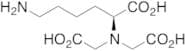
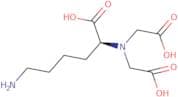
CAS 113231-05-3
:(S)-N-(5-Amino-1-carboxypentyl)iminodiessigsäurehydrat
Beschreibung:
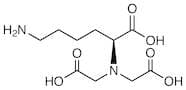
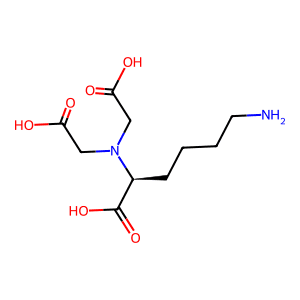
(S)-N-(5-Amino-1-carboxypentyl)iminodiessigsäurehydrat, allgemein als Chelatbildner bezeichnet, zeichnet sich durch seine Fähigkeit aus, stabile Komplexe mit Metallionen zu bilden, was in verschiedenen biochemischen Anwendungen besonders nützlich ist. Diese Verbindung weist ein chirales Zentrum auf, was darauf hinweist, dass sie in zwei enantiomeren Formen existiert, wobei die (S)-Konfiguration biologisch relevant ist. Das Vorhandensein von Amino- und Carboxylgruppen trägt zu ihrer Löslichkeit in Wasser und ihrem Potenzial als Ligand in der Koordinationschemie bei. Die Iminogruppe verbessert ihre chelatbildenden Eigenschaften, sodass sie effektiv an divalente und trivalente Metallionen binden kann, was in Bereichen wie Medizin, Landwirtschaft und Umweltwissenschaften von Wert ist. Darüber hinaus zeigt die hydratisierte Form, dass sie Wassermoleküle enthält, die ihre Stabilität und Reaktivität beeinflussen können. Insgesamt ist diese Verbindung in der Forschung und in industriellen Anwendungen von Bedeutung, in denen die Sequestrierung von Metallionen erforderlich ist.
Formel:C10H18N2O6
InChl:InChI=1S/C10H18N2O6/c11-4-2-1-3-7(10(17)18)12(5-8(13)14)6-9(15)16/h7H,1-6,11H2,(H,13,14)(H,15,16)(H,17,18)/t7-/m0/s1
InChI Key:InChIKey=SYFQYGMJENQVQT-ZETCQYMHSA-N
SMILES:N([C@@H](CCCCN)C(O)=O)(CC(O)=O)CC(O)=O
Synonyme:- (S)-2,2′-((5-Amino-1-carboxypentyl)azanediyl)diacetic acid
- (S)-N-(5-Amino-1-Carboxypentyl)Iminodiacetic Acid
- 13: PN: US20080160089 PAGE: 30 claimed protein
- 1: PN: US20050123932 PAGE: 1 claimed protein
- 4: PN: WO2004072260 PAGE: 12 claimed protein
- 53: PN: WO2004025259 PAGE: 47 claimed protein
- <span class="text-smallcaps">L</span>-Lysine, N<sup>2</sup>,N<sup>2</sup>-bis(carboxymethyl)-
- Ab-Nta
- Lysine-N,N-diacetic acid
- N-(5-Amino-1-carboxypentyl)iminodiacetic acid
- N-Alpha,N-Alpha-Bis(Carboxymethyl)-L-Lysine Hydrate
- N2,N2-bis(carboxymethyl)-L-Lysine
- N<sup>2</sup>,N<sup>2</sup>-Bis(carboxymethyl)-<span class="text-smallcaps">L</span>-lysine
- N~2~,N~2~-bis(carboxymethyl)-D-lysine
- Nα,Nα-Bis(Carboxymethyl)-L-Lysine Hydrate
- Weitere Synonyme anzeigen
Sortieren nach
Reinheit (%)
0
100
|
0
|
50
|
90
|
95
|
100
8 Produkte.
N2,N2-Bis(carboxymethyl)-L-lysine
CAS:Formel:C10H18N2O6Reinheit:>95.0%(T)Farbe und Form:White to Almost white powder to crystalMolekulargewicht:262.26(S)-N-(5-AMINO-1-CARBOXYPENTYL)IMINODIACETIC ACID HYDRATE
CAS:Formel:C10H18N2O6Reinheit:97%Farbe und Form:SolidMolekulargewicht:262.2597(5S)-N-(5-Amino-1-carboxypentyl)iminodiacetic acid
CAS:(5S)-N-(5-Amino-1-carboxypentyl)iminodiacetic acidReinheit:97%Farbe und Form:White To Off White SolidMolekulargewicht:262.26g/mol(5S)-N-(5-Amino-1-carboxypentyl)iminodiacetic acid
CAS:Reinheit:≥ 97.0%Farbe und Form:White to off-white crystalline powderMolekulargewicht:262.26Lysine-N,N-diacetic acid
CAS:Lysine-N,N-diacetic acid (BCML) is a highly efficient TAS2R4 inhibitor, blocking the human TAS2R4-mediated response to quinine.Formel:C10H18N2O6Reinheit:99.76%Farbe und Form:SolidMolekulargewicht:262.26(5S)-N-(5-Amino-1-carboxypentyl)iminodiacetic Acid
CAS:Kontrolliertes ProduktApplications A nitrilotriacetic acid derivative used as a metal chelating adsorbent for metal ion affinity chromatography. This method can be used for identification and rapid one-step purification of gene products expressed as fusion proteins with an oligo-histidine tag. The oligo-histidine tag serves as a high affinity binding sequence for the purification of fusion proteins via a metal chelating absorbent such as N-(5-Amino-1-carboxypentyl)iminodiacetic acid.Also soluble in DMSO:DMF 1:1 and DMSO:CH2Cl2 1:2
References Hochuli, E., et al.: J. Chromatography, 411, 177 (1987), Meredith, G.D., et al.: Bioconjugate Chem., 15, 969 (2004)Formel:C10H18N2O6·H2OFarbe und Form:NeatMolekulargewicht:280.28Nalpha,Nalpha-Bis-(carboxymethyl)-L-lysine
CAS:Nalpha,Nalpha-Bis-(carboxymethyl)-L-lysine is a synthetic amino acid that has been used to immobilize proteins and enzymes. It can be used as an inhibitor in cell culture because it binds to the ryanodine receptor, which regulates calcium release from the sarcoplasmic reticulum. This amino acid has also been shown to inhibit kinesin, a protein involved in the movement of organelles along microtubules. In addition, Nalpha,Nalpha-Bis-(carboxymethyl)-L-lysine has been found to be effective against colony-stimulating factor (CSF) and may serve as a model system for enzymatic reactions.Formel:C10H18N2O6Reinheit:Area-% Max. 95 Area-%Farbe und Form:White Off-White PowderMolekulargewicht:262.26 g/mol(S)-2,2′-((5-Amino-1-carboxypentyl)azanediyl)diacetic acid
CAS:Formel:C10H18N2O6Reinheit:95%Farbe und Form:SolidMolekulargewicht:262.262