CAS 1137-99-1
:4-((2-Hydroxyethoxy)carbonyl)benzoesäure
Beschreibung:
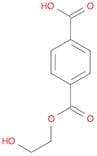
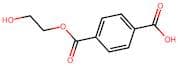
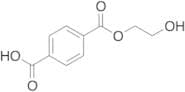
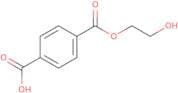
4-((2-Hydroxyethoxy)carbonyl)benzoesäure, auch bekannt unter seiner CAS-Nummer 1137-99-1, ist eine organische Verbindung, die durch ihre benzoesäurehaltige Struktur gekennzeichnet ist, die mit einer Hydroxyethoxycarbonylgruppe an der Para-Position modifiziert ist. Diese Verbindung erscheint typischerweise als weißer bis off-white fester Stoff und ist in polaren Lösungsmitteln löslich, aufgrund der Anwesenheit sowohl von Carbonsäure- als auch von Etherfunktionalgruppen. Ihre molekulare Struktur deutet darauf hin, dass sie potenzielle Anwendungen in der Pharmazie und als Baustein in der organischen Synthese hat. Die Hydroxyethoxygruppe kann zusätzliche Eigenschaften verleihen, wie eine erhöhte Hydrophilie, die ihre Reaktivität und Interaktion mit biologischen Systemen beeinflussen kann. Die Säure des Verbindungs wird dem Carbonsäuregruppe zugeschrieben, die an Wasserstoffbrückenbindungen teilnehmen und ihre Löslichkeit und Stabilität in verschiedenen Umgebungen beeinflussen kann. Insgesamt ist 4-((2-Hydroxyethoxy)carbonyl)benzoesäure eine vielseitige Verbindung mit potenzieller Nützlichkeit in verschiedenen chemischen und industriellen Anwendungen.
Formel:C10H9O5
InChl:InChI=1S/C10H10O5/c11-5-6-15-10(14)8-3-1-7(2-4-8)9(12)13/h1-4,11H,5-6H2,(H,12,13)
InChI Key:InChIKey=BCBHDSLDGBIFIX-UHFFFAOYSA-N
SMILES:C(OCCO)(=O)C1=CC=C(C(O)=O)C=C1
Synonyme:- 1,4-Benzenedicarboxylic acid, 1-(2-hydroxyethyl) ester
- 1,4-Benzenedicarboxylic acid, mono(2-hydroxyethyl) ester
- 1-(2-Hydroxyethyl) 1,4-benzenedicarboxylate
- 2-Hydroxyethyl hydrogen terephthalate
- 2-Hydroxyethyl terephthalate
- Ethylene glycol terephthalate (1:1)
- Ethylene glycol, hydrogen terephthalate (1:1)
- Ethylene glycol, mono(hydrogen terephthalate)
- Ethylene glycol-terephthalic acid monoester
- Hydrogen 2-hydroxyethyl terephthalate
- Mono(2-hydroxyethyl) terephthalate
- Mono(β-hydroxyethyl) terephthalate
- Terephthalic acid ethylene glycol monoester
- Terephthalic acid, 2-hydroxyethyl ester
- Terephthalic acid, mono(2-hydroxyethyl) ester
- Weitere Synonyme anzeigen
Sortieren nach
Reinheit (%)
0
100
|
0
|
50
|
90
|
95
|
100
5 Produkte.
4-((2-Hydroxyethoxy)carbonyl)benzoic acid
CAS:Formel:C10H10O5Reinheit:95%Farbe und Form:SolidMolekulargewicht:210.18344-((2-Hydroxyethoxy)Carbonyl)Benzoic Acid
CAS:4-((2-Hydroxyethoxy)Carbonyl)Benzoic AcidReinheit:95%Molekulargewicht:210.18g/mol1-(2-Hydroxyethyl) Ester, 1,4-Benzenedicarboxylic Acid
CAS:Applications 1-(2-Hydroxyethyl) Ester, 1,4-Benzenedicarboxylic Acid could be used to condition bacteria to enable it to target polymer polyethylene terephthalate (PET).
References Kumar, V., et al.: J. Environ. Chem. Eng., 8, 103977 (2020);Formel:C10H10O5Farbe und Form:NeatMolekulargewicht:210.1834-(2-Hydroxyethoxycarbonyl)benzoate
CAS:4-(2-Hydroxyethoxycarbonyl)benzoate (4HB) is a monomer of poly(4HB). It is used as a biodegradable polymer for the synthesis of hydrogels. 4HB is synthesized from the corresponding dicarboxylic acid, which contains two or more carboxyl groups. The synthesis of 4HB involves esterification with 2-hydroxyethanol and subsequent alkali hydrolysis to remove water. The product is purified by precipitation with ethanol, filtration, and vacuum drying. 4HB has been used as a substrate in biological treatment processes such as anaerobic digestion and aerobic composting. 4HB can be used as a functional group that can react at various temperatures, making it suitable for thermophilic organisms like Thermus aquaticus. The phylogenetic tree of the enzyme β-galactosidase reveals that the enzyme evolved from a common ancestor shared with LacB (β-Formel:C10H10O5Reinheit:Area-% Min. 95 Area-%Farbe und Form:White Off-White PowderMolekulargewicht:210.18 g/mol4-((2-Hydroxyethoxy)carbonyl)benzoic acid
CAS:Reinheit:95%Farbe und Form:SolidMolekulargewicht:210.1849976