CAS 114-25-0
:Biliverdin
Beschreibung:
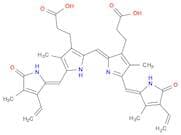
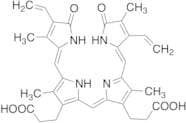
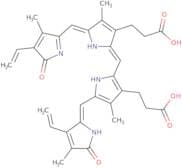
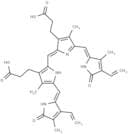
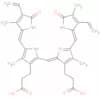
Biliverdin ist ein grünes Tetrapyrrol-Gallensäurepigment, das ein Produkt des Hämabbaus ist, das hauptsächlich aus dem Abbau von Hämoglobin entsteht. Es zeichnet sich durch seine grüne Farbe aus, die auf sein konjugiertes Doppelbindungssystem zurückzuführen ist, das ihm ermöglicht, Licht im sichtbaren Spektrum zu absorbieren. Biliverdin ist wasserlöslich und hat eine chemische Formel von C33H34N4O6, mit einem Molekulargewicht von etwa 582,6 g/mol. Es spielt eine bedeutende Rolle in verschiedenen biologischen Prozessen, einschließlich der Funktion als Antioxidans und der Teilnahme an der Regulierung zellulärer Funktionen. Biliverdin ist auch ein Vorläufer von Bilirubin, einem weiteren wichtigen Gallensäurepigment. In Bezug auf die Stabilität kann Biliverdin licht- und pH-sensitiv sein, was seine Struktur und Reaktivität beeinflussen kann. Sein Vorhandensein in biologischen Systemen wird oft mit der Leberfunktion in Verbindung gebracht und kann auf bestimmte medizinische Zustände hinweisen, wenn es in abnormalen Konzentrationen gefunden wird. Insgesamt ist Biliverdin eine wichtige Verbindung in der Biochemie und Medizin, die die komplexen Prozesse des Hämstoffwechsels widerspiegelt.
Formel:C33H34N4O6
InChl:InChI=1/C33H34N4O6/c1-7-20-19(6)32(42)37-27(20)14-25-18(5)23(10-12-31(40)41)29(35-25)15-28-22(9-11-30(38)39)17(4)24(34-28)13-26-16(3)21(8-2)33(43)36-26/h7-8,13-15,35H,1-2,9-12H2,3-6H3,(H,36,43)(H,37,42)(H,38,39)(H,40,41)/b26-13-,27-14-,28-15-
InChI Key:InChIKey=QBUVFDKTZJNUPP-BBROENKCSA-N
SMILES:C(\C1=C(CCC(O)=O)C(C)=C(/C=C\2/C(C=C)=C(C)C(=O)N2)N1)=C3/C(CCC(O)=O)=C(C)C(/C=C\4/C(C)=C(C=C)C(=O)N4)=N3
Synonyme:- 21H-Biline-8,12-dipropanoic acid, 3,18-diethenyl-1,19,22,24-tetrahydro-2,7,13,17-tetramethyl-1,19-dioxo-
- 3,18-Diethenyl-1,19,22,24-tetrahydro-2,7,13,17-tetramethyl-1,19-dioxo-21H-biline-8,12-dipropanoic acid
- 3-[(2Z)-2-[[3-(2-carboxyethyl)-4-methyl-5-[(Z)-(4-methyl-5-oxo-3-vinyl-pyrrol-2-ylidene)methyl]-1H-pyrrol-2-yl]methylene]-4-methyl-5-[(Z)-(3-methyl-5-oxo-4-vinyl-pyrrol-2-ylidene)methyl]pyrrol-3-yl]propanoic acid
- 3-[2-[(E)-[(5E)-3-(2-carboxyethyl)-4-methyl-5-[(3-methyl-5-oxo-4-vinyl-pyrrol-2-yl)methylene]pyrrol-2-ylidene]methyl]-4-methyl-5-[(E)-(4-methyl-5-oxo-3-vinyl-pyrrol-2-ylidene)methyl]-1H-pyrrol-3-yl]propanoic acid
- 3-[2-[(Z)-[(5E)-3-(2-carboxyethyl)-4-methyl-5-[(3-methyl-5-oxo-4-vinyl-pyrrol-2-yl)methylene]pyrrol-2-ylidene]methyl]-4-methyl-5-[(Z)-(4-methyl-5-oxo-3-vinyl-pyrrol-2-ylidene)methyl]-1H-pyrrol-3-yl]propanoic acid
- 3-[2-[(Z)-[(5Z)-3-(2-carboxyethyl)-4-methyl-5-[(3-methyl-5-oxo-4-vinyl-pyrrol-2-yl)methylene]pyrrol-2-ylidene]methyl]-4-methyl-5-[(Z)-(4-methyl-5-oxo-3-vinyl-pyrrol-2-ylidene)methyl]-1H-pyrrol-3-yl]propanoic acid
- 3-[2-[[3-(2-carboxyethyl)-4-methyl-5-[(3-methyl-5-oxo-4-vinyl-pyrrol-2-yl)methylene]pyrrol-2-ylidene]methyl]-4-methyl-5-[(4-methyl-5-oxo-3-vinyl-pyrrol-2-ylidene)methyl]-1H-pyrrol-3-yl]propanoic acid
- Biline-8,12-dipropionic acid, 1,19,22,24-tetrahydro-2,7,13,17-tetramethyl-1,19-dioxo-3,18-divinyl-
- Biline-8,12-dipropionic acid, 1,19,22,24-tetrahydro-2,7,13,17-tetramethyl-1,19-dioxo-3,18-divinyl- (8CI)
- Biliverdin IXalpha
- Biliverdin IXα
- Biliverdina
- Biliverdine
- Biliverdine (VAN)
- Biliverdine dihydrochloride
- Dehydrobilirubin
- Nsc 62793
- Oocyan
- Protobiliverdin IXα
- Pyrrole-3-propionic acid, 2-[[3-(2-carboxyethyl)-4-methyl-5-[(3-methyl-5-oxo-4-vinyl-3-pyrrolin-2-ylidene)methyl]-2H-pyrrol-2-ylidene]methyl]-4-methyl-5-[(4-methyl-5-oxo-3-vinyl-3-pyrrolin-2-ylidene)methyl]-
- Uteroverdine
- α-Biliverdin
- Biliverdin
- 3-[2-[(Z)-[(5E)-3-(2-carboxyethyl)-5-[(4-ethenyl-3-methyl-5-oxo-pyrrol-2-yl)methylidene]-4-methyl-pyrrol-2-ylidene]methyl]-5-[(Z)-(3-ethenyl-4-methyl-5-oxo-pyrrol-2-ylidene)methyl]-4-methyl-1H-pyrrol-3-yl]propanoic acid
- 3-[2-[(E)-[(5E)-3-(2-carboxyethyl)-5-[(4-ethenyl-3-methyl-5-oxo-pyrrol-2-yl)methylidene]-4-methyl-pyrrol-2-ylidene]methyl]-5-[(E)-(3-ethenyl-4-methyl-5-oxo-pyrrol-2-ylidene)methyl]-4-methyl-1H-pyrrol-3-yl]propanoic acid
- ocyan
- 3,18-Diethenyl-1,19,22,24-tetrahydro-2,7,13,17-tetrametyl-1,19-dioxo-21H-biline-8,12-dipropanoic Acid
- Weitere Synonyme anzeigen
Sortieren nach
Reinheit (%)
0
100
|
0
|
50
|
90
|
95
|
100
5 Produkte.
3,18-Diethenyl-1,19,22,24-tetrahydro-2,7,13,17-tetramethyl-1,19-dioxo-21H-biline-8,12-dipropanoic acid
CAS:Formel:C33H34N4O6Reinheit:70%Farbe und Form:SolidMolekulargewicht:582.6463Biliverdine
CAS:Stability Light Sensitive
Applications Biliverdine is a precursor of Bilirubin. Biliverdine is formed in the body from hemoglobin. The bile of amphibians and of birds contains Biliverdine only. It is also an inhibitor for hepatitis C virus.
References Lemberg et al.: Biochem. J., 35, 363 (1941); Gutierrez-Grobe, Y. et al.: Annals. Hepatol., 10, 105 (2011);Formel:C33H34N4O6Farbe und Form:Dark Green To BlackMolekulargewicht:582.65Biliverdine-d4 (Major, may contain up to 3% d0) (Technical Grade)
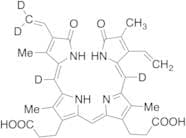
CAS:Kontrolliertes ProduktApplications Labelled Biliverdine is a precursor of Bilirubin. Biliverdine is formed in the body from hemoglobin. The bile of amphibians and of birds contains Biliverdine only. It is also an inhibitor for hepatitis C virus.
References Lemberg et al.: Biochem. J., 35, 363 (1941); Gutierrez-Grobe, Y. et al.: Annals. Hepatol., 10, 105 (2011);Formel:C33H30D4N4O6Reinheit:>90%Farbe und Form:NeatMolekulargewicht:586.67Biliverdine
CAS:Biliverdine is a fluorescent probe that selectively binds to bilirubin and other hydroxycinnamic acids in tissue. Biliverdine can be used to measure the oxidative injury of tissues as well as the activity of enzymes involved in the metabolism of these compounds. The use of biliverdin with other fluorescent probes has been shown to improve the sensitivity and specificity for detecting oxidative injury. Biliverdin has also been shown to have anti-inflammatory properties, which may be due to its ability to inhibit the production of growth factor-β1 and 4-hydroxycinnamic acid.Formel:C33H34N4O6Reinheit:Min. 70 Area-%Farbe und Form:Green PowderMolekulargewicht:582.65 g/molBiliverdin
CAS:Biliverdin, produced through the oxidation of bilirubin, can also be synthesized through a non-protoporphyrin pathway in Corynebacterium glutamicum [1].Formel:C33H34N4O6Farbe und Form:SolidMolekulargewicht:582.65