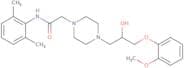
CAS 114246-80-9
:(R)-Ranolazin
Beschreibung:
(R)-Ranolazin ist eine pharmazeutische Verbindung, die hauptsächlich zur Behandlung von chronischer Angina und bestimmten Arten von Herzkrankheiten eingesetzt wird. Es wirkt als antianginales Mittel, indem es den späten Natriumstrom in den Herzmuskelzellen hemmt, was hilft, den myokardialen Sauerstoffverbrauch zu verbessern und ischämische Episoden zu reduzieren. Die Verbindung zeichnet sich durch ihre chirale Natur aus, wobei das (R)-Enantiomer die therapeutisch aktive Form ist. Ranolazin wird typischerweise oral verabreicht und ist bekannt für sein relativ niedriges Nebenwirkungsprofil im Vergleich zu anderen antianginalen Medikamenten. Seine chemische Struktur umfasst einen Piperazinsring und eine Carboxamidgruppe, die zu seinen pharmakologischen Eigenschaften beitragen. Darüber hinaus hat Ranolazin eine moderate Löslichkeit in Wasser und wird hauptsächlich in der Leber metabolisiert, wobei Cytochrom-P450-Enzyme beteiligt sind. Es ist wichtig, potenzielle Arzneimittelwechselwirkungen zu überwachen, insbesondere mit anderen Medikamenten, die den hepatischen Stoffwechsel beeinflussen. Insgesamt stellt (R)-Ranolazin einen bedeutenden Fortschritt im Management von Angina dar und bietet einen alternativen Wirkmechanismus im Vergleich zu traditionellen Therapien.
Formel:C24H33N3O4
Synonyme:- (R)-Ranolazine Q: What is the CAS Number of
- (R)-RanolazineQ: What is
- 1-Piperazineacetamide, N-(2,6-dimethylphenyl)-4-[(2R)-2-hydroxy-3-(2-methoxyphenoxy)propyl]-
- (R)-Ranolazine
Sortieren nach
Reinheit (%)
0
100
|
0
|
50
|
90
|
95
|
100
3 Produkte.
(R)-Ranolazine
CAS:Kontrolliertes ProduktFormel:C24H33N3O4Farbe und Form:NeatMolekulargewicht:427.536(R)-Ranolazine
CAS:<p>(R)-Ranolazine is a potent inhibitor of kinases that has shown promise as an anticancer agent. It has been found to be effective against a variety of tumor cells, including those derived from human urine and Chinese hamster ovaries. (R)-Ranolazine works by inhibiting the activity of protein kinase C, which plays a key role in cancer cell growth and proliferation. This drug has also been shown to induce apoptosis in cancer cells, leading to their death. In addition to its anticancer properties, (R)-Ranolazine has been found to inhibit elastase, an enzyme involved in the breakdown of proteins. This inhibition may have potential therapeutic applications for conditions such as chronic obstructive pulmonary disease (COPD) and other inflammatory diseases. Overall, (R)-Ranolazine is a promising analog with potential therapeutic applications for cancer and other diseases involving abnormal kinase activity or inflammation.</p>Formel:C24H33N3O4Reinheit:Min. 95%Molekulargewicht:427.5 g/mol