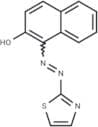
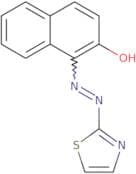
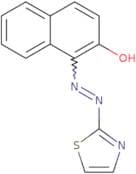
CAS 1147-56-4
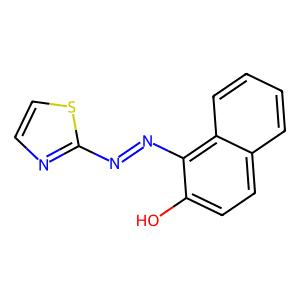
:1-(2-Thiazolylazo)-2-naphthol
Beschreibung:
1-(2-Thiazolylazo)-2-naphthol, allgemein als TANN bezeichnet, ist eine organische Verbindung, die durch ihre Azo- und Thiazol-Funktionalgruppen gekennzeichnet ist. Sie erscheint typischerweise als Feststoff und zeigt oft eine tiefe Farbe aufgrund der Anwesenheit der Azo-Bindung, die für ihre chromophoren Eigenschaften bekannt ist. TANN ist in organischen Lösungsmitteln löslich und hat eine begrenzte Löslichkeit in Wasser, was es in verschiedenen Anwendungen nützlich macht, einschließlich als Farbstoff und Reagenz in der analytischen Chemie. Die Verbindung ist bekannt für ihre Fähigkeit, Chelate mit Metallionen zu bilden, was besonders wertvoll in kolorimetrischen Tests zur Metallnachweis ist. Ihre Stabilität und Reaktivität können durch den pH-Wert und die Anwesenheit anderer Ionen in Lösung beeinflusst werden. Darüber hinaus wurde TANN auf seine potenziellen biologischen Aktivitäten, einschließlich antimikrobieller Eigenschaften, untersucht. Sicherheitsdaten zeigen, dass, wie viele Azo-Verbindungen, es mit Vorsicht behandelt werden sollte, aufgrund potenzieller Toxizität und Umweltbedenken. Insgesamt ist TANN eine vielseitige Verbindung mit bedeutenden Anwendungen sowohl in industriellen als auch in Forschungseinrichtungen.
Formel:C13H9N3OS
InChl:InChI=1S/C13H9N3OS/c17-11-6-5-9-3-1-2-4-10(9)12(11)15-16-13-14-7-8-18-13/h1-8,17H
InChI Key:InChIKey=IOMXCGDXEUDZAK-UHFFFAOYSA-N
SMILES:N(=NC1=NC=CS1)C=2C3=C(C=CC2O)C=CC=C3
Synonyme:- (1Z)-1-(thiazol-2-ylhydrazono)naphthalen-2-one
- (2-Thiazolylazo)-2-naphthol
- 1-(1,3-Thiazolyl-2-azo)-2-naphthol
- 1-(1,3-thiazol-2-ylhydrazono)naphthalen-2(1H)-one
- 1-[2-(2-Thiazolyl)diazenyl]-2-naphthalenol
- 2-Naphthalenol, 1-(2-thiazolylazo)-
- 2-Naphthalenol, 1-[2-(2-thiazolyl)diazenyl]-
- 2-Naphthol, 1-(2-thiazolylazo)-
- NSC 139021
- TAN
- TAN (spectrophotometric reagent)
- β-TAN
- Weitere Synonyme anzeigen
Sortieren nach
Reinheit (%)
0
100
|
0
|
50
|
90
|
95
|
100
8 Produkte.
1-(2-Thiazolylazo)-2-naphthol, 98%
CAS:This Thermo Scientific Chemicals brand product was originally part of the Alfa Aesar product portfolio. Some documentation and label information may refer to the legacy brand. The original Alfa Aesar product / item code or SKU reference has not changed as a part of the brand transition to Thermo SciFormel:C13H9N3OSReinheit:98%Farbe und Form:Red, PowderMolekulargewicht:255.32-Naphthalenol, 1-[2-(2-thiazolyl)diazenyl]-
CAS:Formel:C13H9N3OSReinheit:99%Farbe und Form:SolidMolekulargewicht:255.29511-(2-Thiazolylazo)-2-Naphthol
CAS:1-(2-Thiazolylazo)-2-NaphtholReinheit:99%Molekulargewicht:255.3g/molTAN [=1-(2-Thiazolylazo)-2-naphthol] [Spectrophotometric reagent for transition metals]
CAS:Formel:C13H9N3OSReinheit:>99.0%(T)Farbe und Form:Orange to Brown powder to crystalMolekulargewicht:255.30ERGi-USU
CAS:NSC-139021 (ERGi-USU) is a Rio2 kinase (RIOK2) inhibitor that inhibits ERG protein.Formel:C13H9N3OSReinheit:99.28%Farbe und Form:PowderMolekulargewicht:255.31-(2-Thiazolylazo)-2-naphthol
CAS:1-(2-Thiazolylazo)-2-naphthol is a fluorescent dye that is used in analytical chemistry, cell culture, and flow cytometry. It has been shown to be useful for the detection of cancer cells. The fluorescence of 1-(2-Thiazolylazo)-2-naphthol can also be used to measure the levels of high-sensitivity c-reactive protein (hsCRP) in serum or plasma. This dye has a strong absorption band at 460 nm, which is attributed to its aromatic heterocyclic ring. Hydrogen bonding interactions are the driving force behind this dye's fluorescence.Formel:C13H9N3OSReinheit:Min. 98%Farbe und Form:PowderMolekulargewicht:255.3 g/mol1-(2-Thiazolylazo)-2-naphthol - Bio-X ™
CAS:This product is part of our Bio-X ™ Range. These products are aimed at life science researchers who need high quality ready-to-use products for assay development, screening or other R&D work. With a solubility datasheet and convenient vials, all of our Bio-X ™ products are in stock across our global warehouses for rapid delivery and ease of use.Formel:C13H9N3OSReinheit:Min. 95%Farbe und Form:PowderMolekulargewicht:255.3 g/mol
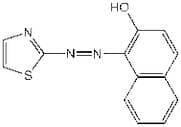

![2-Naphthalenol, 1-[2-(2-thiazolyl)diazenyl]-](/_next/image/?url=https%3A%2Fstatic.cymitquimica.com%2Fproducts%2FIN%2Fthumb%2FDA000F2D.jpg&w=3840&q=75)


![TAN [=1-(2-Thiazolylazo)-2-naphthol] [Spectrophotometric reagent for transition metals]](/_next/image/?url=https%3A%2Fstatic.cymitquimica.com%2Fproducts%2F3B%2Fthumb%2FA5003.jpg&w=3840&q=75)