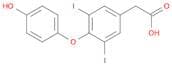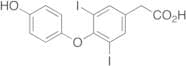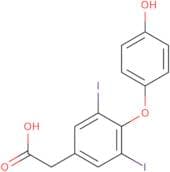
CAS 1155-40-4
:3,5-Diiodthyroessigsäure
- 2-(4-(4-Hydroxyphenoxy)-3,5-diiodophenyl)acetic acid
- 4-(4-Hydroxyphenoxy)-3,5-diiodobenzeneacetic acid
- 4-(4-Hydroxyphenoxy)-3,5-diiodophenylacetic acid
- Acetic acid, [4-(p-hydroxyphenoxy)-3,5-diiodophenyl]-
- Benzeneacetic acid, 4-(4-hydroxyphenoxy)-3,5-diiodo-
- NSC 90463
- Diac
- 3,5-Diiodothyroacetic acid
Diiodothyroacetic acid (4-(4-Hydroxy-phenoxy)-3,5-diiodophenylacetic acid)
CAS:Carboxylic acids with additional oxygen function and their anhydrides, halides, peroxides etc, nesoiFormel:C14H10I2O4Farbe und Form:White SolidMolekulargewicht:495.86685Benzeneacetic acid, 4-(4-hydroxyphenoxy)-3,5-diiodo-
CAS:Formel:C14H10I2O4Reinheit:98%Farbe und Form:SolidMolekulargewicht:496.03573,5-Diiodothyroacetic Acid
CAS:3,5-Diiodothyroacetic acid is a thyroid hormone analog that has been found to reduce cholesterol concentrations and may be used in the study of hypothyroidism.Formel:C14H10I2O4Farbe und Form:SolidMolekulargewicht:496.039Levothyroxine Impurity 11
CAS:Formel:C14H10I2O4Farbe und Form:White To Off-White SolidMolekulargewicht:496.043,5-Diiodo Thyroacetic Acid
CAS:Applications The acetic acid analog of Thyroxine. A potent Thyroxine impurity.
References Horst, C., et al.: Biochem. J., 261, 945 (1989), Kvetny, J., et al.: Horm. Metab. Res., 24, 322 (1992), Yamauchi, K., et al.: J. Biol. Chem., 274, 8460 (1999), Davis, P., et al.: J. Endocrinol. Invest., 25, 377 (2002),Formel:C14H10I2O4Farbe und Form:Off-White To Light BrownMolekulargewicht:496.043,5-Diiodothyroacetic acid
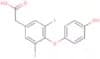
CAS:3,5-Diiodothyroacetic acid is a diphenyl ether that has been shown to have calorigenic activity in rats. This compound inhibits the conversion of thyroxine (T4) to triiodothyronine (T3) by binding to the thyroid hormone receptor and inhibiting the enzyme 3,5-diiodothyroacetic acid deiodinase. It also inhibits the conversion of T4 to reverse T3 by binding to thyroid hormone receptors and competing with thyroxine for nuclear receptors. 3,5-Diiodothyroacetic acid has been shown to be present in human serum and is thought to originate from dietary sources such as soybean products.Formel:C14H10I2O4Reinheit:Min. 95%Farbe und Form:Off-White PowderMolekulargewicht:496.04 g/mol3,5-Diiodo Thyroacetic Acid-13C6
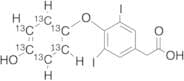
CAS:Kontrolliertes ProduktApplications 3,5-Diiodo Thyroacetic Acid-13C6 is the labeled version of 3,5-Diiodo Thyroacetic Acid (D455140). 3,5-Diiodo Thyroacetic Acid (D455140) is the acetic acid analog of Thyroxine. A potent Thyroxine impurity.
References Horst, C., et al.: Biochem. J., 261, 945 (1989), Kvetny, J., et al.: Horm. Metab. Res., 24, 322 (1992), Yamauchi, K., et al.: J. Biol. Chem., 274, 8460 (1999), Davis, P., et al.: J. Endocrinol. Invest., 25, 377 (2002),Formel:C6C8H10I2O4Farbe und Form:NeatMolekulargewicht:501.992