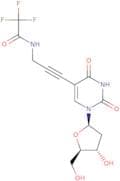
![Uridine, 2'-deoxy-5-[3-[(trifluoroacetyl)amino]-1-propynyl]-](/_next/image/?url=https%3A%2Fstatic.cymitquimica.com%2Fcas-image%2Fthumb-webp%2F93738-uridine-2-deoxy-5-3-trifluoroacetyl-amino-1-propynyl.webp&w=3840&q=75)
CAS 115899-40-6
:Uridin, 2'-desoxy-5-[3-[(trifluoracetyl)amino]-1-propynyl]-
Uridine, 2'-deoxy-5-[3-[(2,2,2-trifluoroacetyl)amino]-1-propyn-1-yl]-
CAS:Formel:C14H14F3N3O6Reinheit:98%Farbe und Form:SolidMolekulargewicht:377.27272'-Deoxy-5-[3-[(2,2,2-trifluoroacetyl)amino]-1-propyn-1-yl]uridine
CAS:Kontrolliertes ProduktApplications 2'-Deoxy-5-[3-[(2,2,2-trifluoroacetyl)amino]-1-propyn-1-yl]uridine is an intermediate in the synthesis of fluorescent labeling compounds of cyclooctyne-modified deoxyuridine triphosphates in DNA.
References Ren, X.M., et al.: Bioorg. Med. Chem., 22, 4384 (2014); Borsenberger, V., et al.: Org. Biomolec. Chem., 7, 3826 (2009);Formel:C14H14F3N3O6Farbe und Form:NeatMolekulargewicht:377.27TFA-ap-dU
CAS:TFA-ap-dU is a modified, ribonucleosides that are used in DNA synthesis. The polymerase chain reaction (PCR) technique can be used to generate a large number of copies of a specific sequence of nucleotides from the original DNA template. This product is used for antiviral and anticancer research. TFA-ap-dU has been shown to be effective against Hepatitis B virus and Human Immunodeficiency Virus (HIV). It is also an activator of DNA and RNA synthesis.
Formel:C14H14F3N3O6Reinheit:Min. 95%Molekulargewicht:377.27 g/mol
![Uridine, 2'-deoxy-5-[3-[(2,2,2-trifluoroacetyl)amino]-1-propyn-1-yl]-](/_next/image/?url=https%3A%2Fstatic.cymitquimica.com%2Fproducts%2FIN%2Fthumb%2FDA000H24.jpg&w=3840&q=75)

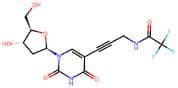


![2'-Deoxy-5-[3-[(2,2,2-trifluoroacetyl)amino]-1-propyn-1-yl]uridine](/_next/image/?url=https%3A%2Fstatic.cymitquimica.com%2Fproducts%2FTR%2Fthumb%2FD282515.jpg&w=3840&q=75)