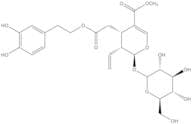
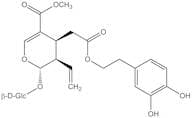
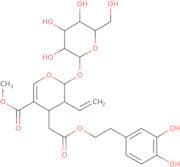
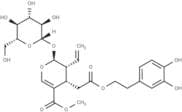
CAS 116383-31-4
:Oleurosid
Beschreibung:
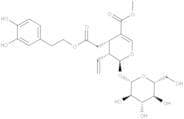
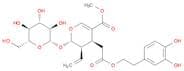
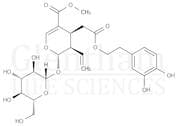
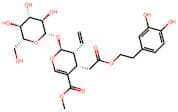
Oleurosid, mit der CAS-Nummer 116383-31-4, ist ein Glykosid, das vom Olivenbaum abgeleitet ist und speziell in Olivenblättern und -früchten vorkommt. Es ist durch seine Struktur gekennzeichnet, die aus einem flavonoiden Aglykon besteht, das an eine Zuckereinheit, typischerweise Glukose, gebunden ist. Oleurosid ist bekannt für seine potenziellen gesundheitlichen Vorteile, einschließlich antioxidativer, entzündungshemmender und kardioprotektiver Eigenschaften. Es hat Interesse im Bereich der Nutraceuticals und funktionellen Lebensmittel geweckt, aufgrund seiner Rolle bei der Förderung der Herzgesundheit und seiner potenziellen Auswirkungen auf Stoffwechselstörungen. Die Verbindung wird auch hinsichtlich ihrer Fähigkeit untersucht, verschiedene biologische Wege zu modulieren, was zu ihrem therapeutischen Potenzial beiträgt. In Bezug auf die Löslichkeit ist Oleurosid in der Regel in polaren Lösungsmitteln löslich, was für viele Glykoside typisch ist. Seine Stabilität und Bioverfügbarkeit können durch Faktoren wie pH und das Vorhandensein anderer Verbindungen beeinflusst werden. Insgesamt stellt Oleurosid ein bedeutendes Forschungsgebiet in der Chemie natürlicher Produkte und der Pharmakologie dar, das die Bedeutung pflanzlicher Verbindungen im Gesundheits- und Krankheitsmanagement hervorhebt.
Formel:C25H32O13
InChl:InChI=1S/C25H32O13/c1-3-13-14(9-19(29)35-7-6-12-4-5-16(27)17(28)8-12)15(23(33)34-2)11-36-24(13)38-25-22(32)21(31)20(30)18(10-26)37-25/h3-5,8,11,13-14,18,20-22,24-28,30-32H,1,6-7,9-10H2,2H3/t13-,14+,18-,20-,21+,22-,24+,25+/m1/s1
InChI Key:InChIKey=WWKVQWHAWPZZDB-ASNPJKIBSA-N
SMILES:C(C(OCCC1=CC(O)=C(O)C=C1)=O)[C@H]2[C@@H](C=C)[C@H](O[C@@H]3O[C@H](CO)[C@@H](O)[C@H](O)[C@H]3O)OC=C2C(OC)=O
Synonyme:- 2H-Pyran-4-acetic acid, 3-ethenyl-2-(β-<span class="text-smallcaps">D</span>-glucopyranosyloxy)-3,4-dihydro-5-(methoxycarbonyl)-, 2-(3,4-dihydroxyphenyl)ethyl ester, (2S,3R,4S)-
- 2H-Pyran-4-acetic acid, 3-ethenyl-2-(β-<span class="text-smallcaps">D</span>-glucopyranosyloxy)-3,4-dihydro-5-(methoxycarbonyl)-, 2-(3,4-dihydroxyphenyl)ethyl ester, [2S-(2α,3β,4β)]-
- 2H-Pyran-4-aceticacid, 3-ethenyl-2-(b-D-glucopyranosyloxy)-3,4-dihydro-5-(methoxycarbonyl)-,2-(3,4-dihydroxyphenyl)ethyl ester, [2S-(2a,3b,4b)]-
- Oleuroside
- 2H-Pyran-4-acetic acid, 3-ethenyl-2-(β-D-glucopyranosyloxy)-3,4-dihydro-5-(methoxycarbonyl)-, 2-(3,4-dihydroxyphenyl)ethyl ester, [2S-(2α,3β,4β)]-
- 2H-Pyran-4-acetic acid, 3-ethenyl-2-(β-D-glucopyranosyloxy)-3,4-dihydro-5-(methoxycarbonyl)-, 2-(3,4-dihydroxyphenyl)ethyl ester, (2S,3R,4S)-
Sortieren nach
Reinheit (%)
0
100
|
0
|
50
|
90
|
95
|
100
8 Produkte.
Oleuroside
CAS:Oleuroside analytical standard provided with chromatographic purity, to be used as reference material for qualitative determination.Formel:C25H32O13Reinheit:(HPLC) ≥90%Farbe und Form:PowderMolekulargewicht:540.52(2S,3R,4S)-Methyl 4-(2-(3,4-dihydroxyphenethoxy)-2-oxoethyl)-2-(((2S,3R,4S,5S,6R)-3,4,5-trihydroxy-6-(hydroxymethyl)tetrahydro-2H-pyran-2-yl)oxy)-3-vinyl-3,4-dihydro-2H-pyran-5-carboxylate
CAS:(2S,3R,4S)-Methyl 4-(2-(3,4-dihydroxyphenethoxy)-2-oxoethyl)-2-(((2S,3R,4S,5S,6R)-3,4,5-trihydroxy-6-(hydroxymethyl)tetrahydro-2H-pyran-2-yl)oxy)-3-vinyl-3,4-dihydro-2H-pyran-5-carboxylateReinheit:97% mix TBC as stabilizerMolekulargewicht:540.52g/molOleuroside
CAS:Oleuroside is a bioactive compound classified as a secoiridoid, which is derived from the leaves of the olive tree (Olea europaea). The source of oleuroside, the olive leaf, is rich in polyphenolic compounds, among which oleuropein is prominent and hydrolyzes to form oleuroside. The mode of action of oleuroside is primarily based on its antioxidant properties. It scavenges free radicals, thereby mitigating oxidative stress and protecting cells from damage. This mechanism is crucial in modulating inflammatory pathways, contributing to its potential therapeutic effects.Formel:C25H32O13Reinheit:Min. 95%Molekulargewicht:540.51 g/molOleuroside
CAS:Oleuroside can protect against mitochondrial dysfunction in models of early Alzheimer's disease and brain ageing.Formel:C25H32O13Reinheit:98%Farbe und Form:SolidMolekulargewicht:540.51