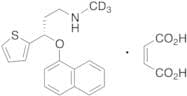
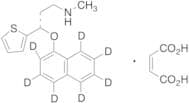
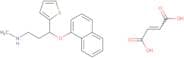
CAS 116817-86-8
:2-Thiophenpropanamin, N-methyl-γ-(1-naphthalenyloxy)-, (γS)-, (2Z)-2-butenedioat (1:1)
Beschreibung:
2-Thiophenpropanamin, N-methyl-γ-(1-naphthalenyloxy)-, (γS)-, (2Z)-2-butenedioat (1:1), mit der CAS-Nummer 116817-86-8, ist eine chemische Verbindung, die durch ihre komplexe Struktur gekennzeichnet ist, die einen Thiophenring, eine Naphthalen-Einheit und eine Aminfunktion umfasst. Diese Verbindung weist ein Stereozentrum auf, das durch die Bezeichnung (γS) angezeigt wird, was spezifische räumliche Anordnungen ihrer Atome suggeriert, die ihre biologische Aktivität und Reaktivität beeinflussen können. Das Vorhandensein der Butenedioat-Einheit weist auf ein Reaktivitätspotenzial hin, das typisch für ungesättigte Carbonsäuren ist, die an verschiedenen chemischen Reaktionen wie Esterifizierung oder Konjugation teilnehmen können. Die einzigartige Kombination von aromatischen und heterozyklischen Komponenten der Verbindung kann zu ihren Löslichkeitseigenschaften und Wechselwirkungen mit biologischen Systemen beitragen. Insgesamt könnte diese Substanz von Interesse in der medizinischen Chemie und Materialwissenschaft sein, insbesondere bei der Entwicklung von Arzneimitteln oder als Baustein für komplexere organische Synthesen. Spezifische Anwendungen und biologische Aktivitäten würden jedoch weitere Untersuchungen und Charakterisierungen erfordern.
Formel:C18H19NOS·C4H4O4
SMILES:O([C@@H](CCNC)C1=CC=CS1)C=2C3=C(C=CC2)C=CC=C3.C(=C\C(O)=O)\C(O)=O
Synonyme:- 2-Thiophenepropanamine, N-methyl-γ-(1-naphthalenyloxy)-, (S)-, (Z)-2-butenedioate (1:1)
- 2-Thiophenepropanamine, N-methyl-γ-(1-naphthalenyloxy)-, (γS)-, (2Z)-2-butenedioate (1:1)
Sortieren nach
Reinheit (%)
0
100
|
0
|
50
|
90
|
95
|
100
3 Produkte.
Duloxetine-d3 Maleate
CAS:Kontrolliertes ProduktApplications Duloxetine-d3 Maleate, is the labeled analogue of Duloxetine (D721000), which is used as an antidepressant. A dual serotonin and norepinephrine reuptake inhibitor (SNRI).
References Wong, D.T., et al.: Neuropsychopharmacology, 8, 23 (1993), Fuller, R.W., et al.: J. Pharmacol. Exp. Ther., 269, 132 (1994), Sharma, A., et al.: J. Clin. Pharmacol., 40, 161 (2000)Formel:C18D3H16NOS·C4H4O4Farbe und Form:White SolidMolekulargewicht:416.5Duloxetine-d7 Maleate
CAS:Kontrolliertes ProduktApplications Labelled Duloxetine, which is used as an antidepressant. A dual serotonin and norepinephrine reuptake inhibitor (SNRI).
References Wong, D.T., et al.: Neuropsychopharmacology, 8, 23 (1993), Fuller, R.W., et al.: J. Pharmacol. Exp. Ther., 269, 132 (1994), Sharma, A., et al.: J. Clin. Pharmacol., 40, 161 (2000)Formel:C22H16D7NO5SFarbe und Form:NeatMolekulargewicht:420.53Duloxetine maleate
CAS:Kontrolliertes ProduktDuloxetine maleate is an apoptosis-inducing drug that belongs to the class of anticancer inhibitors. It has been shown to be effective against a variety of tumor types, including thyroid and cancer cells. Duloxetine maleate is an analog inhibitor of kinases, which are enzymes involved in cell signaling pathways that regulate cell growth and division. This drug has been studied extensively in Chinese hamster ovary (CHO) and human urine protein models, where it has demonstrated potent anticancer activity by inducing apoptosis in cancer cells. Additionally, studies have shown that duloxetine maleate can inhibit the growth of tumors by blocking the activity of specific kinases involved in cancer cell proliferation. Overall, duloxetine maleate is a promising drug for the treatment of various types of cancer.Formel:C22H23NO5SReinheit:Min. 95%Molekulargewicht:413.5 g/mol