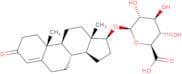
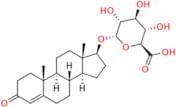
CAS 1180-25-2
:Testosteron-Glucuronid
Beschreibung:
Testosteron-Glucuronid ist ein Metabolit von Testosteron, der durch den Prozess der Glucuronidierung gebildet wird, bei dem ein Molekül Glucuronsäure mit Testosteron konjugiert wird. Diese Modifikation erhöht die Löslichkeit von Testosteron und erleichtert dessen Ausscheidung aus dem Körper, hauptsächlich über den Urin. Die Substanz ist durch ihre Rolle im Metabolismus von Androgenen gekennzeichnet und wird häufig als Biomarker in klinischen und forensischen Kontexten verwendet, um die Testosteronspiegel zu bewerten und den Gebrauch von anabolen Steroiden zu überwachen. Testosteron-Glucuronid ist typischerweise in niedrigen Konzentrationen im Körper vorhanden und kann mit verschiedenen analytischen Techniken, einschließlich Flüssigkeitschromatographie-Massenspektrometrie (LC-MS/MS), nachgewiesen werden. Ihre Anwesenheit in biologischen Proben kann Einblicke in das hormonelle Gleichgewicht, die endokrine Funktion und mögliche Störungen im Zusammenhang mit dem Testosteronmetabolismus geben. Als Glucuronid ist es in der Regel biologisch weniger aktiv als die Ausgangsverbindung, Testosteron, spielt jedoch dennoch eine bedeutende Rolle in der Pharmakokinetik von Steroidhormonen.
Formel:C25H36O8
InChl:InChI=1S/C25H36O8/c1-24-9-7-13(26)11-12(24)3-4-14-15-5-6-17(25(15,2)10-8-16(14)24)32-23-20(29)18(27)19(28)21(33-23)22(30)31/h11,14-21,23,27-29H,3-10H2,1-2H3,(H,30,31)/t14-,15-,16-,17-,18-,19-,20+,21-,23+,24-,25-/m0/s1
InChI Key:InChIKey=NIKZPECGCSUSBV-HMAFJQTKSA-N
SMILES:C[C@@]12[C@@]3([C@]([C@]4([C@](C)(CC3)[C@@H](O[C@@H]5O[C@H](C(O)=O)[C@@H](O)[C@H](O)[C@H]5O)CC4)[H])(CCC1=CC(=O)CC2)[H])[H]
Synonyme:- (17Beta)-3-Oxoandrost-4-En-17-Yl Hexopyranosiduronic Acid
- (17beta)-3-oxoandrost-4-en-17-yl beta-D-glucopyranosiduronic acid
- (17β)-3-Oxoandrost-4-en-17-yl β-<span class="text-smallcaps">D</span>-glucopyranosiduronic acid
- Androstane, β-<span class="text-smallcaps">D</span>-glucopyranosiduronic acid deriv.
- Epitestosterone glucuronide
- Glucopyranosiduronic acid, 3-oxoandrost-4-en-17β-yl, β-<span class="text-smallcaps">D</span>-
- Nsc 92192
- Testosterone 17-glucosiduronate
- Testosterone 17-glucuronide
- Testosterone 17β-(β-<span class="text-smallcaps">D</span>-glucuronide)
- Testosterone glucopyranuronoside
- Testosterone glucosiduronide
- Testosterone glucuronate
- Testosterone glucuronide
- Testosterone glucuronide conjugate
- Testosterone glucuronoside
- beta-D-Glucopyranosiduronic acid, (17beta)-3-oxoandrost-4-en-17-yl
- β-<span class="text-smallcaps">D</span>-Glucopyranosiduronic acid, (17β)-3-oxoandrost-4-en-17-yl
- β-D-Glucopyranosiduronic acid, (17β)-3-oxoandrost-4-en-17-yl
- (17β)-3-Oxoandrost-4-en-17-yl β-D-glucopyranosiduronic acid
- Glucopyranosiduronic acid, 3-oxoandrost-4-en-17β-yl, β-D-
- Weitere Synonyme anzeigen
Sortieren nach
Reinheit (%)
0
100
|
0
|
50
|
90
|
95
|
100
2 Produkte.
Testosterone b-D-glucuronide
CAS:Kontrolliertes ProduktTestosterone b-D-glucuronide (TbG) is a clinically relevant metabolite of testosterone. It is the glucuronide conjugate of testosterone, which means that it is formed by the addition of a glucuronic acid molecule to the hydroxyl group at position 17. TbG has been detected in human plasma, urine and feces. The concentration of TbG in these fluids reflects the levels of total testosterone in the body. TbG may also be used as a biomarker for assessing exposure to nonsteroidal anti-inflammatory drugs (NSAIDs). It has been shown that NSAIDs can form conjugates with glucuronic acid, leading to elevated concentrations of TbG in urine samples. TbG binds to monoclonal antibodies and is therefore used as a sample preparation step prior to analysis by polymerase chain reaction or flow assay.Formel:C25H36O8Reinheit:Min. 95%Farbe und Form:White PowderMolekulargewicht:464.55 g/mol