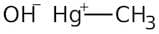
CAS 1184-57-2
:Methylquecksilber(II)-hydroxid
Beschreibung:
Methylquecksilber(II)-hydroxid, mit der CAS-Nummer 1184-57-2, ist eine organomerkurielle Verbindung, die durch ihre Methylgruppe, die an ein Quecksilberatom gebunden ist, gekennzeichnet ist, das zusätzlich mit Hydroxidionen koordiniert ist. Diese Verbindung ist typischerweise ein weißer Feststoff und ist bekannt für ihre hohe Toxizität, hauptsächlich aufgrund der Anwesenheit von Quecksilber, einem Schwermetall, das erhebliche Gesundheitsrisiken darstellt. Methylquecksilber ist besonders besorgniserregend, da es sich in aquatischen Nahrungsnetzen bioakkumulieren kann, was zu erhöhten Konzentrationen in Fischen und anderen Organismen führt, die dann die menschliche Gesundheit beim Verzehr beeinträchtigen können. Die Verbindung ist in organischen Lösungsmitteln löslich, hat jedoch eine begrenzte Löslichkeit in Wasser. Methylquecksilber(II)-hydroxid wird häufig im Kontext der Umweltchemie und Toxikologie untersucht, da es nachteilige Auswirkungen auf die neurologische Entwicklung und Funktion haben kann. Eine ordnungsgemäße Handhabung und Entsorgung sind aufgrund ihrer gefährlichen Natur entscheidend, und es sind regulatorische Maßnahmen in Kraft, um die Exposition und Umweltverschmutzung zu begrenzen.
Formel:CH4HgO
InChl:InChI=1/CH3.Hg.H2O/h1H3;;1H2/rCH3Hg.H2O/c1-2;/h1H3;1H2
InChI Key:InChIKey=KRZWEBVPFGCYMY-UHFFFAOYSA-M
SMILES:[Hg](C)O
Synonyme:- Hydroxo(methyl)mercury
- Hydroxymethylmercury
- Mercury, hydroxymethyl-
- Methylhydroxymercury
- Methylmercuric hydroxide
- Methylmercury Hydrate
- Methylmercury Hydroxide
- Methylmercury(1+) Hydroxide
- NSC 19997
- Panogen Soil Drench
- Methylmercury(II) hydroxide
- Mercury, hydroxyMethyl-(7CI,8CI,9CI)
- Methylmercury(II) hydroxide, 1M in H2O, packaged under Argon in resealable ChemSeal bottles
- Methyl-mercuryhydroxide
- Methylmercury(II)hydroxide,~1Maqueoussolution
- Methylmercury(II)hydroxide,1MinH2O
- hydroxymethyl-mercur
- Methylmercury(II) hydroxide, 1M in H2O, packaged under Argon in resealable ChemSealTM bottles
- methylmercuryhydroxide
- O
- Methylmercury (II) hydroxide,approx. 1M aqueous solution
- Methylhydroxymercury(II)
- METHYLMERCURY(II) HYDROXIDE: CA. 1M AQUEOUS SOLUTION
- Methylmercury(II) hydroxide solution, 1M in water
- methylmerkurihydroxid
- methylhydrargyriumhydroxid
- methylmercury(ii) hydroxide, 1m in h
- O, packaged under Argon in resealable ChemSealTM bottles
- Methylmercury(II) hydroxide, 1M in H{2}O, packaged under Argon in resealable ChemSeal^t bottles
- methylmercury(ii) hydroxide, 1m in h, packaged under argon in resealable chemseal
- Hydroxy(methyl)mercury(II)
- 2
- Weitere Synonyme anzeigen
Sortieren nach
Reinheit (%)
0
100
|
0
|
50
|
90
|
95
|
100
3 Produkte.
Methylmercury(II) hydroxide, 1M in H{2}O
CAS:As a defoliant and epoxidation catalyst, as denaturing agentFormel:CH4HgOFarbe und Form:LiquidMolekulargewicht:232.63Methylmercury(II) hydroxide, ~1M aqueous solution
CAS:Methylmercury(II) hydroxide, ~1M aqueous solution
Formel:CH3HgOHFarbe und Form:colorless liq.Molekulargewicht:232.63Methylmercury(II) hydroxide, ~1M aqueous solution
CAS:Kontrolliertes ProduktMethylmercury(II) hydroxide, ~1M aqueous solution is a highly potent and concentrated solution of Methylmercury(II) hydroxide. It is commonly used in various research applications such as electrophoresis, adipose studies, herbicide testing, and pluripotent cell research. This solution contains the active ingredient Methylmercury(II) hydroxide, which is a member of the fluoroquinolone family of compounds. It has been shown to have strong binding properties with collagen and can be used in intraocular applications. Additionally, it has demonstrated inhibitory effects on tyrosinase activity. Researchers often utilize this solution for its high purity and reliability. Whether you're conducting cutting-edge scientific experiments or exploring new possibilities in your field, our Methylmercury(II) hydroxide, ~1M aqueous solution is an essential addition to your research arsenal.Formel:CH3HgOHReinheit:Min. 95%Molekulargewicht:232.63 g/mol