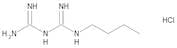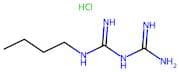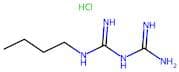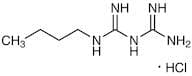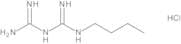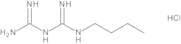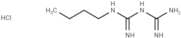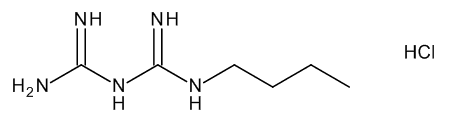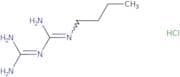
CAS 1190-53-0
:Buformin-Hydrochlorid
Beschreibung:
Buformin-Hydrochlorid ist eine pharmazeutische Verbindung, die hauptsächlich als antihyperglykämisches Mittel zur Behandlung von Typ-2-Diabetes mellitus eingesetzt wird. Es gehört zur Klasse der Biguanide, zu der auch Metformin gehört. Die Substanz zeichnet sich durch ihre Fähigkeit aus, den Blutzuckerspiegel zu senken, indem sie die hepatische Glukoseproduktion verringert, die Insulinempfindlichkeit erhöht und die Glukoseaufnahme in peripheren Geweben fördert. Buformin-Hydrochlorid wird typischerweise oral verabreicht und ist bekannt für seinen relativ schnellen Wirkungseintritt. In Bezug auf die physikalischen Eigenschaften handelt es sich um ein weißes bis schwach weißes kristallines Pulver, das in Wasser löslich ist, was es für die Formulierung in verschiedenen Darreichungsformen geeignet macht. Sein Einsatz hat jedoch zugunsten von Metformin abgenommen, da Bedenken hinsichtlich möglicher Nebenwirkungen, einschließlich einer Laktatazidose, bestehen. Wie bei jedem Medikament ist es wichtig, Kontraindikationen und mögliche Wechselwirkungen mit anderen Arzneimitteln bei der Verschreibung von Buformin-Hydrochlorid zu berücksichtigen. Insgesamt sind sorgfältige Überwachung und Patientenauswahl entscheidend für eine sichere Anwendung.
Formel:C6H15N5·ClH
InChl:InChI=1S/C6H15N5.ClH/c1-2-3-4-10-6(9)11-5(7)8;/h2-4H2,1H3,(H6,7,8,9,10,11);1H
InChI Key:InChIKey=KKLWSPPIRBIEOV-UHFFFAOYSA-N
SMILES:N(C(NC(=N)N)=N)CCCC.Cl
Synonyme:- 1-Butyl-biguanid hydrochlorid
- 1-Butyl-biguanid hydrochlorid [German]
- 1-Butylbiguanide hydrochloride
- 1-Butyldiguanide hydrochloride
- 2-Butyl-1-(Diaminomethylidene)Guanidine Hydrochloride (1:1)
- Adebit
- Andere
- Biforon
- Biguanide, 1-butyl-, hydrochloride
- Biguanide, 1-butyl-, monohydrochloride
- Bigunal
- Bufonamin
- Buformin hydrochloride
- Buformine HCl
- Bulbonin
- Butyl guanylguanidine
- Butylbiguanide hydrochloride
- DBV hydrochloride
- Diabrin
- Dibetos
- Glibutide
- Gliporal
- Glybutide
- Imidodicarbonimidic diamide, N-butyl-, hydrochloride (1:1)
- Imidodicarbonimidic diamide, N-butyl-, monohydrochloride
- Insulamin
- Krebon
- N(sup 1)-n-Butylbiguanide hydrochloride
- N-Butyl-imidodicarbonimidic diamide monohydrochloride (9CI)
- N-Butylbiguanide hydrochloride
- N<sup>1</sup>-Butyl-biguanide hydrochloride
- N<sup>1</sup>-n-Butylbiguanide hydrochloride
- Nsc 113665
- Nsc 528218
- Panformin
- Sb 103
- Silubin
- Sindiatil
- Tidemol
- W37
- Weitere Synonyme anzeigen
Sortieren nach
Reinheit (%)
0
100
|
0
|
50
|
90
|
95
|
100
12 Produkte.
Buformin Hydrochloride
CAS:Formel:C6H15N5·HClReinheit:>95.0%(HPLC)Farbe und Form:White to Light yellow to Light orange powder to crystalMolekulargewicht:193.68Buformin hydrochloride
CAS:Kontrolliertes ProduktFormel:C6H15N5·ClHFarbe und Form:NeatMolekulargewicht:193.68Buformin hydrochloride
CAS:Buformin hydrochloride, an oral biguanide antidiabetic, activates AMPK, enhances insulin sensitivity, and inhibits hepatic glucose production.Formel:C6H16ClN5Reinheit:97.83%Farbe und Form:SolidMolekulargewicht:193.68Buformin Hydrochloride
CAS:Kontrolliertes ProduktStability Hygroscopic
Applications Buformin, clinically used for diabetes mellitus, is known to improve resistance to insulin in patients. It suppresses the expression of glyceraldehyde 3-phosphate dehydrogenase.
References Owen, M.,et al.: J. Biochem., 348, 607 (2000), Detaille, D., et al.: Biochem. Pharmacol. 63, 1259 (2002).Formel:C6H15N5·ClHFarbe und Form:WhiteMolekulargewicht:193.68Buformin hydrochloride
CAS:Buformin hydrochloride is an oral hypoglycemic drug that belongs to the group of biguanides. It is used for the treatment of type 2 diabetes mellitus and has been shown to have a hypoglycemic effect in patients with breast cancer. The mechanism of action of buformin hydrochloride is not fully understood, but it may involve the regulation of mitochondrial membrane potential and transcription activators. Buformin hydrochloride has been shown to decrease the number of lymphocytes, which are responsible for immune responses. This drug also inhibits the growth of c. glabrata, an opportunistic fungal pathogen, by disrupting energy metabolism. Buformin hydrochloride is metabolized in humans and animals by glucuronidation or sulfation. In analytical studies, benzalkonium chloride (BAK) was used as a crystalline cellulose carrier to increase solubility and stability.Formel:C6H16ClN5Reinheit:Min. 95%Farbe und Form:White PowderMolekulargewicht:193.68 g/mol