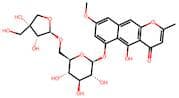
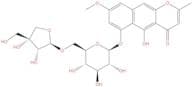
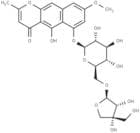
![6-[(6-O-D-Apio-β-D-furanosyl-β-D-glucopyranosyl)oxy]-5-hydroxy-8-methoxy-2-methyl-4H-naphtho[2,3-b…](/_next/image/?url=https%3A%2Fstatic.cymitquimica.com%2Fcas-image%2Fthumb-webp%2F480816-6-6-o-d-apio-b-d-furanosyl-b-d-glucopyranosyl-oxy-5-hydroxy-8-methoxy-2-methyl-4h-naphtho-23-b-pyran-4-one.webp&w=3840&q=75)
CAS 119170-51-3
:6-[(6-O-D-Apio-β-D-furanosyl-β-D-glucopyranosyl)oxy]-5-hydroxy-8-methoxy-2-methyl-4H-naphtho[2,3-b]pyran-4-on
Beschreibung:
Die chemische Substanz, die als "6-[(6-O-D-Apio-β-D-furanosyl-β-D-glucopyranosyl)oxy]-5-hydroxy-8-methoxy-2-methyl-4H-naphtho[2,3-b]pyran-4-on" bekannt ist, mit der CAS-Nummer 119170-51-3, ist ein komplexer glykosylierter Flavonoidderivat. Diese Verbindung weist ein Naphthopyran-Rückgrat auf, das für viele Flavonoide charakteristisch ist und zu seinen potenziellen antioxidativen Eigenschaften beiträgt. Das Vorhandensein mehrerer Zuckereinheiten, insbesondere einer Furanosyl- und einer Glucopyranosyl-Einheit, deutet darauf hin, dass sie eine verbesserte Löslichkeit und Bioverfügbarkeit im Vergleich zu nicht-glykosylisierten Flavonoiden aufweisen könnte. Die Hydroxyl- und Methoxygruppen auf der Naphthopyran-Struktur können ihre Reaktivität und Interaktion mit biologischen Systemen beeinflussen, was potenziell ihre pharmakologischen Aktivitäten beeinflusst. Solche Verbindungen werden oft auf ihr therapeutisches Potenzial untersucht, einschließlich entzündungshemmender und krebsbekämpfender Eigenschaften. Darüber hinaus kann die strukturelle Komplexität auf eine Rolle in den Abwehrmechanismen von Pflanzen oder Interaktionen mit anderen biologischen Molekülen hinweisen. Insgesamt stellt diese Substanz ein faszinierendes Forschungsgebiet in der Chemie natürlicher Produkte und der Pharmakognosie dar.
Formel:C26H30O14
InChl:InChI=1S/C26H30O14/c1-10-3-13(28)18-14(38-10)5-11-4-12(35-2)6-15(17(11)20(18)30)39-24-22(32)21(31)19(29)16(40-24)7-36-25-23(33)26(34,8-27)9-37-25/h3-6,16,19,21-25,27,29-34H,7-9H2,1-2H3/t16-,19-,21+,22-,23+,24-,25-,26-/m1/s1
InChI Key:InChIKey=NIVCJAYDAMQSJO-PAMAHNMISA-N
SMILES:O(C=1C2=C(C=C3C(=C2O)C(=O)C=C(C)O3)C=C(OC)C1)[C@@H]4O[C@H](CO[C@H]5[C@H](O)[C@](CO)(O)CO5)[C@@H](O)[C@H](O)[C@H]4O
Synonyme:- 4H-Naphtho[2,3-b]pyran-4-one, 6-[(6-O-<span class="text-smallcaps">D</smallcap>-apio-β-<smallcap>D</smallcap>-furanosyl-β-<smallcap>D</span>-glucopyranosyl)oxy]-5-hydroxy-8-methoxy-2-methyl-
- 6-[(6-O-<span class="text-smallcaps">D</smallcap>-Apio-β-<smallcap>D</smallcap>-furanosyl-β-<smallcap>D</span>-glucopyranosyl)oxy]-5-hydroxy-8-methoxy-2-methyl-4H-naphtho[2,3-b]pyran-4-one
- Cassiaside B
- CassiasideB
- Rubrofusarin-6-O-β-<span class="text-smallcaps">D</smallcap>-apiofuranosyl-(1→6)-O-β-<smallcap>D</span>-glucopyranoside
- 4H-Naphtho[2,3-b]pyran-4-one, 6-[(6-O-D-apio-β-D-furanosyl-β-D-glucopyranosyl)oxy]-5-hydroxy-8-methoxy-2-methyl-
- 6-[(6-O-D-Apio-β-D-furanosyl-β-D-glucopyranosyl)oxy]-5-hydroxy-8-methoxy-2-methyl-4H-naphtho[2,3-b]pyran-4-one
- Rubrofusarin-6-O-β-D-apiofuranosyl-(1→6)-O-β-D-glucopyranoside
Sortieren nach
Reinheit (%)
0
100
|
0
|
50
|
90
|
95
|
100
4 Produkte.
Cassiaside B
CAS:Cassiaside B is a natural product with potent antibacterial activity.Formel:C26H30O14Reinheit:99.82%Farbe und Form:SolidMolekulargewicht:566.51Cassiaside B
CAS:<p>Cassiaside B is a type of natural anthraquinone glycoside, derived primarily from the seeds of the Cassia genus, particularly Cassia tora and Cassia obtusifolia. These plants are well-recognized in traditional medicine systems for their therapeutic properties. The mode of action of Cassiaside B involves its role as a potent antioxidant, scavenging free radicals and reducing oxidative stress. Additionally, it exhibits anti-inflammatory effects by modulating specific pathways that are instrumental in the inflammatory response.</p>Formel:C26H30O14Reinheit:Min. 95%Molekulargewicht:566.50 g/mol