CAS 1192-33-2
:3,3-Dimethylcyclobutanon
Beschreibung:
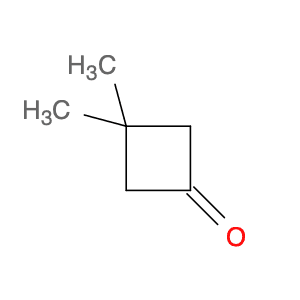
3,3-Dimethylcyclobutanon ist eine zyklische Keton, die durch ihren viergliedrigen Cyclobutanring mit zwei Methylgruppen, die an dasselbe Kohlenstoffatom gebunden sind, insbesondere an der Position 3, gekennzeichnet ist. Diese strukturelle Anordnung trägt zu ihren einzigartigen chemischen Eigenschaften bei, einschließlich ihrer Reaktivität und Stabilität. Die Anwesenheit der Carbonylgruppe (C=O) im Cyclobutanrahmen macht sie zu einem Keton, das an verschiedenen chemischen Reaktionen wie nucleophilen Additionen teilnehmen kann. Die Verbindung ist typischerweise eine farblose Flüssigkeit bei Raumtemperatur und hat einen charakteristischen Geruch. Ihre chemische Formel spiegelt ihre Zusammensetzung aus Kohlenstoff, Wasserstoff und Sauerstoff wider und zeigt aufgrund der Carbonylfunktion eine moderate Polarität. 3,3-Dimethylcyclobutanon ist von Interesse in der organischen Synthese und kann als Zwischenprodukt bei der Herstellung komplexerer Moleküle dienen. Darüber hinaus werden ihre physikalischen Eigenschaften, wie Siedepunkt und Löslichkeit, durch die sterischen Effekte der Methylgruppen und die Ringbelastung, die der Struktur des Cyclobutans innewohnt, beeinflusst.
Formel:C6H10O
InChl:InChI=1/C6H10O/c1-6(2)3-5(7)4-6/h3-4H2,1-2H3
SMILES:CC1(C)CC(=O)C1
Synonyme:- Cyclobutanone, 3,3-Dimethyl-
Sortieren nach
Reinheit (%)
0
100
|
0
|
50
|
90
|
95
|
100
4 Produkte.
Cyclobutanone, 3,3-dimethyl-
CAS:Formel:C6H10OReinheit:95%Farbe und Form:LiquidMolekulargewicht:98.14303,3-Dimethylcyclobutan-1-one
CAS:3,3-Dimethylcyclobutan-1-oneReinheit:≥95%Molekulargewicht:98.14g/mol3,3-Dimethylcyclobutan-1-one
CAS:3,3-Dimethylcyclobutan-1-one is a molecule that has been shown to be a sensitizer of ethylene in the presence of activated oxygen. The kinetics of this reaction were studied by determining the rate constant for the formation of 3,3-dimethylcyclobutan-1-one at various temperatures. This compound is an analog to cyclobutanone and can be synthesized by photolytic or reductive elimination. The nature of the substituents on the ring affects the bond cleavage and product yields during these reactions. 3,3-Dimethylcyclobutan-1-one has been used as a radiation sensitizer for polymers, although this application is limited because it reacts with oxygen. In addition, 3,3-dimethylcyclobutan-1-one can be used to produce isobutene by coupling with acetylene.Formel:C6H10OReinheit:Min. 95%Molekulargewicht:98.14 g/mol