

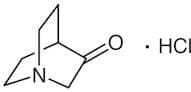
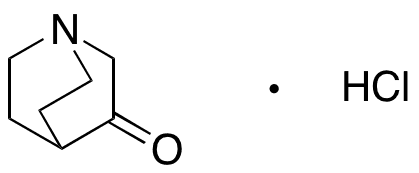
![1-Azabicyclo[2.2.2]octan-3-one, hydrochloride (1:1)](/_next/image/?url=https%3A%2Fstatic.cymitquimica.com%2Fcas-image%2Fthumb-webp%2F205218-1-azabicyclo-2-2-2-octan-3-one-hydrochloride-1-1.webp&w=3840&q=75)
CAS 1193-65-3
:1-Azabicyclo[2.2.2]octan-3-on, Hydrochlorid (1:1)
Beschreibung:
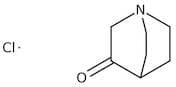
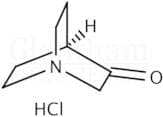
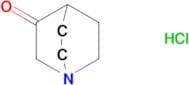
1-Azabicyclo[2.2.2]octan-3-on, Hydrochlorid (1:1), allgemein bekannt als Quinuclidin-3-on-Hydrochlorid, ist eine bicyclische Verbindung, die durch ihre einzigartige bicyclische Struktur gekennzeichnet ist, die ein Stickstoffatom im Ringsystem enthält. Diese Verbindung ist typischerweise ein weißes bis off-white kristallines Feststoff, löslich in Wasser und verschiedenen organischen Lösungsmitteln, was sie in pharmazeutischen Anwendungen nützlich macht. Die Anwesenheit der Hydrochlorid-Salzform verbessert ihre Stabilität und Löslichkeit und erleichtert ihre Verwendung in biologischen Systemen. Sie zeigt Eigenschaften, die die Neurotransmittersysteme beeinflussen können, insbesondere in Bezug auf die cholinerge Aktivität, was sie in der medizinischen Chemie und der Arzneimittelentwicklung von Interesse macht. Die molekulare Struktur der Verbindung trägt zu ihrem Potenzial als Ligand für verschiedene Rezeptoren bei, und sie könnte für therapeutische Anwendungen, einschließlich der Behandlung neurologischer Störungen, untersucht werden. Wie bei vielen chemischen Substanzen sollte der Umgang mit Vorsicht erfolgen, wobei die Sicherheitsprotokolle aufgrund der potenziellen biologischen Aktivität beachtet werden sollten.
Formel:C7H11NO·ClH
InChl:InChI=1S/C7H11NO.ClH/c9-7-5-8-3-1-6(7)2-4-8;/h6H,1-5H2;1H
InChI Key:InChIKey=RFDPHKHXPMDJJD-UHFFFAOYSA-N
SMILES:O=C1C2CCN(C1)CC2.Cl
Synonyme:- 1-Azabicyclo(2.2.2)Octan-3-One
- 1-Azabicyclo[2,2,2]octan-3-one hydrochloride
- 1-Azabicyclo[2.2.2]Octan-3-One Hydrochloride (1:1)
- 1-Azabicyclo[2.2.2]octan-3-on
- 1-Azabicyclo[2.2.2]octan-3-one Hydrochloride
- 3-Oxoquinuclidine hydrochloride
- 3-Quinuclidone hydrochloride
- Quinuclidin-3-one
- Quinuclidinone hydrochloride
- 3-Quinuclidinone, hydrochloride
Sortieren nach
Reinheit (%)
0
100
|
0
|
50
|
90
|
95
|
100
8 Produkte.
3-Quinuclidinone Hydrochloride
CAS:Formel:C7H11NO·HClReinheit:>98.0%(T)Farbe und Form:White to Orange to Green powder to crystalMolekulargewicht:161.633-Quinuclidinone hydrochloride, 98+%
CAS:This Thermo Scientific Chemicals brand product was originally part of the Alfa Aesar product portfolio. Some documentation and label information may refer to the legacy brand. The original Alfa Aesar product / item code or SKU reference has not changed as a part of the brand transition to Thermo SciFormel:C7H11ClNOReinheit:98+%Farbe und Form:Crystals or powder or crystalline powder or fused solid, White to pale cream to pale yellowMolekulargewicht:160.623-Quinuclidone hydrochloride
CAS:Formel:C7H11NO·HClReinheit:≥ 98.0%Farbe und Form:White to light-yellow crystalline powderMolekulargewicht:161.63Quinuclidin-3-one hydrochloride
CAS:Reinheit:97.0%Farbe und Form:Solid, Beige powderMolekulargewicht:161.63000488281253-Quinuclidinone Hydrochloride
CAS:Kontrolliertes ProduktFormel:C7H12ClNOFarbe und Form:NeatMolekulargewicht:161.633-Quinuclidinone hydrochloride
CAS:Kontrolliertes Produkt3-Quinuclidinone hydrochloride is an organic compound that is used as a reagent in organic synthesis. It is synthesized by the acylation of 3-quinuclidinol with ethyl bromoacetate in the presence of a base. This reaction occurs in an isolated yield, and the product can be purified by rotary evaporation. 3-Quinuclidinone hydrochloride has a high affinity for GABA receptors, which are found on nerve cells in the brain and inhibitory neurons throughout the body. The binding of 3-quinuclidinone hydrochloride to these receptors leads to a decrease in neuronal excitability. This drug also has been shown to have effects on motor function, including a positive effect on motor performance when tested using a rotarod test. The rate of this reaction can be increased by adding chloride or sodium carbonate as a catalyst and by increasing the reaction time. Substrate binding plays an importantFormel:C7H12CINOReinheit:Min. 95%Farbe und Form:White PowderMolekulargewicht:161.63 g/mol1-Azabicyclo[2.2.2]octan-3-one, hydrochloride (1:1)
CAS:Formel:C7H12ClNOReinheit:98%Farbe und Form:SolidMolekulargewicht:161.6293







![1-Azabicyclo[2.2.2]octan-3-one, hydrochloride (1:1)](/_next/image/?url=https%3A%2Fstatic.cymitquimica.com%2Fproducts%2FIN%2Fthumb%2FDA000IK0.jpg&w=3840&q=75)
