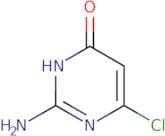
CAS 1194-21-4
:2-Amino-6-chlor-4(1H)-pyrimidinon
Beschreibung:
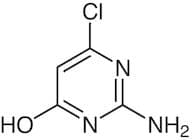
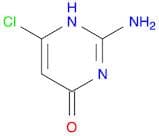
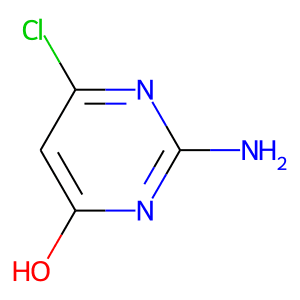
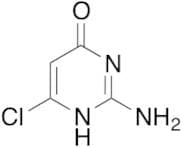
2-Amino-6-chlor-4(1H)-pyrimidinon, mit der CAS-Nummer 1194-21-4, ist eine heterocyclische organische Verbindung, die durch ihre Pyrimidinringstruktur gekennzeichnet ist, die sowohl Amino- als auch Chlorsubstituenten enthält. Diese Verbindung zeigt typischerweise ein weißes bis schmutzig-weißes kristallines Aussehen und ist in polaren Lösungsmitteln wie Wasser und Alkoholen löslich, was ihre polaren funktionellen Gruppen widerspiegelt. Die Anwesenheit der Aminogruppe trägt zu ihrer Basizität bei, während der Chlorsubstituent ihre Reaktivität und das Potenzial zur Bildung von Wasserstoffbrücken beeinflussen kann. 2-Amino-6-chlor-4(1H)-pyrimidinon ist von Interesse in der medizinischen Chemie und kann als Baustein für die Synthese verschiedener Arzneimittel dienen, insbesondere bei der Entwicklung von antiviralen und krebsbekämpfenden Mitteln. Ihre chemischen Eigenschaften, einschließlich Schmelzpunkt und Siedepunkt, können je nach Reinheit und Umweltbedingungen variieren. Wie viele stickstoffhaltige Heterocyclen kann es an verschiedenen chemischen Reaktionen teilnehmen, einschließlich nucleophiler Substitutionen und Kondensationsreaktionen, was es zu einer vielseitigen Verbindung in der organischen Synthese macht.
Formel:C4H4ClN3O
InChl:InChI=1S/C4H4ClN3O/c5-2-1-3(9)8-4(6)7-2/h1H,(H3,6,7,8,9)
InChI Key:InChIKey=VBWACOJLJYUFKJ-UHFFFAOYSA-N
SMILES:ClC1=CC(=O)N=C(N)N1
Synonyme:- 2-Amino-4-chloro-6-hydroxypyrimidine
- 2-Amino-4-chloropyrimidine-6-one
- 2-Amino-4-hydroxy-6-chloropyrimidine
- 2-Amino-6-Chloropyrimidin-4-Ol Hydrate
- 2-Amino-6-chloro-1H-pyrimidin-4-one
- 2-Amino-6-chloro-3,4-dihydropyrimidin-4-one
- 2-Amino-6-chloro-3H-pyrimidin-4-one
- 2-Amino-6-chloro-4(1H)-pyrimidinone
- 2-Amino-6-chloro-4(3H)-pyrimidinone
- 2-Amino-6-chloro-4-pyrimidinol hydrate
- 2-Amino-6-chloro-4-pyrimidinol monohydrate
- 2-Amino-6-chloro-4-pyrimidinone
- 2-amino-6-chloropyrimidin-4(3H)-one
- 4(1H)-Pyrimidinone, 2-amino-6-chloro-
- 4(3H)-Pyrimidinone, 2-amino-6-chloro-
- 4-Pyrimidinol, 2-amino-6-chloro-
- 6-Chloroisocytosine
- NSC 35655
- Weitere Synonyme anzeigen
Sortieren nach
Reinheit (%)
0
100
|
0
|
50
|
90
|
95
|
100
6 Produkte.
2-Amino-4-chloro-6-hydroxypyrimidine
CAS:Formel:C4H4ClN3OReinheit:>98.0%(T)(HPLC)Farbe und Form:White to Light yellow to Light orange powder to crystalMolekulargewicht:145.554(1H)-Pyrimidinone, 2-amino-6-chloro-
CAS:Formel:C4H4ClN3OReinheit:96%Farbe und Form:SolidMolekulargewicht:145.54712-Amino-6-chloro-pyrimidin-4-ol
CAS:2-Amino-6-chloro-pyrimidin-4-olFormel:C4H4ClN3OReinheit:97%Farbe und Form: pale yellow solidMolekulargewicht:145.55g/mol2-Amino-6-chloropyrimidin-4(3H)-one
CAS:Formel:C4H4ClN3OReinheit:96%Farbe und Form:Yellow powderMolekulargewicht:145.552-Amino-6-chloro-4-pyrimidinol
CAS:Kontrolliertes ProduktFormel:C4H4ClN3OFarbe und Form:NeatMolekulargewicht:145.552-Amino-6-chloropyrimidin-4(3h)-one
CAS:2-Amino-6-chloropyrimidin-4(3H)-one (ACPP) is a betaine that has been shown to exhibit potent activity against clinical isolates of methicillin-resistant Staphylococcus aureus (MRSA). It is a mesomeric molecule, which means that it can exist as two different tautomers. The frequency of the absorption bands in the FTIR spectra for ACPP are characteristic of the carbenes and ethanolamine tautomers. The presence of these tautomers may be due to stabilization from the nucleophilic character of the nitrogen atom in betaines. Betaines are also able to form polymersized chains by reacting with themselves or other molecules, such as ethanolamine.
Formel:C4H4ClN3OReinheit:Min. 95%Farbe und Form:PowderMolekulargewicht:145.55 g/molRef: 3D-FA35262
Ausgelaufenes produkt