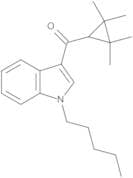
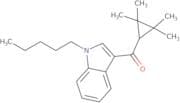
CAS 1199943-44-6
:(1-Pentyl-1H-indol-3-yl)(2,2,3,3-tetramethylcyclopropyl)methanon
Beschreibung:
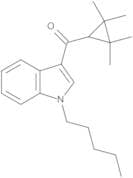
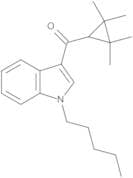
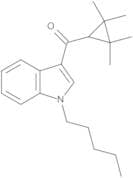
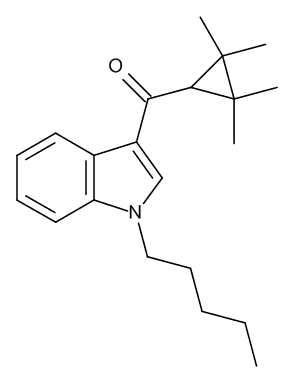
(1-Pentyl-1H-indol-3-yl)(2,2,3,3-tetramethylcyclopropyl)methanon, identifiziert durch seine CAS-Nummer 1199943-44-6, ist eine synthetische Verbindung, die zur Klasse der Indolderivate gehört. Diese Substanz zeichnet sich durch ihre komplexe molekulare Struktur aus, die eine Indolgruppe enthält, die mit einer Cyclopropylgruppe verbunden ist. Die Anwesenheit der Pentylkette trägt zu ihren hydrophoben Eigenschaften bei, während die Tetramethylcyclopropylkomponente sterische Masse hinzufügt, die ihre Wechselwirkung mit biologischen Zielen beeinflusst. Diese Verbindung hat in Forschungskontexten, insbesondere in Studien zu Cannabinoid-Rezeptoren, aufgrund ihrer potenziellen psychoaktiven Wirkungen Aufmerksamkeit erregt. Ihre Löslichkeit und Stabilität können je nach Umweltbedingungen variieren, und sie kann einzigartige pharmakologische Eigenschaften aufweisen. Wie bei vielen synthetischen Cannabinoiden ist es entscheidend, ihr Sicherheitsprofil, einschließlich Toxizität und Missbrauchspotenzial, zu verstehen, um ihre Implikationen in therapeutischen und Freizeitkontexten zu bewerten. Eine ordnungsgemäße Handhabung und die Einhaltung von Vorschriften sind unerlässlich, wenn man mit solchen Substanzen in Laborumgebungen arbeitet.
Formel:C21H29NO
InChl:InChI=1S/C21H29NO/c1-6-7-10-13-22-14-16(15-11-8-9-12-17(15)22)18(23)19-20(2,3)21(19,4)5/h8-9,11-12,14,19H,6-7,10,13H2,1-5H3
InChI Key:InChIKey=NBMMIBNZVQFQEO-UHFFFAOYSA-N
SMILES:C(=O)(C1C(C)(C)C1(C)C)C=2C=3C(N(CCCCC)C2)=CC=CC3
Synonyme:- (1-Pentyl-1H-Indol-3-Yl)(2,2,3,3-Tetramethylcyclopropyl)Methanone
- Methanone, (1-pentyl-1H-indol-3-yl)(2,2,3,3-tetramethylcyclopropyl)-
- Methanone, (1- pentyl- 1H- indol- 3- yl) (2, 2, 3, 3- tetramethylcycloprop yl)
- Ur-144
Sortieren nach
Reinheit (%)
0
100
|
0
|
50
|
90
|
95
|
100
9 Produkte.
UR-144 ((1-Pentylindol-3-yl)(2,2,3,3-tetramethylcyclopropyl)methanone; KM X-1)
CAS:Kontrolliertes ProduktFarbe und Form:NeatUR-144 ((1-Pentylindol-3-yl)(2,2,3,3-tetramethyl-cyclopropyl)methanone; KM X-1) 0.1 mg/ml in Acetonitrile
CAS:Kontrolliertes ProduktFarbe und Form:Single SolutionUR-144 ((1-Pentylindol-3-yl)(2,2,3,3-tetramethylcyclopropyl)methanone; KM X-1) 1.0 mg/ml in Acetonitrile
CAS:Kontrolliertes ProduktFarbe und Form:Single Solution(1-Pentyl-1H-indol-3-yl)(2,2,3,3-tetramethylcyclopropyl)methanone (UR-144)
CAS:Kontrolliertes Produkt<p>Applications (1-Pentyl-1H-indol-3-yl)(2,2,3,3-tetramethylcyclopropyl)methanone is an Indol-3-ylcycloalkyl Ketone with high affinity for the CB2 cannabinoid receptor. Tetramethylcyclopropyl group was found to lead to high affinity CB2 agonists. Synthetic Cannabinoids<br>References Malan, T., et al.: Curr. Opin. Pharmacol., 3, 62 (2003), Cabral, G., et al.: J. Leukocyte Biol., 78, 1192 (2005), Beltramo, M., et al.: Eur. J. Neurosci., 23, 1530 (2006), Dziadulewicz, E., et al.: J. Med. Chem., 50, 3851 (2007),<br></p>Formel:C21H29NOFarbe und Form:White To Off-WhiteMolekulargewicht:311.46(1-Pentyl-1H-indol-3-yl)(2,2,3,3-tetramethylcyclopropyl)methanone (UR-144) (1.0 mg/mL in Methanol)
CAS:Kontrolliertes ProduktFormel:C21H29NOFarbe und Form:Single SolutionMolekulargewicht:311.46UR 144
CAS:Kontrolliertes ProduktUR-144 is a weak synthetic cannabinoid that binds as a selective full agonist to the peripheral cannabinoid receptor CB2 (EC50 = 72 nM). It also binds to CB1 (EC50 = 421 nM) with much lower affinity1. It was recently shown to impair cell proliferation and induce the activation of apoptotic pathways in vitro through different mechanisms as well as causing loss of mitochondrial membrane potential in placental trophoblasts in vitro2. Salmonella/microsome assays revealed induction of DNA damage without gene aberration in lymphocytes3. In vivo mice models showed depression of locomotor activity, catalepsy and hypothermia at a dosage of 10mg/kg, indicating a weak cannabinoid-like activity1.Formel:C21H29NOReinheit:Min. 95%Molekulargewicht:311.46 g/mol