CAS 120004-79-7
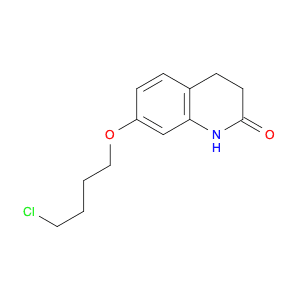
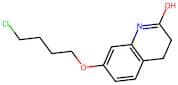
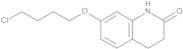
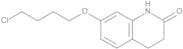
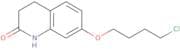
:7-(4-Chlorbutoxy)-3,4-dihydro-2(1H)-chinolinon
Beschreibung:
7-(4-Chlorbutoxy)-3,4-dihydro-2(1H)-chinolinon ist eine chemische Verbindung, die durch ihre einzigartige Struktur gekennzeichnet ist, die einen modifizierten Quinolinon-Kern mit einer 4-Chlorbutoxy-Gruppe umfasst. Diese Verbindung zeigt typischerweise Eigenschaften, die sowohl mit den funktionellen Gruppen von Quinolin als auch von Ether verbunden sind, was möglicherweise ihre Löslichkeit, Reaktivität und biologische Aktivität beeinflusst. Die Anwesenheit des Chloratoms kann die Lipophilie erhöhen und die Wechselwirkung der Verbindung mit biologischen Zielen verändern. Als Dihydroquinolinon kann es verschiedene pharmakologische Eigenschaften aufweisen, was es in der medizinischen Chemie von Interesse macht. Die molekulare Struktur der Verbindung deutet auf potenzielle Anwendungen in der Arzneimittelentwicklung hin, insbesondere in Bereichen, die neurologische oder kardiovaskuläre Erkrankungen ansprechen. Seine spezifischen Eigenschaften, wie Schmelzpunkt, Siedepunkt und spektrale Daten, würden durch experimentelle Methoden bestimmt. Sicherheits- und Handhabungsvorkehrungen sollten beachtet werden, wie bei jeder chemischen Substanz, aufgrund möglicher Toxizität oder Reaktivität. Insgesamt stellt diese Verbindung eine Klasse von Molekülen dar, die vielversprechendes Potenzial für weitere Forschung und Anwendung in der Pharmazie haben könnte.
Formel:C13H16ClNO2
InChl:InChI=1S/C13H16ClNO2/c14-7-1-2-8-17-11-5-3-10-4-6-13(16)15-12(10)9-11/h3,5,9H,1-2,4,6-8H2,(H,15,16)
InChI Key:InChIKey=SRMLSNBGMDJSJH-UHFFFAOYSA-N
SMILES:O(CCCCCl)C=1C=C2C(=CC1)CCC(=O)N2
Synonyme:- 2(1H)-Quinolinone, 7-(4-chlorobutoxy)-3,4-dihydro-
- 7-(4-Chlorobutoxy)-3,4-Dihydro-2(1H)-Quinolone
- 7-(4-Chlorobutoxy)-3,4-Dihydro-2(1H)-quinoline
- 7-(4-Chlorobutoxy)-3,4-Dihydro2(1H)-Quinolinone
- 7-(4-Chlorobutoxy)-3,4-Dihydroc2(1H)-Quinolinone
- 7-(4-Chlorobutoxy)-3,4-dihydro-2(1H)-quinolinone
- 7-(4-Chlorobutoxy)-3,4-dihydro-C2(1 H)-quinoline
- 7-(4-Chlorobutoxy)-3,4-dihydrocarbostyril
- 7-(4-chlorobutoxy)-3,4-dihydroquinolin-2(1H)-one
- Arp-B-7-(4-Halobutoxy)-3,4-Dihydrocarbostyril
- 3,4-Dihydro-7-(4-chlorobutoxy)-2(1H)-quinolinone
Sortieren nach
Reinheit (%)
0
100
|
0
|
50
|
90
|
95
|
100
10 Produkte.
Chlorobutoxyquinolinone (7-(4-chlorobutoxy)-3,4-dihydroquinolin-2(1H)-one)
CAS:Lactams, nesoiFormel:C13H16ClNO2Farbe und Form:White Off-White SolidMolekulargewicht:253.086962(1H)-Quinolinone, 7-(4-chlorobutoxy)-3,4-dihydro-
CAS:Formel:C13H16ClNO2Reinheit:97%Farbe und Form:SolidMolekulargewicht:253.72467-(4-chlorobutoxy)-3,4-dihydro-1H-quinolin-2-one
CAS:7-(4-chlorobutoxy)-3,4-dihydro-1H-quinolin-2-oneReinheit:97%Aripiprazole Impurity 1
CAS:Formel:C13H16ClNO2Farbe und Form:White To Off-White SolidMolekulargewicht:253.737-(4-Chlorobutoxy)-3,4-dihydro-2(1H)-quinolinone
CAS:Kontrolliertes ProduktFormel:C13H16ClNO2Farbe und Form:NeatMolekulargewicht:253.72Acridine Impurity 6
CAS:Formel:C20H21N3O3Farbe und Form:White To Off-White SolidMolekulargewicht:351.41Ref: 10-F609026
50mg34,00€100mg65,00€250mg90,00€500mg152,00€1g208,00€2.5g438,00€5g633,00€10g1.118,00€7-(4-Chlorobutoxy)-3,4-dihydro-2(1H)-quinolinone
CAS:Kontrolliertes ProduktStability Hygroscopic
Applications 7-(4-Chlorobutoxy)-3,4-dihydro-2(1H)-quinolinone is used in the synthesis of aripiprazole, an antipsychotic oral drug used in the treatment of Schizophrenia.
References Bonacorsi, S. et al.: J. Label. Comp. Radiopharm., 49, 1 (2006); Morita, Seiji; K. et al.: Tetrahedron, 54, 4811 (1998);Formel:C13H16ClNO2Farbe und Form:Off-WhiteMolekulargewicht:253.723,4-Dihydro-7-(4-chlorobutoxy)-2(1H)-Quinolinone
CAS:3,4-Dihydro-7-(4-chlorobutoxy)-2(1H)-Quinolinone is a crystalline organic base. It is used as an intermediate in the synthesis of piperazine derivatives. 3,4-Dihydro-7-(4-chlorobutoxy)-2(1H)-Quinolinone can be used to acetylate phenols and amines. This compound also has been shown to be useful in the industrial production of carbostyril and other pharmaceuticals. 3,4-Dihydro-7-(4-chlorobutoxy)-2(1H)-Quinolinone is also a high yield coupling agent for the production of heterocyclic compounds such as 1,5,6,8-tetrahydropyrimidines and benzimidazoles.Reinheit:Min. 95%