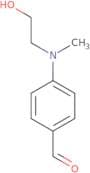
CAS 1201-91-8
:4-(n-Methyl-n-hydroxyethyl)amino benzaldehyd
Beschreibung:
4-(n-Methyl-n-hydroxyethyl)amino benzaldehyd, mit der CAS-Nummer 1201-91-8, ist eine organische Verbindung, die durch ihre aromatische Struktur gekennzeichnet ist und eine Benzaldehydgruppe aufweist, die an eine Aminogruppe gebunden ist, die zusätzlich mit einer Hydroxyethyl- und einer Methylgruppe substituiert ist. Diese Verbindung erscheint typischerweise als Feststoff oder Flüssigkeit, abhängig von ihrer spezifischen Form und Reinheit. Sie ist bekannt für ihre potenziellen Anwendungen in verschiedenen Bereichen, einschließlich der Pharmazie und der Farbstoffherstellung, aufgrund ihrer Reaktivität und Fähigkeit, an verschiedenen chemischen Reaktionen wie Kondensation und Substitution teilzunehmen. Das Vorhandensein sowohl der Aldehyd- als auch der Aminofunktionalgruppen ermöglicht ein vielfältiges chemisches Verhalten, was sie zu einem wertvollen Zwischenprodukt in der organischen Synthese macht. Darüber hinaus trägt die Hydroxyethylgruppe zu ihrer Löslichkeit in polaren Lösungsmitteln bei, was ihre Nützlichkeit in verschiedenen chemischen Umgebungen erhöht. Sicherheitsdaten sollten für den Umgang konsultiert werden, da Verbindungen dieser Art Gesundheitsrisiken darstellen können, wenn sie nicht ordnungsgemäß gehandhabt werden.
Formel:C10H13NO2
InChl:InChI=1/C10H13NO2/c1-11(6-7-12)10-4-2-9(8-13)3-5-10/h2-5,8,12H,6-7H2,1H3
SMILES:CN(CCO)c1ccc(cc1)C=O
Synonyme:- N-Hydroxyethyl-N-Methyl-4-Aminobenzaldehyde
- N-methyl-N-hydroxyethyl-4-amino benzaldehyde
- 4-[(2-Hydroxyethyl)(Methyl)Amino]Benzaldehyde
- N-Methyl-N-(2-hydroxyethyl)-4-aminobenzaldehyde
Sortieren nach
Reinheit (%)
0
100
|
0
|
50
|
90
|
95
|
100
6 Produkte.
Benzaldehyde, 4-[(2-hydroxyethyl)methylamino]-
CAS:Formel:C10H13NO2Reinheit:97%Farbe und Form:SolidMolekulargewicht:179.2157N-Methyl-N-(2-hydroxyethyl)-4-aminobenzaldehyde
CAS:N-Methyl-N-(2-hydroxyethyl)-4-aminobenzaldehydeReinheit:97%Farbe und Form:SolidMolekulargewicht:179.22g/mol4-[(2-Hydroxyethyl)(methyl)amino]benzaldehyde
CAS:Formel:C10H13NO2Reinheit:>95.0%(T)(HPLC)Farbe und Form:White to Light yellow to Light orange powder to crystalMolekulargewicht:179.224-((2-Hydroxyethyl)(methyl)amino)benzaldehyde
CAS:Formel:C10H13NO2Reinheit:97%Molekulargewicht:179.2194-[(2-Hydroxyethyl)methylamino]benzaldehyde
CAS:Kontrolliertes ProduktApplications 4-[(2-hydroxyethyl)methylamino]-Benzaldehyde is used in the synthesis crosslinkable tricyanopyrroline polymeric electro-optic materials. 4-[(2-hydroxyethyl)methylamino]-Benzaldehyde is also used in the chemical process when synthesizing polymethacrylates.
References Wang, L. et al.: Polym. Sci. Ser. B, 54, 297 (2012); Rondou, P. et al.: Makromol. Chem., 193, 3045 (1992); Liu, J. et al.: J. Mat. Sci. Mat. Elect., 23, 1182 (2012);Formel:C10H13NO2Farbe und Form:NeatMolekulargewicht:179.22N-Methyl-N-hydroxyethyl-4-aminobenzaldehyde
CAS:N-Methyl-N-hydroxyethyl-4-aminobenzaldehyde (NHABA) is a bathochromic molecule that absorbs light at wavelengths of 400 to 500 nm. It is reactive and reacts with metal cations to form chromophores. NHABA has been shown to be a fluorescent probe for the detection of tyrosinase and autophagy in human serum. It also has inhibitory properties against tyrosinase, which may be due to its ability to inhibit the formation of melanin. NHABA is used as an analytical chemistry reagent for the determination of ammonia, nitrite, and nitrate ions in water samples. This molecule can also be used as a chemosensor for the detection of phenolic compounds in water samples.Formel:C10H13NO2Reinheit:Min. 95%Molekulargewicht:179.22 g/mol
![Benzaldehyde, 4-[(2-hydroxyethyl)methylamino]-](/_next/image/?url=https%3A%2Fstatic.cymitquimica.com%2Fproducts%2FIN%2Fthumb%2FDA000QAS.jpg&w=3840&q=75)

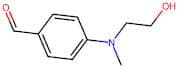

![4-[(2-Hydroxyethyl)(methyl)amino]benzaldehyde](/_next/image/?url=https%3A%2Fstatic.cymitquimica.com%2Fproducts%2F3B%2Fthumb%2FH1844.jpg&w=3840&q=75)



![4-[(2-Hydroxyethyl)methylamino]benzaldehyde](/_next/image/?url=https%3A%2Fstatic.cymitquimica.com%2Fproducts%2FTR%2Fthumb%2FH942255.jpg&w=3840&q=75)