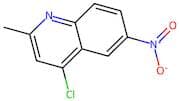
CAS 1207-81-4
:4-chlor-2-methyl-6-nitrochinolin
Beschreibung:
4-chlor-2-methyl-6-nitrochinolin ist eine organische Verbindung, die durch ihre Chinolinstruktur gekennzeichnet ist, die aus einem fusionierten Benzol- und Pyridinring besteht. Das Vorhandensein eines Chloratoms an der Position 4, einer Methylgruppe an der Position 2 und einer Nitrogruppe an der Position 6 trägt zu ihren einzigartigen chemischen Eigenschaften bei. Diese Verbindung ist typischerweise ein gelbes bis orangefarbenes Feststoff und ist bekannt für ihre potenziellen Anwendungen in der Pharmazie und Agrochemie, insbesondere als Zwischenprodukt in der Synthese verschiedener bioaktiver Moleküle. Ihre Nitrogruppe kann an elektrophilen aromatischen Substitutionsreaktionen teilnehmen, während die Chlor- und Methylgruppen ihre Reaktivität und Löslichkeit beeinflussen können. Darüber hinaus kann die Verbindung biologische Aktivität zeigen, was sie in der medizinischen Chemie von Interesse macht. Sicherheitsdaten sollten konsultiert werden, da Verbindungen mit Nitro- und Chlorsubstituenten Gesundheits- und Umweltgefahren darstellen können. Angemessene Handhabungs- und Entsorgungsverfahren sind unerlässlich, wenn mit dieser Substanz gearbeitet wird.
Formel:C10H7ClN2O2
InChl:InChI=1/C10H7ClN2O2/c1-6-4-9(11)8-5-7(13(14)15)2-3-10(8)12-6/h2-5H,1H3
SMILES:Cc1cc(c2cc(ccc2n1)N(=O)=O)Cl
Synonyme:- Akos Bbs-00000122
- Iflab-Bb F1901-0064
Sortieren nach
Reinheit (%)
0
100
|
0
|
50
|
90
|
95
|
100
3 Produkte.
4-Chloro-2-methyl-6-nitroquinoline
CAS:4-Chloro-2-methyl-6-nitroquinolineReinheit:95%Molekulargewicht:222.62778g/mol4-Chloro-2-methyl-6-nitroquinoline
CAS:Formel:C10H7ClN2O2Reinheit:95.0%Farbe und Form:SolidMolekulargewicht:222.634-Chloro-2-methyl-6-nitroquinoline
CAS:4-Chloro-2-methyl-6-nitroquinoline is an antimicrobial agent that exhibits a broad spectrum of activity against both gram-positive and gram-negative bacteria. It also has antifungal properties. 4-Chloro-2-methyl-6-nitroquinoline inhibits the growth of bacteria by binding to DNA and RNA in the bacterial cell, thereby inhibiting transcription and replication. It also inhibits the synthesis of proteins in fungi, which may be due to its ability to bind to fungal ribosomes and inhibit protein synthesis.
Formel:C10H7ClN2O2Reinheit:Min. 95%Molekulargewicht:222.63 g/mol