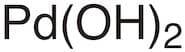
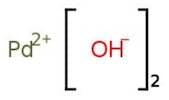
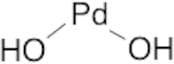
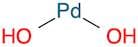
CAS 12135-22-7
:Palladiumhydroxid
- Escat 1951
- Palladium Dihydrate
- Palladium dihydroxide
- Palladium hydroxide (Pd(OH)2)
- Palladium hydroxide (Pd(OH)<sub>2</sub>)
- Palladium(2+) Dihydroxide
- Palladium(II) Hydroxide
- Pearlman's catalyst
- Pearlmans Catalyst
- ESCAT 1421
- ESCAT 1431
- ESCAT TM 1621
- ESCAT TM 1951
- ESCAT 1471
- ESCAT 1621
- ESCAT TM 1421
- ESCAT TM 1431
- PALLADIUM-ACTIVATED CARBON
- ESCAT 1921
- ESCAT 1931
- ESCAT(TM) 1911B
- PALLADIUM CARBON
- ESCAT(TM) 1921
- ESCAT(TM) 1971
- ESCAT(TM) 1961
- ESCAT(TM) 1471
- ESCAT(TM) 1941
- Weitere Synonyme anzeigen
Palladium Hydroxide (contains Pd, PdO) on Carbon (wetted with ca. 50% Water)
CAS:Formel:Pd(OH)2Farbe und Form:Black powder to crystalMolekulargewicht:140.43Palladium hydroxide, Pd 20% on carbon, nominally 50% water, Pearlman's Catalyst
CAS:Hydrogenolysis of benzyl-nitrogen bondsPalladium hydroxide, Pd 20% on carbon, nominally 50% water is used as a catalyst for hydrogenolysis of benzyl groups and epoxides. It is used to reduce nitro compounds to amines. It acts as a dehydrogenation reagent as well as a useful reagent for debenzylationFormel:H2O2PdMolekulargewicht:140.43Palladium hydroxide, Pd 5% on carbon powder, Type A403002-5, nominally 50% water
CAS:This Thermo Scientific Chemicals brand product was originally part of the Alfa Aesar product portfolio. Some documentation and label information may refer to the legacy brand. The original Alfa Aesar product / item code or SKU reference has not changed as a part of the brand transition to Thermo SciFormel:H2O2PdMolekulargewicht:140.43Palladium hydroxide, 99%
CAS:Acts as a catalyst for arylation reactions. It is employed in hydrogenolysis of benzyl-nitrogen bonds. This Thermo Scientific Chemicals brand product was originally part of the Alfa Aesar product portfolio. Some documentation and label information may refer to the legacy brand. The original Alfa AesFormel:H2O2PdReinheit:99%Molekulargewicht:140.43Palladium(II) hydroxide on carbon, 20% Pd, wet support, powder
CAS:Palladium(II) hydroxide on carbon, 20% Pd, wet support, powderFormel:·Pd·2OHReinheit:95%Farbe und Form: solidMolekulargewicht:140.43g/molPalladium hydroxide on carbon 5%
CAS:Formel:H2O2PdReinheit:95.0%Farbe und Form:SolidMolekulargewicht:140.43Palladium hydroxide on carbon, 20 wt.% 50% water
CAS:Formel:H4O3PdReinheit:95.0%Farbe und Form:Solid, Black powderMolekulargewicht:158.45Palladium Hydroxide (20% on Carbon) (~50% water by weight)
CAS:Kontrolliertes ProduktApplications Palladium Hydroxide is a catalyst for hydrogenation reactions as well as in the synthesis of glycopeptides used in obtaining antibodies from autoimmune diseases.
References Bonache, M. et al.: Adv. Exp. med. Bio., 611, 411 (2009); Dzhardimalieva, G. et al.: Russ. Chem. Bull., 58, 2070 (2009);Formel:H2O2PdFarbe und Form:NeatMolekulargewicht:140.43Palladium hydroxide on carbon - 20 wt. % loading (dry basis)
CAS:Palladium hydroxide on carbon is a metal oxide with antimicrobial activity. Palladium hydroxide on carbon has been shown to have significant receptor activity against bacteria and fungi, as well as other microorganisms. It has also been shown to inhibit the growth of Helicobacter pylori, which is associated with ulcers and stomach cancer. Palladium hydroxide on carbon is used in the treatment of bowel disease and infections caused by bacteria such as Escherichia coli, Salmonella typhi, Staphylococcus aureus, Streptococcus pyogenes, Mycobacterium tuberculosis, and Helicobacter pylori. Palladium hydroxide on carbon has also been shown to be effective in the treatment of autoimmune diseases such as rheumatoid arthritis and multiple sclerosis.
Formel:H2O2PdReinheit:Min. 95%Molekulargewicht:140.43 g/mol