CAS 1217623-74-9
:Sortieren nach
Reinheit (%)
0
100
|
0
|
50
|
90
|
95
|
100
6 Produkte.
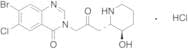
4(3H)-Quinazolinone, 7-bromo-6-chloro-3-[3-[(2R,3S)-3-hydroxy-2-piperidinyl]-2-oxopropyl]-, hydrochloride (1:1), rel-
CAS:Formel:C16H18BrCl2N3O3Farbe und Form:SolidMolekulargewicht:451.1424Halofuginone Hydrochloride
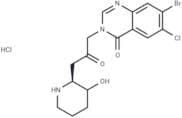
CAS:Kontrolliertes ProduktFormel:C16H17BrClN3O3·ClHFarbe und Form:Colourless SolidMolekulargewicht:451.14Halofuginone-13C,15N2 Hydrochloride
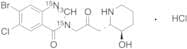
CAS:Kontrolliertes ProduktFormel:CC15H17BrCl15N2NO3·HClFarbe und Form:NeatMolekulargewicht:454.122Halofuginone hydrochloride
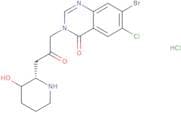
CAS:Halogenated derivative of febrifugine; coccidiostatFormel:C16H17BrClN3O3·HClReinheit:Min. 95%Farbe und Form:White To Off-White SolidMolekulargewicht:451.14 g/molHalofuginone hydrochloride
CAS:Halofuginone hydrochloride (RU-19110), a derivative of Febrifugine, functions as a competitive inhibitor of prolyl-tRNA synthetase, displaying a Ki value of 18.3 nM. This compound effectively inhibits type-I collagen synthesis, providing therapeutic benefits in osteoarthritis (OA) by impeding TGF-β signaling. Additionally, it serves as a potent pulmonary vasodilator, mainly through the activation of Kv channels and the inhibition of various calcium channels including voltage-gated, receptor-operated, and store-operated ones. Beyond its vascular effects, Halofuginone hydrochloride exhibits a broad spectrum of biological activities, including anti-malarial, anti-inflammatory, anti-cancer, and anti-fibrotic properties, supported by multiple studies.Formel:C16H18BrCl2N3O3Farbe und Form:SolidMolekulargewicht:451.14
![4(3H)-Quinazolinone, 7-bromo-6-chloro-3-[3-[(2R,3S)-3-hydroxy-2-piperidinyl]-2-oxopropyl]-, hydroc…](/_next/image/?url=https%3A%2Fstatic.cymitquimica.com%2Fproducts%2FIN%2Fthumb%2FDA0015U8.jpg&w=3840&q=75)