CAS 121816-84-0
:4-brom-2-nitro-1H-imidazol
Beschreibung:
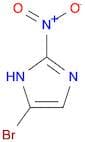
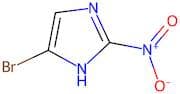
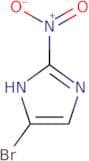
4-brom-2-nitro-1H-imidazol ist eine heterocyclische organische Verbindung, die durch das Vorhandensein von sowohl Brom- als auch Nitro-Funktionsgruppen, die an einen Imidazolring gebunden sind, gekennzeichnet ist. Diese Verbindung weist typischerweise ein blassgelbes bis bräunliches Aussehen auf und ist in polaren organischen Lösungsmitteln löslich. Der Imidazolring trägt zu seiner Basizität und potenziellen Reaktivität bei, was ihn zu einem nützlichen Zwischenprodukt in verschiedenen chemischen Synthesen macht, insbesondere in der Pharmazeutik und Agrochemie. Das Vorhandensein des Bromatoms verbessert seine elektrophilen Eigenschaften, während die Nitrogruppe als vielseitiger Ansatz für weitere chemische Modifikationen dienen kann. Darüber hinaus kann 4-brom-2-nitro-1H-imidazol biologische Aktivität aufweisen, die in der medizinischen Chemie untersucht wurde. Seine Stabilität unter Standardlaborbedingungen ermöglicht eine Vielzahl von Anwendungen, einschließlich der Verwendung in der organischen Synthese und als Baustein für komplexere Moleküle. Sicherheitsvorkehrungen sollten beim Umgang mit dieser Verbindung getroffen werden, da sie aufgrund ihrer chemischen Natur Gesundheitsrisiken darstellen kann.
Formel:C3H2BrN3O2
InChl:InChI=1/C3H2BrN3O2/c4-2-1-5-3(6-2)7(8)9/h1H,(H,5,6)
SMILES:c1c(Br)[nH]c(n1)N(=O)=O
Synonyme:- 1H-imidazole, 4-bromo-2-nitro-
- 4-Bromo-2-nitro-1H-imidazole
- 1H-Imidazole, 5-bromo-2-nitro-
- 5-bromo-2-nitro-1H-Imidazole
Sortieren nach
Reinheit (%)
0
100
|
0
|
50
|
90
|
95
|
100
4 Produkte.
1H-Imidazole, 5-bromo-2-nitro-
CAS:Formel:C3H2BrN3O2Reinheit:97%Farbe und Form:SolidMolekulargewicht:191.97095-Bromo-2-nitro-1H-imidazole
CAS:5-Bromo-2-nitro-1H-imidazoleReinheit:97%Molekulargewicht:191.97g/mol4-Bromo-2-nitro-1H-imidazole
CAS:Formel:C3H2BrN3O2Reinheit:97%Farbe und Form:SolidMolekulargewicht:191.9724-Bromo-2-nitro-1H-imidazole
CAS:4-Bromo-2-nitro-1H-imidazole (4BNI) is a synthetic drug that is used in the treatment of cancer. 4BNI inhibits the synthesis of DNA, which leads to cell death by preventing the production of proteins vital for cell division. When 4BNI is taken up by cells it becomes activated and binds to DNA, inhibiting the synthesis of RNA and protein. This process eventually leads to apoptosis (cell death). 4BNI has been shown to be effective against tumors in mice, but has not yet been tested on humans. The uptake of 4BNI in tumor tissue can be visualized using hypoxia imaging techniques such as positron emission tomography or magnetic resonance imaging.
Formel:C3H2BrN3O2Reinheit:Min. 95%Farbe und Form:PowderMolekulargewicht:191.97 g/mol