CAS 123-00-2
:4-(3-Aminopropyl)morpholin
Beschreibung:
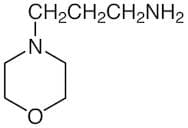
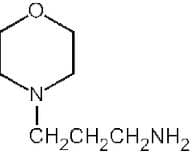
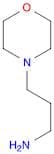
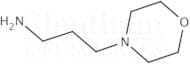
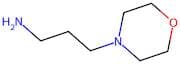
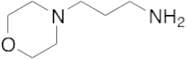
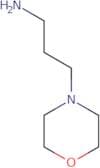
4-(3-Aminopropyl)morpholin, mit der CAS-Nummer 123-00-2, ist eine organische Verbindung, die durch ihre Morpholiringstruktur gekennzeichnet ist, die ein sechsgliedriger Heterozyklus mit einem Stickstoffatom ist. Diese Verbindung weist eine Propylamin-Seitenkette an der 4-Position der Morpholine auf, was zu ihrer Aminfunktionalität beiträgt. Sie ist typischerweise eine farblose bis blassgelbe Flüssigkeit oder ein Feststoff, abhängig von Temperatur und Reinheit. Das Vorhandensein sowohl der Morpholin- als auch der Aminogruppen verleiht basische Eigenschaften, wodurch sie in Wasser und verschiedenen organischen Lösungsmitteln löslich ist. Diese Verbindung wird häufig in der chemischen Synthese verwendet, insbesondere in der Herstellung von Arzneimitteln und Agrochemikalien, aufgrund ihrer Fähigkeit, als Baustein oder Zwischenprodukt zu fungieren. Darüber hinaus kann sie biologische Aktivität zeigen, was in der medizinischen Chemie von Interesse sein kann. Sicherheitsdaten sollten konsultiert werden, da sie Gesundheitsrisiken darstellen kann, wenn sie nicht ordnungsgemäß gehandhabt wird, einschließlich möglicher Reizungen von Haut und Augen.
Formel:C7H16N2O
InChl:InChI=1S/C7H16N2O/c8-2-1-3-9-4-6-10-7-5-9/h1-8H2
InChI Key:InChIKey=UIKUBYKUYUSRSM-UHFFFAOYSA-N
SMILES:C(CCN)N1CCOCC1
Synonyme:- 1-Amino-3-morpholinopropane
- 1-Morpholino-3-aminopropane
- 3-(4-Morpholino)propylamine
- 3-(4-Morpholinyl)-1-propanamine
- 3-(4-Morpholinyl)-1-propylamine
- 3-(4-Morpholinyl)propanamine
- 3-(4-Morpholinyl)propylamine
- 3-(Morpholin-4-yl)propan-1-amine
- 3-(Morpholin-4-yl)propylamine
- 3-(Morpholino)-n-propylamine
- 3-(N-Morpholino)-1-aminopropane
- 3-Amino-1-(morpholino)propane
- 3-Morfolinopropilamina
- 3-Morpholinopropanamine
- 3-Morpholinopropylamin
- 3-Morpholinopropylamine
- 4-(3'-Aminopropyl)morpholine
- 4-(γ-Aminopropyl)morpholine
- Morpholine, 4-(3-Aminopropyl)-
- N-(3-Aminopropyl)-Morpholin
- N-(3-Aminopropyl)morpholine
- N-Morpholino-3-propylamine
- Nsc 1081
- [3-(4-Morpholinyl)propan-1-yl]amine
- [3-(Morpholino)propan-1-yl]amine
- γ-Morpholinopropylamine
- Weitere Synonyme anzeigen
Sortieren nach
Reinheit (%)
0
100
|
0
|
50
|
90
|
95
|
100
8 Produkte.
N-(3-Aminopropyl)morpholine
CAS:Formel:C7H16N2OReinheit:>99.0%(GC)Farbe und Form:Colorless to Almost colorless clear liquidMolekulargewicht:144.223-(4-Morpholinyl)propylamine, 98%
CAS:3-(4-Morpholinyl)propylamine is catalytic agent, petrochemical additive. It is an important raw material and intermediate used in organic synthesis, pharmaceuticals, agrochemicals and dyestuffs. This Thermo Scientific Chemicals brand product was originally part of the Alfa Aesar product portfolio. SFormel:C7H16N2OReinheit:98%Farbe und Form:Clear colorless to pale yellow, LiquidMolekulargewicht:144.224-Morpholinepropanamine
CAS:Formel:C7H16N2OReinheit:98%Farbe und Form:LiquidMolekulargewicht:144.2147N-(3-Aminopropyl)morpholine (AMP)
CAS:Formel:C7H16N2OReinheit:≥ 98.0%Farbe und Form:Colourless liquidMolekulargewicht:144.223-Morpholinopropylamine
CAS:Kontrolliertes ProduktApplications 3-Morpholinopropylamine is a reactant used in the preparation of pyridinyl-quinazolinone derivatives as potential anti-influenza A virus compounds.
Not a dangerous good if item is equal to or less than 1g/ml and there is less than 100g/ml in the package
References Liu, S., et. al.: Chem. Biol. Drug Design., (Ahead of Print) (2015)Formel:C7H16N2OFarbe und Form:NeatMolekulargewicht:144.213-Morpholinopropylamine
CAS:3-Morpholinopropylamine is a nitrogen-containing heterocyclic organic amine. It has been shown to bind to receptor cells and inhibit the uptake of chloride ions by liver cells, which may be due to its ability to form hydrogen bonds with chloride ions. The binding constants for this drug have also been determined using X-ray crystallography and nuclear magnetic resonance spectroscopy. 3-Morpholinopropylamine has been shown to have anticancer properties and is able to bind with DNA in a manner that inhibits DNA synthesis. This drug also inhibits the production of hydrochloric acid in the stomach, which may be due to its ability to interact electrochemically with amines.Formel:C7H16N2OReinheit:Min. 95%Molekulargewicht:144.21 g/mol