CAS 123-38-6
:Propanal
Beschreibung:
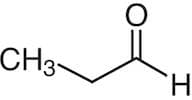
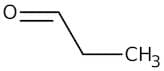
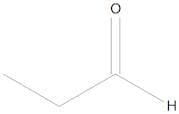
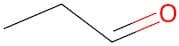
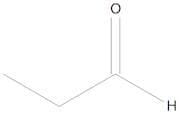
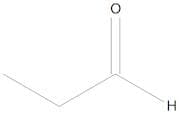
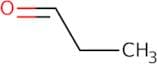
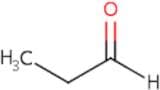
Propanal, auch bekannt als Propionaldehyd, ist ein aliphatisches Aldehyd mit der chemischen Formel C3H6O. Es ist durch eine drei Kohlenstoffatome umfassende Kette mit einer terminalen Aldehydfunktion gekennzeichnet, die ihm ausgeprägte chemische Eigenschaften verleiht. Propanal ist bei Raumtemperatur eine farblose Flüssigkeit mit einem stechenden, fruchtigen Geruch. Es ist in Wasser und organischen Lösungsmitteln löslich, was es vielseitig in verschiedenen Anwendungen macht. Die Verbindung ist brennbar und sollte mit Vorsicht behandelt werden, da sie explosive Gemische mit Luft bilden kann. Propanal wird hauptsächlich in der Synthese anderer Chemikalien verwendet, einschließlich pharmazeutischer Produkte und Aromastoffe, und dient als Zwischenprodukt in der organischen Synthese. Seine Reaktivität ist typisch für Aldehyde, was es ihm ermöglicht, an verschiedenen chemischen Reaktionen teilzunehmen, wie z.B. der Oxidation zur Bildung von Propansäure oder der Reduktion zur Erzeugung von Propanol. Darüber hinaus kann Propanal Kondensationsreaktionen unterliegen, was es wertvoll für die Herstellung größerer organischer Moleküle macht. Insgesamt ist Propanal eine wichtige Verbindung sowohl in industriellen als auch in Laborumgebungen aufgrund seiner Reaktivität und Nützlichkeit in der organischen Synthese.
Formel:C3H6O
InChl:InChI=1/C3H6O/c1-2-3-4/h3H,2H2,1H3
InChI Key:InChIKey=NBBJYMSMWIIQGU-UHFFFAOYSA-N
SMILES:C(C=O)C
Synonyme:- 1-Propanal
- 1-Propanone
- Ethylcarboxaldehyde
- Methylacetaldehyde
- Nsc 6493
- Propaldehyde
- Propanaldehyde
- Propional
- Propionaldehido
- Propionaldehyd
- Propionaldehyde
- Propionic aldehyde
- Propyl aldehyde
- Propylaldehyde
- Propylic aldehyde
- n-Propanal
- n-Propionaldehyde
- Propionaldhyde
- propanal
- Proprionaldehyde
- Aldehyde C(3)
- Propanal
- ethanecarbaldehyde
- ALDEHYDE C3
- femanumber2923
- Aldehyde propionique
- TRIMETHYLENE GLYCOL
- aldehydepropionique(french)
- C2H5CHO
- aldehydepropionique
- FEMA 2923
- Weitere Synonyme anzeigen
Sortieren nach
Reinheit (%)
0
100
|
0
|
50
|
90
|
95
|
100
17 Produkte.
Propionaldehyde
CAS:Formel:C3H6OReinheit:>98.0%(GC)Farbe und Form:Colorless clear liquidMolekulargewicht:58.08Propionaldehyde, 97%
CAS:Propionaldehyde applications include as an intermediate, in pharmaceuticals, perfumes, plastics and polyols or polyhydric alcohols. It is also used as a precursor to trimethylolethane (CH3C(CH2OH)3) through a condensation reaction with formaldehyde, this triol is an important intermediate in the proFormel:C3H6OReinheit:97%Farbe und Form:Clear colorless to pale yellow, LiquidMolekulargewicht:58.08Propionaldehyde
CAS:Formel:CH3CH2CHOReinheit:≥ 98.0%Farbe und Form:Clear, colourless liquidMolekulargewicht:58.08Propanal
CAS:PropanalFormel:C3H6OReinheit:≥95%Farbe und Form: clear. almost colourless liquidMolekulargewicht:58.08g/molPropionaldehyde (>80%)
CAS:Kontrolliertes ProduktFormel:C3H6OReinheit:>80%Farbe und Form:ColourlessMolekulargewicht:58.08Propionaldehyde
CAS:Kontrolliertes ProduktStability Moisture Sensitive, Volatile
Applications Propionaldehyde is a reagent combined with formaldehyde to produce trimethylolethane, a compound important in the production of alkyd resins. Propionaldehyde is also a strong inducer of aneuploidy in cultured Chinese hamster cells.
Not a dangerous good if item is equal to or less than 1g/ml and there is less than 100g/ml in the package
References Furnus, C., et al.: Mutagenesis, 5, 323 (1990); Kraft, W. & Forschirm, A.: J. Am. Oil Chem. Soc., 36, 164 (1959); Laemmle, G., et al.: Ind. Eng. Chem., 52, 33 (1960);Formel:C3H6OFarbe und Form:ColourlessMolekulargewicht:58.08Propionaldehyde
CAS:Propionaldehyde is a simple aliphatic aldehyde that is used in the synthesis of other compounds. It can be synthesized by oxidizing propylene with an oxidation catalyst such as manganese dioxide or platinum metal under pressure. Propionaldehyde can also be formed by the direct oxidation of propanol using ferric chloride, but this reaction has been shown to produce a mixture of products. Propionaldehyde can be produced by the oxidation of acetaldehyde with hydrogen peroxide, which produces formaldehyde and acetone. In addition to its use as a chemical reagent, propionaldehyde has been used as an additive in nutrient solutions for experiments in plant physiology and microbiology. The kinetic data for reactions involving propionaldehyde have been determined using methyl ethyl ketone (MEK) as the solvent and copper(II) sulfate pentahydrate as the catalyst. The redox potential for this molecule is -0.034 volts at pH 7,Formel:C3H6OReinheit:Min. 95%Farbe und Form:Colorless Clear LiquidMolekulargewicht:58.08 g/molPropionaldehyde (Propanal) pure, 97%
CAS:Formel:C3H6OReinheit:min. 97%Farbe und Form:Clear, Yellow, LiquidMolekulargewicht:58.08