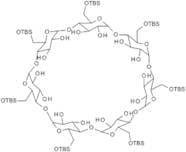
CAS 123155-03-3
:HEPTAKIS-6-(DIMETHYL-TERT-BUTYLSILYL)-BETA-CYCLODEXTRIN
Beschreibung:
Heptakis-6-(Dimethyl-tert-butyldimethylsilyl)-beta-Cyclodextrin ist eine modifizierte Cyclodextrin, die ein zyklisches Oligosaccharid aus Glucoseeinheiten ist. Diese Verbindung weist eine Heptakis-Substitution an der 6-Position der Beta-Cyclodextrin auf, an der eine Dimethyl-tert-butyldimethylsilyl-Gruppe angebracht ist. Die Modifikation verbessert die Löslichkeit und Stabilität der Cyclodextrin, was sie in verschiedenen Anwendungen, insbesondere in der Pharmazie und analytischen Chemie, nützlich macht. Cyclodextrine sind bekannt für ihre Fähigkeit, Einschlusskomplexe mit einer breiten Palette von Gastmolekülen zu bilden, was die Bioverfügbarkeit von schlecht löslichen Arzneimitteln verbessern kann. Die Anwesenheit der voluminösen Silyl-Gruppe kann auch die Wirt-Gast-Interaktionen beeinflussen und möglicherweise eine selektive Bindung spezifischer Verbindungen ermöglichen. Darüber hinaus kann diese Modifikation Schutz gegen enzymatische Zersetzung bieten und die thermische Stabilität der Cyclodextrin verbessern. Insgesamt ist Heptakis-6-(Dimethyl-tert-butyldimethylsilyl)-beta-Cyclodextrin eine vielseitige Verbindung mit erheblichem Potenzial in der Arzneimittelabgabesystemen und anderen chemischen Anwendungen.
Formel:C84H168O35Si7
Sortieren nach
Reinheit (%)
0
100
|
0
|
50
|
90
|
95
|
100
1 Produkte.
6-Tert-butyldimethylsilyl-b-cyclodextrin
CAS:This beta-cyclodextrin (β-CD) derivative is a functionalized cyclic oligosaccharide composed of seven glucose units, characterized by a hydrophilic exterior and a lipophilic cavity (bigger than α-CD and smaller than γ-CDs), which allows it to encapsulate various guest molecules. This structural feature facilitates its use in multiple applications, including pharmaceuticals, food enhancement, and cosmetics. In the pharmaceutical industry, it enhances the solubility and stability of poorly water-soluble drugs, improving their bioavailability and efficacy while also masking unpleasant tastes. The food sector utilizes it as a stabilizer for flavors, colors, and nutrients, extending shelf life by protecting sensitive ingredients from degradation. In cosmetics, it serves as a complexing agent for fragrances and active components, ensuring their stability and controlled release. Its use expands to many other fields, including nanotechnology for drug delivery systems, environmental remediation for extracting organic pollutants, textiles for slow-release fragrances, and analytical chemistry for chiral separation.Formel:C84H168O35Si7Reinheit:Min. 95%Molekulargewicht:1,934.81 g/mol