CAS 126716-28-7
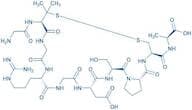
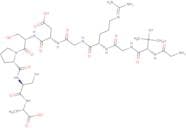
:H-GLY-PEN-GLY-ARG-GLY-ASP-SER-PRO-CYS-ALA-OH
Beschreibung:
Die chemische Substanz, die als H-GLY-PEN-GLY-ARG-GLY-ASP-SER-PRO-CYS-ALA-OH bekannt ist, mit der CAS-Nummer 126716-28-7, ist ein synthetisches Peptid, das aus einer Sequenz von Aminosäuren besteht. Dieses Peptid weist eine Kombination aus Glycin (GLY), Penicillamin (PEN), Arginin (ARG), Asparaginsäure (ASP), Serin (SER), Prolin (PRO), Cystein (CYS) und Alanin (ALA) auf, was auf seine potenzielle Rolle in biologischen Prozessen oder therapeutischen Anwendungen hinweist. Die Anwesenheit von Cystein deutet auf die Möglichkeit der Bildung von Disulfidbrücken hin, die die dreidimensionale Struktur und Stabilität des Peptids beeinflussen können. Die N-terminale Modifikation (H-) zeigt an, dass es sich um eine geschützte Form handelt, die seine Löslichkeit und Bioverfügbarkeit verbessern kann. Peptide wie dieses werden häufig auf ihre biologische Aktivität untersucht, einschließlich potenzieller Rollen in Signalwegen, Enzyminhibition oder als therapeutische Mittel. Die spezifischen Eigenschaften wie Löslichkeit, Stabilität und biologische Aktivität würden von der Konformation des Peptids und der Umgebung abhängen, in der es untersucht wird.
Formel:C35H57N13O14S2
Synonyme:- H-Gly-Pen-Gly-Arg-Gly-Asp-Ser-Pro-Cys-Ala-OH, (Disulfide bond between Pen2 and Cys9)
- L-Alanine, glycyl-3-mercapto-L-valylglycyl-L-arginylglycyl-L-α-aspartyl-L-seryl-L-prolyl-L-cysteinyl-, cyclic (2→9)-disulfide
- H-Gly-Pen-Gly-Arg-Gly-Asp-Ser-Pro-Cys-Ala-OH trifluoroacetate salt (Disulfide bond between Pen? and Cys?)
- H-GLY-PEN-GLY-ARG-GLY-ASP-SER-PRO-CYS-ALA-OH
- Pyrrolo[2,1-g][1,2,5,8,11,14,17,20,23]dithiaheptaazacyclohexacosine,cyclic peptide deriv
- H-Gly-Pen-Gly-Arg-Gly-Asp-Ser-Pro-Cys-Ala-OH trifluoroacetate salt (Disulfide bond between Pen2 and Cys)
- H-Gly-Pen-Gly-Arg-Gly-Asp-Ser-Pro-Cys-Ala-OH (Disulfide bond between Pen2 and Cys?)
Sortieren nach
Reinheit (%)
0
100
|
0
|
50
|
90
|
95
|
100
2 Produkte.
H-Gly-Pen-Gly-Arg-Gly-Asp-Ser-Pro-Cys-Ala-OH
CAS:GPenGRGDSPCA (cRGD), a cyclic RGD peptide has been used in the study of vascular wound response. GPenGRGDSPCA caused vasodilation when applied to isolated rat cremaster arterioles. The vasodilation is dependent on interaction of the soluble cRGD sequence with the αvβ3 integrin expressed by smooth muscle cells in the arteriolar wall.Formel:C35H57N13O14S2Reinheit:96.3%Farbe und Form:White LyophilisateMolekulargewicht:948.05H-Gly-Pen-Gly-Arg-Gly-Asp-Ser-Pro-Cys-Ala-OH trifluoroacetate salt (Disulfide bond between Pen2 and Cys9)
CAS:Gly-Pen-Gly-Arg-Gly-Asp-Ser-Pro-Cys (GPEG) is a peptide that modulates the function of muscle cells and is present in collagen. GPEG has been shown to improve oxidative damage, which occurs during exercise. The effect of GPEG on muscle cells is dependent on the dose. Low doses of GPEG activate proteins that are involved in transcription and increases the synthesis of oxidative enzymes, while high doses inhibit these proteins. GPEG also modulates integrin receptor expression and decreases fibronectin production by vascular smooth muscle cells.Formel:C35H57N13O14S2Reinheit:Min. 95%Molekulargewicht:948.04 g/mol