CAS 12707-58-3
:Gangliosid GD1a
Beschreibung:
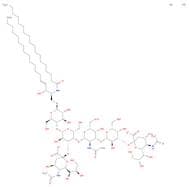
Gangliosid GD1a ist ein komplexes Glycosphingolipid, das hauptsächlich im Nervensystem vorkommt, insbesondere in den Membranen von Neuronen. Es ist durch seine Struktur gekennzeichnet, die ein Ceramidgerüst umfasst, das mit einer Kohlenhydratkomponente verbunden ist, die Sialinsäure enthält, insbesondere N-Acetylneuraminsäure. Diese Struktur trägt zu seiner Rolle in der Zellkommunikation, der Zellidentifikation und der Modulation der neuronalen Aktivität bei. GD1a ist bekannt dafür, an verschiedenen biologischen Prozessen teilzunehmen, einschließlich der Neuroentwicklung und der synaptischen Plastizität. Es ist auch an bestimmten pathologischen Zuständen beteiligt, wie neurodegenerativen Erkrankungen. Die Anwesenheit von Sialinsäure in seiner Struktur verleiht GD1a eine negative Ladung, die seine Wechselwirkungen mit anderen Biomolekülen beeinflusst. Darüber hinaus sind Ganglioside wie GD1a an der Bildung von Lipidraft beteiligt, die Mikrodoma in Zellmembranen sind und eine entscheidende Rolle bei der Signalübertragung spielen. Insgesamt ist GD1a ein wichtiger Bestandteil der neuronalen Membranen, der sowohl zur strukturellen Integrität als auch zur funktionalen Dynamik im Nervensystem beiträgt.
Formel:Unspecified
InChl:InChI=1/C86H152N4O39.2Na/c1-6-8-10-12-14-16-18-20-22-24-26-28-30-32-34-36-51(100)50(90-60(105)37-35-33-31-29-27-25-23-21-19-17-15-13-11-9-7-2)46-118-80-69(111)67(109)72(57(43-94)120-80)123-82-71(113)78(129-86(84(116)117)39-53(102)62(88-48(4)98)77(128-86)65(107)55(104)41-92)74(59(45-96)122-82)124-79-63(89-49(5)99)75(66(108)56(42-93)119-79)125-81-70(112)68(110)73(58(44-95)121-81)126-85(83(114)115)38-52(101)61(87-47(3)97)76(127-85)64(106)54(103)40-91;;/h34,36,50-59,61-82,91-96,100-104,106-113H,6-33,35,37-46H2,1-5H3,(H,87,97)(H,88,98)(H,89,99)(H,90,105)(H,114,115)(H,116,117);;/q;2*+1/p-2/b36-34+;;/t50-,51+,52?,53?,54-,55-,56?,57?,58?,59?,61+,62+,63?,64-,65-,66?,67?,68?,69?,70?,71?,72?,73?,74?,75?,76?,77?,78?,79?,80?,81?,82?,85?,86?;;/m0../s1
SMILES:CCCCCCCCCCCCCCCC=CC(C(COC1C(C(C(C(CO)O1)OC1C(C(C(C(CO)O1)OC1C(C(C(C(CO)O1)O)OC1C(C(C(C(CO)O1)OC1(CC(C(C(C(C(CO)O)O)O1)N=C(C)O)O)C(=O)O)O)O)N=C(C)O)OC1(CC(C(C(C(C(CO)O)O)O1)N=C(C)O)O)C(=O)O)O)O)O)N=C(CCCCCCCCCCCCCCCCC)O)O.[Na].[Na]
Synonyme:- G<sub>D1a</sub>
- GD1a
- Ganglioside B1
- Ganglioside B<sub>1</sub>
- Ganglioside G3
- Ganglioside G<sub>3</sub>
- Ganglioside G<sub>D1a</sub>
- Ganglioside G<sub>II</sub>
- Ganglioside GD1a
- Ganglioside GII
- disialoganglioside-gd1A from bovine*brain
Sortieren nach
Reinheit (%)
0
100
|
0
|
50
|
90
|
95
|
100
6 Produkte.
Ganglioside GD1a mixture (sodium salt)
CAS:Ganglioside GD1a, a glycosphingolipid in various organs, boosts tumor growth and vascular proliferation, and serves as a TLR2 coreceptor.Formel:C84H146N4O392NaFarbe und Form:SolidMolekulargewicht:1836.1GD1a-Ganglioside
CAS:Formel:C84H146N4O39·2NaReinheit:≥ 95%Farbe und Form:White to yellow or light-tan powderMolekulargewicht:1882.10GD1a-Ganglioside sodium
CAS:GD1a (shown as sodium salt) is one of the major gangliosides in neuronal and glial membranes. It has a core tetrasaccharide structure (Galβ1,3GalNAcβ1,4Galβ1,4Glc) with sialic acids linked α2,3/α2,8 to the inner galactose residue, α2,3 to the outer galactose residue and ceramide linked β to position 1 on the reducing terminal glucose residue (Ledeen, 2009). It interacts with myelin-associated glycoprotein (MAG) and is essential for long-term axon-myelin stability. It plays a role in viral infection as it is a receptor for viral glycoproteins in rotavirus and paramyxovirus 1. The hexasaccharide GD1a moiety was also found on a glycoprotein that acts as a receptor for adenovirus type 37. GD1a ganglioside also interacts with botulinum neurotoxin and is crucial for its entry into cells (Kolter, 2012).Formel:C84H148N4O39·xNaReinheit:Min. 95%Farbe und Form:White PowderMolekulargewicht:1,838.08 g/molGD1a-Ganglioside
CAS:GD1a ganglioside is one of the major gangliosides in neuronal and glial membranes. It has a core tetrasaccharide structure (Galβ1,3GalNAcβ1,4Galβ1,4Glc) with sialic acids linked α2,3/α2,8 to the inner galactose residue, α2,3 to the outer galactose residue, and ceramide linked β to position 1 on the reducing terminal glucose residue (Ledeen, 2009). GD1a ganglioside interacts with myelin-associated glycoprotein (MAG) and is essential for long-term axon-myelin stability. GD1a ganglioside plays a role in viral infection as it is a receptor for viral glycoproteins in rotavirus and paramyxovirus 1. The hexasaccharide GD1a moiety was also found on a glycoprotein that acts as a receptor for adenovirus type 37. GD1a ganglioside also interacts with botulinum neurotoxin (BoNT) and is crucial for its entry into cells (Kolter, 2012). The functional significance of ammonia in the brain is not fully understood see: (Modi, 1994).Formel:C84H148N4O39Reinheit:Min. 95%Farbe und Form:PowderMolekulargewicht:1,838.08 g/mol