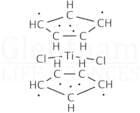
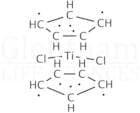
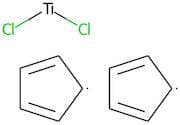
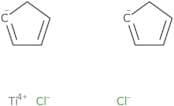
CAS 1271-19-8
:Titanocen-dichlorid
- Bis(Cyclopentadienyl)Dichlorotitanium
- Bis(Eta(5)-Cyclopentadienyl)Titaniumdichloride
- Bis(Eta(Sup5)-Cyclopentadienyl)Titaniumdichloride
- Bis(eta(sup5)-cyclopentadienyl)titanium dichloride
- Bis(pi-cyclopentadienyl)dichlorotitanium
- Bis(pi-cyclopentadienyl)titanium dichloride
- Bis(Η-Ciclopentadienil)Diclorotitanio
- Bis(η5-cyclopentadienyl)titanium dichloride
- Bis(η<sup>5</sup>-cyclopentadienyl)titanium dichloride
- Bis(π-cyclopentadienyl)titanium dichloride
- Cyclopenta-1,3-Diene
- Cyclopenta-1,3-Diene - Dichlorotitanium (2:1)
- Dichloro(Dicyclopenta-1,3-Dien-1-Yl)Titanium
- Dichlorobis(1,3-cyclopentadiene)titanium
- Dichlorobis(cyclopentadienyl)titanium
- Dichlorobis(Η-Cyclopentadienyl)Titanium
- Dichlorobis(η-cyclopentadienyl)titan
- Dichlorobis(η-cyclopentadienyl)titane
- Dichlorobis(η5-2,4-cyclopentadien-1-yl)titanium
- Dichlorobis(η5-cyclopentadienyl)titanium
- Dichlorobis(η<sup>5</sup>-2,4-cyclopentadien-1-yl)titanium
- Dichlorobis(η<sup>5</sup>-cyclopentadienyl)titanium
- Dichlorobis(π-cyclopentadienyl)titanium
- Dichlorodi-π-cyclopentadienyltitanium
- Dichlorodicyclopentadienyltitanium
- Dichlorotitanium
- Dichlorotitanocene
- Dicyclopenta-1,3-Dien-1-Yltitanium(2+) Dichloride
- Dicyclopentadienyl Titanium Dichloride
- Dicyclopentadienyldichlorotitanium
- Dicyclopentadienyltitanium dichloride
- Dicyclopentadienyltitanium(IV) dichloride
- Nsc 78453
- Titanium(4+) Dichloride Dicyclopenta-1,3-Dienide
- Titanium, Di-1,3-Cyclopentadien-1-Yl-, Chloride (1:2)
- Titanium, dichlorobis(η5-2,4-cyclopentadien-1-yl)-
- Titanium, dichlorobis(η<sup>5</sup>-2,4-cyclopentadien-1-yl)-
- Titanium, dichlorodi-π-cyclopentadienyl-
- Titanocene Dichloride
- bis(eta5-Cyclopentadienyl) titanium dichloride
- Weitere Synonyme anzeigen
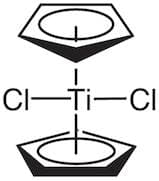
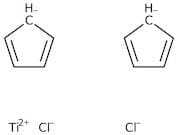
Titanocene Dichloride
CAS:Formel:C10H10Cl2TiReinheit:>98.0%(T)Farbe und Form:Orange to Brown to Dark red powder to crystalMolekulargewicht:248.96Bis(cyclopentadienyl)titanium dichloride, 97%
CAS:One-pot synthesis of -methylene--butyrolactones from benzaldehydes and bromomethylacrylates. Bis-(cyclopentadienyl)-titanium dichloride alkylaluminum complexls acts as catalysts for the polymerization of ethylene. Polyethylene prepared with these catalysts. Complexes of aluminum chloride and methylaFormel:C10H10Cl2TiReinheit:97%Farbe und Form:Crystals or powder or crystalline powder, Dark redMolekulargewicht:248.96Bis(cyclopentadienyl)titanium dichloride, 99+%
CAS:This metallocene is a common reagent in organometallic and organic synthesis. Titanocene dichloride is used to prepare titanocene pentasulfide. Used as an anticancer drug. This Thermo Scientific Chemicals brand product was originally part of the Alfa Aesar product portfolio. Some documentation and lFormel:C10H10Cl2TiReinheit:99+%Molekulargewicht:249.0Titanium, dichlorobis(h5-2,4-cyclopentadien-1-yl)-
CAS:Formel:C10H10Cl2TiReinheit:98%Farbe und Form:SolidMolekulargewicht:248.9594Bis(cyclopentadienyl)titanium(IV) chloride
CAS:Bis(cyclopentadienyl)titanium(IV) chlorideFormel:C5H5·Cl2TiReinheit:≥95%Farbe und Form: crimsom crystalline powderMolekulargewicht:248.96g/molBis(cyclopentadienyl)titanium dichloride, 99+% (Titanocene dichloride)
CAS:Bis(cyclopentadienyl)titanium dichloride, 99+% (Titanocene dichloride)
Formel:(C5H5)2TiCl2Reinheit:99+%Farbe und Form:red xtl.Molekulargewicht:249.00Bis(cyclopentadienyl)titanium (IV) dichloride
CAS:Bis(cyclopentadienyl)titanium (IV) dichloride is a cationic polymerization catalyst that has been used to produce polyolefins with high molecular weights. It is also an important component of solid catalysts for the production of butadiene and styrene. Bis(cyclopentadienyl)titanium (IV) dichloride is a potent carcinogen in animals and is mutagenic in bacteria. It has been shown to cause cancer in animal models, and has been shown to be mutagenic in bacterial mutation assay tests. Bis(cyclopentadienyl)titanium (IV) dichloride reacts with dimethylformamide and aromatic hydrocarbons to produce photochemical properties that can lead to skin irritation or sensitization. This compound also has hydroxyl groups, which can react with oxidants such as chlorine gas to form chlorohydrins, which are toxic compounds that may be carcinogenic.
Formel:C10H10TiCl2Reinheit:Min. 95%Farbe und Form:Red Clear LiquidMolekulargewicht:248.96 g/mol