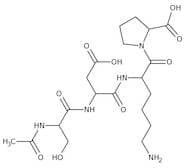
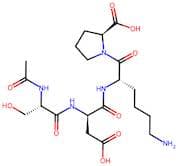
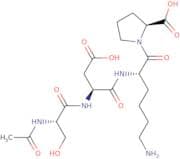
CAS 127103-11-1
:acetyl-ser-asp-lys-pro
- Ac-Ser-Asp-Lys-Pro-OH
N-Acetyl-Ser-Asp-Lys-Pro
CAS:N-Acetyl-Ser-Asp-Lys-Pro inhibits the entry of pluripotent hemopoietic stem cells into S-phase of the cell cycle and protects against Ara-C lethality in mice. It is a specific substrate for the N-terminal active site of angiotensin converting enzyme, which is responsible for its degradation in vivo.
Formel:C20H33N5O9Farbe und Form:White, Lyophilized PowderMolekulargewicht:487.51N-Acetyl-Ser-Asp-Lys-Pro
CAS:Acetyl Ser-Asp-Lys-Pro, derived from thymosin β4 in bone marrow, blocks stem cell cycle progression and shields mice from Ara-C toxicity.Formel:C20H33N5O9Reinheit:99.85%Farbe und Form:SolidMolekulargewicht:487.5Ac-Ser-Asp-Lys-Pro-OH
CAS:Ac-Ser-Asp-Lys-Pro-OH is a tetrapeptide that has been shown to stimulate the growth of cells in vitro. It has been found to inhibit the production of interleukin-1β and tumor necrosis factor α, which are cytokines that are involved in inflammation. Ac-Ser-Asp-Lys-Pro-OH stimulates the production of growth factor β1 and collagen, which may be due to its ability to bind to toll like receptor 4 (TLR4). Acetylserotonin has been shown to have antiinflammatory and antifibrotic properties in animal models. Acetylserotonin also inhibits cancer cell growth and reduces drug resistance.
Formel:C20H33N5O9Reinheit:Min. 95%Molekulargewicht:487.5 g/mol