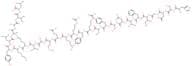
CAS 127317-03-7
:hypophysen-adenylatcyclase-aktivierendes Polypeptid
Beschreibung:
Das hypophysäre Adenylatcyclase-aktivierende Polypeptid (PACAP) ist ein Neuropeptid, das eine entscheidende Rolle in verschiedenen physiologischen Prozessen spielt, einschließlich Neuroprotektion, Neurotransmission und Hormonsekretion. Es ist gekennzeichnet durch seine Fähigkeit, die Adenylatcyclase zu aktivieren, was zu erhöhten Konzentrationen von cyclischem AMP (cAMP) in Zielzellen führt. PACAP ist bekannt für seine vielfältigen biologischen Funktionen, einschließlich der Modulation von zirkadianen Rhythmen, der Regulierung von Stressreaktionen und der Beteiligung an reproduktiven Funktionen. Das Peptid zeigt eine hohe Affinität zu spezifischen Rezeptoren, nämlich den PACAP-Rezeptoren (PAC1, VPAC1 und VPAC2), die seine Wirkungen in verschiedenen Geweben vermitteln. Darüber hinaus ist PACAP an verschiedenen pathophysiologischen Bedingungen beteiligt, einschließlich neurodegenerativer Erkrankungen und Stoffwechselstörungen. Seine Struktur besteht aus einer Aminosäuresequenz, die zu seiner Stabilität und Aktivität beiträgt, und es wird häufig auf seine potenziellen therapeutischen Anwendungen in der Neurologie und Endokrinologie untersucht. Insgesamt ist PACAP ein bedeutendes Molekül sowohl in der Grundlagen- als auch in der klinischen Forschung, was seine Bedeutung für das Verständnis komplexer biologischer Systeme unterstreicht.
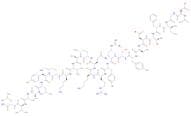
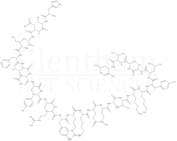
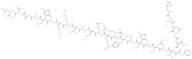
Formel:C142H224N40O39S
Synonyme:- Pituitary Adenylate Cyclase Activating Polypeptide (1-27) amide (human, ovine, rat)
- H-His-Ser-Asp-Gly-Ile-Phe-Thr-Asp-Ser-Tyr-Ser-Arg-Tyr-Arg-Lys-Gln-Met-Ala-Val-Lys-Lys-Tyr-Leu-Ala-Ala-Val-Leu-NH2
- PACAP 27 Amide, Ovine
Sortieren nach
Reinheit (%)
0
100
|
0
|
50
|
90
|
95
|
100
9 Produkte.
PACAP (1-27), Human, Ovine, Rat
CAS:For cellular and molecular biology applications
Formel:C142H224N40O39SMolekulargewicht:3147.64PACAP-27 (human, mouse, ovine, porcine, rat)
CAS:PACAP-38 and its N-terminal fragment PACAP-27 are neuropeptides originally isolated from ovine hypothalamus, but also found in humans and rats. Both PACAP-27, which shows considerable homology with vasoactive intestinal polypeptide (VIP), and PACAP-38 stimulate adenylate cyclase much more potently than VIP. Specific PACAP receptors have been identified in different tissues and cell lines.Kojro et al. observed that the PAC1 agonists PACAP-27 and PACAP-38 strongly increased the activity of α-secretase, thus promoting the non-amyloidogenic processing of amyloid precursor protein.Formel:C142H224N40O39SReinheit:≥ 97%Farbe und Form:WhiteMolekulargewicht:3147.65H-HIS-SER-ASP-GLY-ILE-PHE-THR-ASP-SER-TYR-SER-ARG-TYR-ARG-LYS-GLN-MET-ALA-VAL-LYS-LYS-TYR-LEU-ALA-ALA-VAL-LEU-NH2
CAS:Formel:C142H224N40O39SReinheit:95%Molekulargewicht:3147.6076Pituitary adenylate cyclase activating polypeptide-27 ovine
CAS:Formel:C142H224N40O39SMolekulargewicht:3147.64PACAP (1-27), human, ovine, rat
CAS:PACAP (1-27) (the N-terminal fragment of PACAP-38) is a novel neuropeptides originally isolated from bovine hypothalamus, also found in humans and rats.Formel:C142H224N40O39SReinheit:98%Farbe und Form:SolidMolekulargewicht:3147.66PACAP-27 (human, mouse, ovine, porcine, rat)
CAS:PACAP 1-27 (Pituitary adenylate cyclase-activating polypeptide 27) is a potent stimulator of adenylyl cyclase and increases cAMP levels.Formel:C142H224N40O39SMolekulargewicht:3,147.65 g/molPACAP-27 (human, mouse, ovine, porcine, rat)
CAS:Custom research peptide; min purity 95%.
Formel:C142H224N40O39SReinheit:Min. 95%Molekulargewicht:3,147.68 g/molPACAP27 (Human, 1-27 Amide)
CAS:PACAP27 is a peptide that is used as a research tool. PACAP27 binds to the receptor for pituitary adenylate cyclase-activating polypeptide (PACAP). The binding of PACAP27 to the receptor leads to activation of adenylyl cyclase, which increases intracellular levels of cAMP. This increase in cAMP may lead to cellular responses such as increased ion channel activity and increased protein synthesis.Formel:C142H224N40O39SReinheit:Min. 95%Molekulargewicht:3,147.6 g/molPACAP-27 (human, mouse, ovine, porcine, rat) trifluoroacetate salt
CAS:Trifluoroacetate saltFormel:C142H224N40O39SReinheit:Min. 95%Molekulargewicht:3,147.61 g/mol