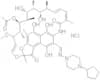
CAS 127923-87-9
:Rifapentin-Hydrochlorid
Beschreibung:
Rifapentin-Hydrochlorid ist ein synthetisches Antibiotikum, das zur Klasse der Rifamycine gehört und hauptsächlich zur Behandlung von Tuberkulose eingesetzt wird, insbesondere in der Kombinationstherapie für sowohl medikamentensensible als auch medikamentenresistente Stämme. Es zeigt ein breites Spektrum antibakterieller Aktivität, indem es die bakterielle RNA-Synthese durch Bindung an das DNA-abhängige RNA-Polymerase-Enzym hemmt. Diese Verbindung zeichnet sich durch ihre relativ lange Halbwertszeit aus, die eine weniger häufige Dosierung im Vergleich zu anderen Rifamycinen ermöglicht, was die Patientenadhärenz verbessert. Rifapentin-Hydrochlorid wird typischerweise oral verabreicht und ist bekannt für seine gute Bioverfügbarkeit. Die Hydrochlorid-Salzform verbessert seine Löslichkeit und Stabilität. Häufige Nebenwirkungen können gastrointestinale Störungen, Hautausschläge und mögliche Erhöhungen der Leberenzymwerte umfassen, was eine Überwachung während der Behandlung erforderlich macht. Darüber hinaus ist es wichtig, Arzneimittelwechselwirkungen zu berücksichtigen, da Rifapentin den Stoffwechsel verschiedener Medikamente aufgrund ihres Einflusses auf die Cytochrom-P450-Enzyme beeinflussen kann. Insgesamt stellt Rifapentin-Hydrochlorid einen bedeutenden Fortschritt in der Tuberkulosetherapie dar, insbesondere im Kontext von direkt beobachteten Therapieansätzen.
Formel:C47H65ClN4O12
InChl:InChI=1/C47H64N4O12.ClH/c1-24-13-12-14-25(2)46(59)49-37-32(23-48-51-20-18-50(19-21-51)31-15-10-11-16-31)41(56)34-35(42(37)57)40(55)29(6)44-36(34)45(58)47(8,63-44)61-22-17-33(60-9)26(3)43(62-30(7)52)28(5)39(54)27(4)38(24)53;/h12-14,17,22-24,26-28,31,33,38-39,43,53-57H,10-11,15-16,18-21H2,1-9H3,(H,49,59);1H/b13-12+,22-17+,25-14-,48-23+;/t24-,26+,27+,28+,33?,38-,39+,43+,47?;/m0./s1
Synonyme:- Rifamycin, 3-[[(4-Cyclopentyl-1-Piperazinyl)Imino]Methyl]-, Monohydrochloride
- 3-[[(4-Cyclopentyl-1-Piperazinyl)-Imino]Methyl]Rifamycin/Rifapentine Hydrochloride
- Rifapentine Pharma-0630
- (2S,12Z,14E,16S,17S,18R,19R,20R,21S,22R,23S,24E)-8-{(E)-[(4-cyclopentylpiperazin-1-yl)imino]methyl}-5,6,9,17,19-pentahydroxy-23-methoxy-2,4,12,16,18,20,22-heptamethyl-1,11-dioxo-1,2-dihydro-2,7-(epoxypentadeca[1,11,13]trienoimino)naphtho[2,1-b]furan-21-yl acetate
- (12Z,14E,16S,17S,18R,19R,20R,21S,22R,24E)-8-{(E)-[(4-cyclopentylpiperazin-1-yl)imino]methyl}-5,6,9,17,19-pentahydroxy-23-methoxy-2,4,12,16,18,20,22-heptamethyl-1,11-dioxo-1,2-dihydro-2,7-(epoxypentadeca[1,11,13]trienoimino)naphtho[2,1-b]furan-21-yl acetate hydrochloride (1:1)
- Rifapentine hydrochloride USP/EP/BP
- RIFAPENTINE
- RIFAPENTINE HYDROCHLORIDE
- Rifamycin hydrochloride
- 3-[[(4-Cyclopentyl-1-piperazinyl)imino]methyl]rifamycin hydrochloride
Sortieren nach
Reinheit (%)
0
100
|
0
|
50
|
90
|
95
|
100
1 Produkte.
RifapentineHydrochloride
CAS:<p>Rifapentine is an anti-tuberculosis drug that belongs to the class of rifamycins. It is the most active of the rifamycins for the treatment of tuberculosis. Rifapentine inhibits bacterial growth by binding to DNA-dependent RNA polymerase, thereby preventing transcription and replication. The high frequency of human activity has been shown using a patch-clamp technique on human erythrocytes. This active form is metabolized through a number of metabolic transformations, including hydrolysis by esterases or glucuronidases, oxidation by cytochrome P450 enzymes, reduction by glutathione reductase, or conjugation with glucuronic acid. Rifapentine also specifically binds to markers expressed at high levels in Mycobacterium tuberculosis strains (e.g., ESX-1 secretion system protein) and inhibits cell growth in culture.</p>Formel:C47H65ClN4O12Reinheit:Min. 95%Molekulargewicht:913.49 g/mol
